
It is renewal week and two numbers are moving in the same direction when they should not be. Your headcount is flat. Your reporting bill is up again. You signed four new clients last quarter, which is the whole point of running an agency, and the reward was a fatter invoice from the tool that is supposed to make you look good in front of those clients.
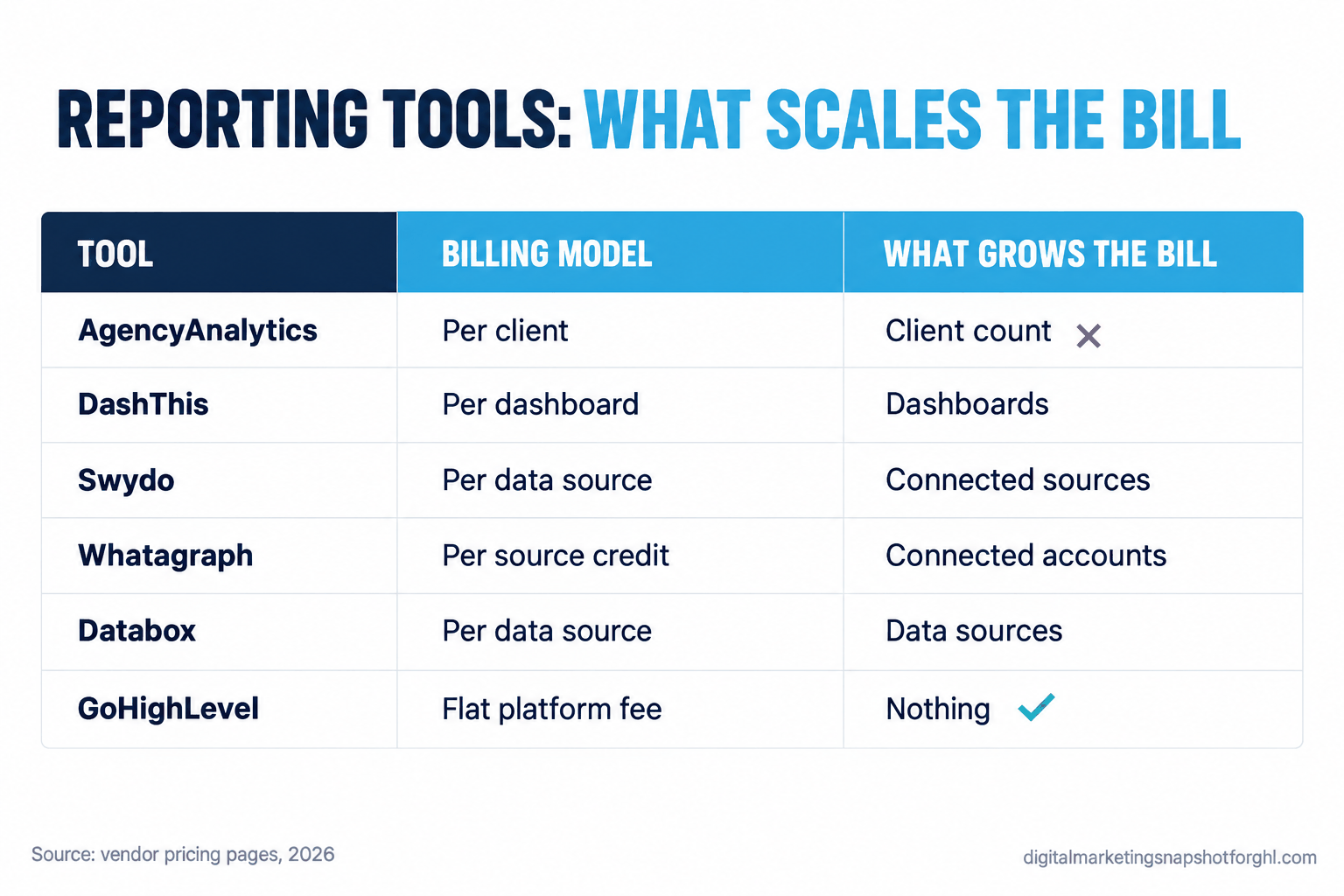
That is the AgencyAnalytics trade. It is a genuinely good product, priced so that every win quietly raises your fixed cost, because the meter runs per client. If you want off that meter, the short version is: the alternatives that do not charge per client price by dashboard (DashThis), by connected data source (Swydo, Whatagraph, Databox), or as a flat platform fee that never moves no matter how many clients you add (a full CRM like GoHighLevel with reporting built in). Which fits depends on how many clients you run, how many platforms each uses, and whether you want a dedicated reporting tool or one system that also reports.
What this article covers
- Why per-client pricing punishes growth
- What AgencyAnalytics costs in 2026
- The five ways off the per-client meter
- The models compared
- Three scenarios: solo, mid-size, 30-plus clients
- What switching actually costs
- The compliance cost nobody prices in
- Objections
- FAQ
Why per-client pricing punishes the thing you want most
Most software bills you for capacity: storage, seats, contacts, API calls. Per-client reporting software bills you for success. Every retainer you close moves the reporting line up. Reporting does not win you the client, it is a cost of keeping them, so you are adding a variable cost to the least revenue-generating part of the relationship, right when delivery is already squeezing your margin.
That squeeze is measurable. Billable utilization across professional services firms fell to 66.4% in 2025, the lowest in the history of SPI Research’s survey, under the 70% line the firm treats as minimum-healthy (SPI Research 2026 Professional Services Maturity Benchmark, via Certinia). When the hours you can bill are shrinking, a fixed cost that grows with client count is the last thing you want bolted on.
Here is the shape of it, using AgencyAnalytics’ published tiers on annual billing. The tool is identical at 5 clients and 30. Only the invoice changes.
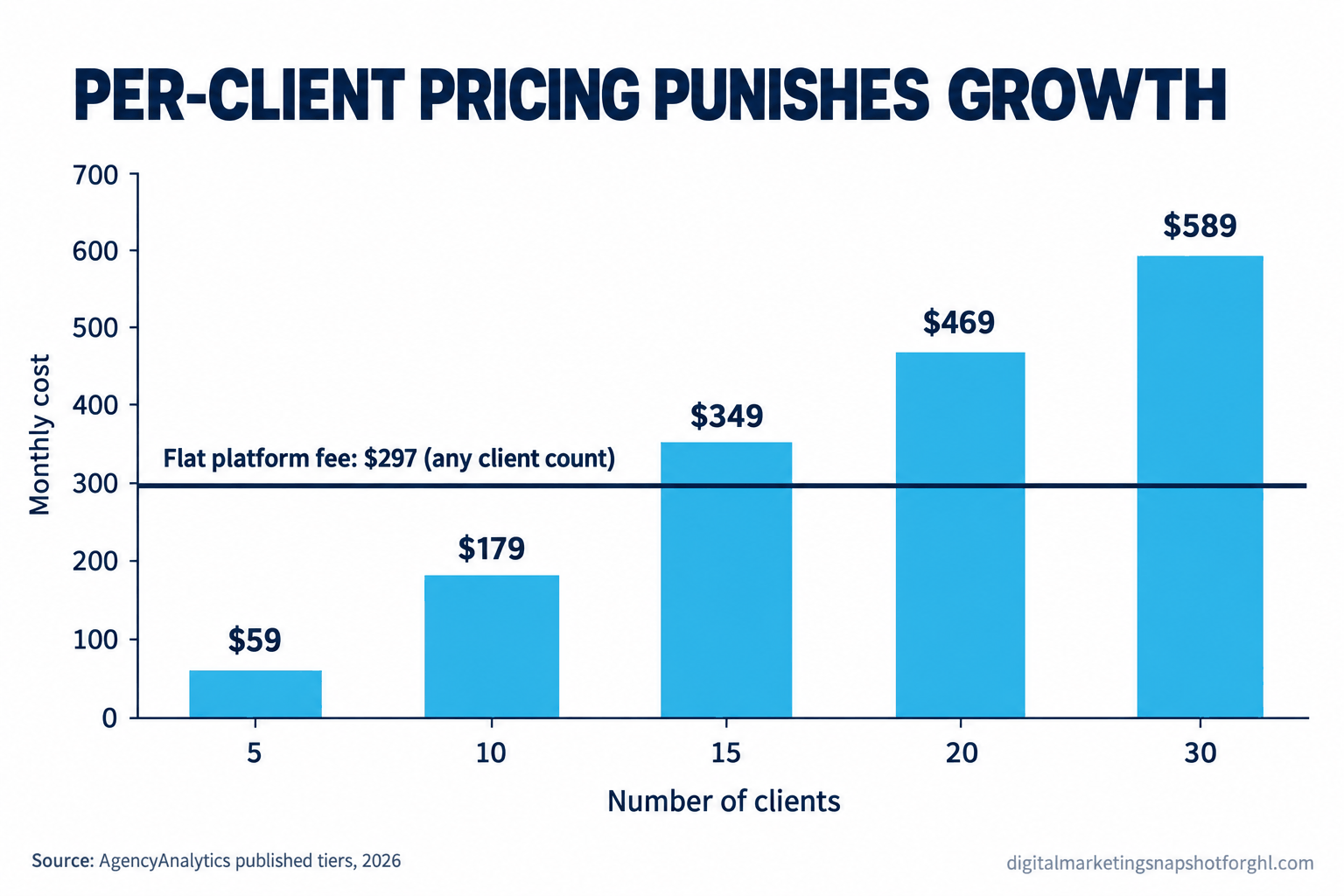
And the pain worsens per client, because the overage rate itself climbs with the tier. Every extra client past your bundle costs more to report on than the last.
AgencyAnalytics overage charge per extra client per month, by plan tier. Source: SocialRails, 2026 and ReportingNinja, 2026 pricing breakdowns.
What AgencyAnalytics actually costs in 2026
Credit where it is due: AgencyAnalytics publishes its numbers, unlike several tools here. The 2026 structure runs Freelancer, Agency, Agency Pro, and Enterprise tiers, with clean per-client logic.
The published entry is roughly $59 per month for 5 clients on annual billing, and the effective rate lands near $20 per client per month annually (about $25 monthly) past the intro tier (ReportingNinja, 2026). Each tier bundles a client allowance then charges overage per extra client, and the overage climbs with the tier: Freelancer includes 5 clients at about $12 each extra, Agency includes 10 at about $18, Agency Pro includes 15 at about $24 (SocialRails, 2026). Add a client past your bundle and the bill moves the same week. Add-ons sit on top too: the Rank Tracker runs about $41.67/mo per 500 keywords annually. None of this is a scandal. It just assumes your client count and budget grow in lockstep, and for a lean shop, they usually do not.
The five ways off the per-client meter
There are five pricing models in this market. “Does not charge per client” means picking one of the four that are not AgencyAnalytics’ model. Here is each, including who it is wrong for.
1. Per-dashboard pricing: DashThis
DashThis charges by the number of dashboards you build, not clients served. On annual billing that is roughly Individual $44/mo (3 dashboards), Professional $139/mo (10), Business $279/mo (25), and Standard $429/mo (50) (DashThis via 2026 comparison). As of March 30, 2026, each tier also caps connected data sources (15, 40, 100, 200), so the “just build dashboards” pitch has a second dial.
Right for: agencies that keep a tidy one-dashboard-per-client habit. Wrong for: anyone who builds three views per client. At that rate a 10-client shop needs 30 dashboards and hits the Business tier fast, chasing the same growth curve, just relabelled.
2. Per-source pricing: Swydo
Swydo charges per connected data source, independent of client count, starting around $69/mo with 10 data sources included (Swydo pricing via 2026 comparison). If each client is basically Meta Ads plus Google Ads plus GA4 (three sources), your cost tracks sources and stays sane.
Right for: focused paid-ads or SEO-only agencies where each client connects a small, predictable set of platforms. Wrong for: full-service shops whose clients each connect eight or ten platforms. Source count is just client count in a different hat.
3. Per-source-credit pricing: Whatagraph
Whatagraph restructured in mid-2026 and now counts usage in “source credits,” where one credit is one connected data account. The Go plan starts around $286/mo, the Max plan around €699/mo with 50+ credits, and Prime is custom-quoted (Whatagraph pricing, 2026). It is a polished, presentation-grade tool, and the most expensive floor on this list; a full-service roster climbs quickly.
Right for: agencies that live and die on how the report looks in the client’s inbox. Wrong for: cost-sensitive shops. The entry price alone tops most of the field’s mid-tiers.
4. Per-source pricing: Databox
Databox is more of a metrics-and-KPI dashboard than a white-label client-reporting tool, but agencies use it, and it prices by data source. In 2026 it runs Analyst about $64/mo, Pro $159/mo, and Growth $399/mo on annual billing, plus about $5.60/month per extra data source; the free plan was retired (Databox pricing via findstack, 2026). Pro and Growth include unlimited users but only three data sources, so the per-source add-ons are where the real bill forms.
Right for: teams that want live KPI monitoring more than polished monthly PDFs. Wrong for: agencies whose whole job is a branded monthly report per client.
5. Flat platform pricing: GoHighLevel and the all-in-one route
The only model that does not move with client, dashboard, or source count is a flat platform fee where reporting is one feature among many. GoHighLevel publishes $97/mo (Starter), $297/mo (Unlimited), and $497/mo (SaaS Pro) (GoHighLevel pricing), and the Unlimited and SaaS Pro tiers include unlimited sub-accounts and contacts. Add your fifth client or your fiftieth, the platform fee is the same line.
The honest catch: GoHighLevel is not a dedicated reporting tool. It is a full CRM and automation platform that includes white-label dashboards and scheduled reports, so it is more to set up than a point tool. The upside is you may already pay for it to run your pipelines, in which case the reporting is effectively free and pulls from the same system that holds the leads, so attribution is not stitched across tools. We broke down GoHighLevel’s plans for agencies separately.
Side-by-side: the models compared
Entry prices only tell you where each tool starts. What matters is the model, because the model decides how fast the bill grows as you win business.
| Tool | Billing model | Entry price (annual) | What scales the bill | White-label | Best for |
|---|---|---|---|---|---|
| AgencyAnalytics | Per client | ~$59/mo (5 clients) | Client count | Yes | Agencies that want a dedicated report and accept the per-client meter |
| DashThis | Per dashboard | ~$44/mo (3 dashboards) | Dashboards + source caps | Yes | Tidy one-dashboard-per-client shops |
| Swydo | Per data source | ~$69/mo (10 sources) | Connected sources | Yes | Focused paid-ads or SEO agencies |
| Whatagraph | Per source credit | ~$286/mo (Go) | Connected accounts | Yes | Presentation-first agencies with budget |
| Databox | Per data source | ~$64/mo (Analyst) | Data sources beyond 3 | Limited | KPI monitoring more than client PDFs |
| GoHighLevel | Flat platform fee | $97-$497/mo | Nothing (client count is free) | Yes | Agencies consolidating a stack, unlimited clients |
Two things jump out. Only the flat model has “nothing” in the scaling column, which is the whole point. And “white-label” is table stakes now, not the tiebreaker people think. The scaling column is.
Three real scenarios: solo, mid-size, and 30-plus clients
The right answer genuinely changes with your size. Here is the same decision run three ways, using annual-billing numbers.
The solo operator or 5-client freelancer
At five clients the gaps are small: AgencyAnalytics about $59/mo, DashThis Individual about $44/mo, Swydo around $69/mo. Any of them is a rounding error next to one retainer.
So do not optimize for price here. Optimize for the model’s slope, because five clients is where you are trying to become fifteen. If you already run GoHighLevel for the pipeline, use its built-in reporting and pay nothing extra. Otherwise DashThis at one dashboard per client is the cheapest flat-ish start, and you will not feel the per-client meter until later, which is the trap.
The 15-person, 15-client mid-size shop
This is where the model bites. AgencyAnalytics at 15 clients is roughly $269 to $349/mo depending on tiering. DashThis (often 30-plus dashboards once each client has an SEO board and a paid board) pushes you to the Business tier near $279/mo. Swydo depends on source count, and a full-service 15-client roster is a lot of sources.
At this size the question is no longer “which reporting tool” but “should reporting even be a separate line item.” A flat platform at $297/mo covers all 15 clients and every future one, and runs the pipeline, follow-up, and client comms too. If reporting is all you would use it for, a point tool is simpler. If you are already juggling a CRM, a scheduler, an automation tool, and a reporting tool, consolidating is the calmer move. We walk through that math in how to scale an agency without adding headcount.
The 30-plus-client agency
Above 30 clients, per-client pricing is openly hostile. AgencyAnalytics pushes toward $589 to $700+/mo on the published tiers and keeps climbing (SocialRails, 2026). Whatagraph’s credit model at that scale lands in Max or Prime territory, custom-quote and not cheap.
A flat platform fee at $297 to $497/mo does not care whether you have 30 clients or 80. That is a several-hundred-dollar-a-month swing that grows every month you stay on the meter, so the switching effort pays for itself inside a quarter. The only argument for staying is “we do not want to rebuild templates,” a real but one-time cost.
What switching actually costs (and how it breaks)
The subscription is the small number. The real cost of moving is time, and it shows up three predictable ways. Price them, because a cheaper tool you migrate badly costs more than the one you left.
Failure mode 1: the template rebuild eats a week. Report layouts do not export cleanly between tools, so moving means rebuilding your standard report from scratch. The fix: build one flagship template, get it approved, then clone it. Do not rebuild per client.
Failure mode 2: connectors do not map one-to-one. Your old tool might name a metric differently. GA4 is where this bites: a mislabelled metric looks fine until a client asks why “sessions” dropped 40% (they did not; the new tool counts them differently). The fix: run old and new side by side for a full month, reconcile every top-line number, then pull the plug.
Failure mode 3: the team keeps using the old tool. People default to what they know, and half the team logging into the old dashboard means you pay for two. The fix: set a hard cutover date and delete the old logins that day.
This is also the argument for switching once. Do not hop to DashThis this year and a platform next year. Pick the model that fits where you will be in two years. See stopping client churn with automated reporting and the white-label client portal that houses it.
The compliance cost nobody prices in
Reporting tools touch client data, which pulls two rules into the decision that never show up on a pricing page.
First, data handling. The moment a client has a lead or customer in the EU or UK, GDPR applies to how that data moves, including into and out of your reporting tool (European Commission, GDPR overview). Every extra tool in the chain is another data processor you are responsible for, so consolidating reporting into a platform you already vet is one fewer processor agreement, not a bigger one.
Second, what the report claims. If it leans on client reviews, the FTC’s revised Endorsement Guides (2023) govern how you present them: fake and incentivized reviews are out, and the old “results not typical” disclaimer no longer shelters an unrepresentative claim (FTC Endorsement Guides). Both nudge toward fewer tools holding client data, not more.
Objections
“AgencyAnalytics is a great tool. Why leave something that works?” Because “works” and “priced right for how you grow” are different questions. If the per-client bill is comfortable and you love the product, stay. The trigger is not dissatisfaction; it is the moment the reporting line climbs faster than the margin on the clients driving it.
“I have 40 templates built. Migration sounds miserable.” It is a one-time cost, smaller than a year of avoidable per-client fees at 30-plus clients. You do not migrate 40 templates either. You rebuild one great one, clone it, and run old and new in parallel for a month. Budget a couple of days, not weeks.
“Do I need to be technical to run a flat-fee platform?” More than for a point tool, yes; a dedicated reporting app is simpler to stand up. That is the honest trade for flat pricing, and it is why done-for-you setups exist: config is a one-time job, and reporting then runs on a schedule.
“Won’t a general platform’s reports look worse?” A few years ago, sometimes. Today the white-label dashboards and scheduled PDFs in a mature platform are plenty for a monthly client report, and they pull from the same system that holds the leads, so attribution ties out. Whatagraph still wins a beauty contest, but most clients want the numbers right and the report on time, not a design award.
Frequently asked questions
AgencyAnalytics alternatives: quick answers
Which reporting tools do not charge per client?
DashThis charges per dashboard; Swydo and Databox charge per connected data source; Whatagraph charges per source credit; and all-in-one platforms like GoHighLevel charge a flat fee regardless of client count. AgencyAnalytics is the main tool that prices per client, roughly $20 per client per month annually.
Does per-dashboard or per-source pricing actually beat per client?
It depends on your mix. Per-dashboard (DashThis) wins if you keep one dashboard per client. Per-source (Swydo) wins for focused agencies whose clients connect few platforms. Both can cost more than per-client for full-service shops with many platforms and several dashboards each. Run your real client, dashboard, and source counts through each model first.
How much does AgencyAnalytics cost in 2026?
The published entry is about $59/mo for 5 clients annually, with an effective rate near $20 per client per month (about $25 monthly). Overage per extra client rises by tier: roughly $12 (Freelancer), $18 (Agency), $24 (Agency Pro). Add-ons like the Rank Tracker (about $41.67/mo per 500 keywords) sit on top. At 30-plus clients the bill pushes past $589 to $700+.
Is it worth switching reporting tools, given the migration effort?
Under about 10 clients, usually not for cost alone. Above 20 to 30 clients, per-client pricing gets expensive enough that a flat-fee model repays the migration inside a quarter. Switching is mostly rebuilding one template and reconciling connectors for a month, a one-time effort. Switch once, to the model that fits where you will be in two years.
Can GoHighLevel really replace a dedicated reporting tool?
For most agencies' monthly client reporting, yes. It offers white-label dashboards and scheduled reports inside a flat platform fee, and because the reports pull from the same system that holds the pipeline, attribution ties out without stitching tools together. The trade-off is more initial setup than a single-purpose app, which is why many agencies use a prebuilt system to skip the config.
The bottom line
Per-client pricing is not a rip-off. It just charges you more for succeeding, and once you notice that, it is hard to unsee on renewal week. The way off it is to price by dashboard, by source, or flat, based on how fast the bill climbs as you win business, not the sticker price today.
If your clients are focused and few, a per-source or per-dashboard tool stays cheap and simple. If you are consolidating a stack and want your client count to be free, a flat platform is the calmer long game. Either way, do the ten-minute audit, price all four models at today’s count and next year’s, and buy the flattest line. The renewal week you want is the one where you sign four new clients and your reporting bill does not notice.
Related reading: GoHighLevel pricing for agencies, lead attribution that proves ROI, and how to price agency retainers.