
The email lands on a Tuesday, and it is polite. “We have really appreciated the work, but we are going to pause for now and reassess in a quarter.” You know a pause is a goodbye. What stings is that the results were fine. The rankings moved, the leads came in, the ads worked. So why did they go?
Here is the short answer. Most agency churn is not a delivery problem. It is a structure problem, baked into the retainer before the client is ever unhappy. A loose retainer with vague deliverables, no scope boundary, no proof-of-value cadence, and an auto-lapsing end date does not renew itself. It waits for the client to notice they are paying and cannot say what for. Fix the structure, and the same work that used to churn starts renewing on its own.
What this article covers
- Why retainers churn even when the work is good
- What loose retainers cost you
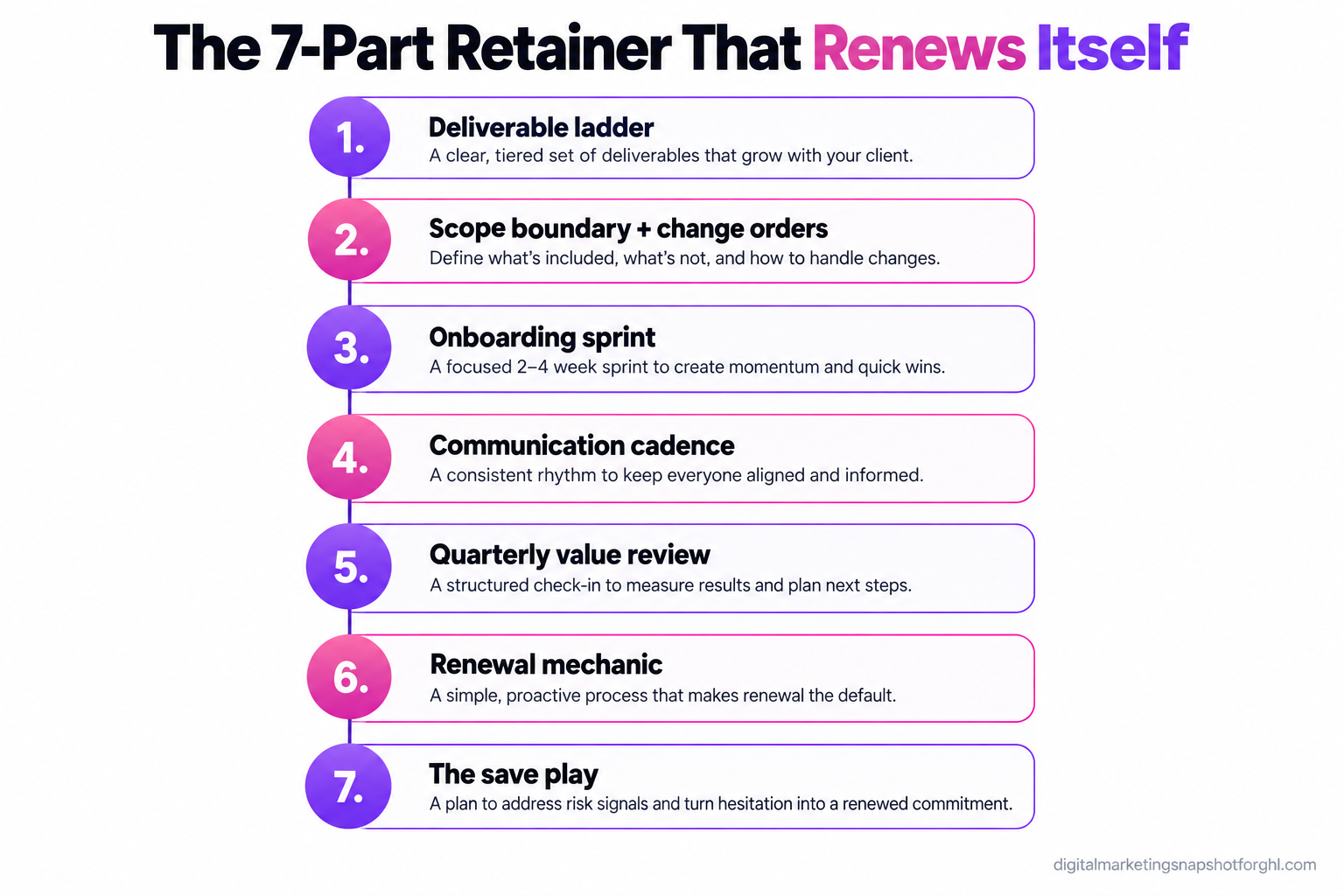
- The seven parts of a retainer that renews itself
- Three engagement models, three churn traps
- The compliance clauses your retainer needs
- Steal this: the clauses, the QBR agenda, and the messages
- Objections
- FAQ
Why retainers churn even when the work is good
Clients do not renew based on the work you did. They renew based on the value they remember, and the gap between the two is where retainers die. You spent the month executing. They spent it running their business and forgetting you exist, until the invoice reminds them. When the only regular touchpoint is a charge on the card, the retainer becomes a cost they can see and a benefit they cannot.
A structured retainer closes that gap on purpose. It sets expectations so nobody drifts, draws a line around scope, and surfaces the value on a schedule so the client never wonders what they are buying. None of that is about working harder. It is about making the good work visible.
What a loose retainer is quietly costing you
Two costs stack up when retainers are not structured. The first is churn itself. Frederick Reichheld’s research at Bain found that a 5% increase in customer retention produces more than a 25% increase in profit in financial services (Bain, Prescription for cutting costs), and the widely cited Harvard Business Review figure puts the cost of winning a new customer at five to twenty-five times the cost of keeping one (HBR, 2014). Retention is not a soft metric. It is the number that moves your profit most.
The second cost is scope creep, which is really churn with a delay. Keep saying yes to small out-of-scope asks and you erode your own margin until the account feels unprofitable and resentful, which is exactly what clients leave over. The 2025 Ignition Agency Pricing and Cash Flow Report found that 57% of agencies lose between $1,000 and $5,000 a month to unbilled work, another 30% lose more than $5,000 a month, and 78% rarely or only sometimes charge for scope creep while just 1% bill for all of it (Ignition, 2025).
It is getting worse, not better. The Project Management Institute found that 52% of projects experience scope creep, up from 43% five years earlier (PMI, Scope Patrol), and it lands on your most expensive people, dragging down a billable utilization rate that already fell to a record-low 66.4% across professional services in 2025 (SPI Research 2026, via Certinia). A loose retainer leaks in two directions: the client who leaves, and the hours you gave away trying to keep them.
How agencies handle out-of-scope work, share of agencies. Source: Ignition 2025 Agency Pricing and Cash Flow Report.
The seven parts of a retainer that renews itself
A retainer that holds is not a longer contract. It is a better-shaped one. These seven parts each close a specific hole that churn slips through.
Part 1: The deliverable ladder
Vague retainers churn because nobody agrees on what “the work” is. Replace “ongoing SEO” with a named, countable list: four blog posts, two technical fixes, one monthly report, one strategy call. Then ladder it into two or three tiers so the client who wants more has a next rung to climb, not a competitor to call.
How it breaks: agencies write the deliverable list once and never revisit it, so the client’s needs drift past the page and the retainer feels stale. Revisit the ladder at every quarterly review and move clients up a rung as their goals grow.
Part 2: The scope boundary and change-order clause
This is the single most important clause for margin. Name what is included, name what is not, and define what happens when a request falls outside the line: a short written estimate before any work starts. The boundary is not there to say no. It turns invisible give-away work into a clear paid add-on or a clean decline.
How it breaks: the clause exists on paper but nobody enforces it, because saying no in the moment feels risky. Hand your team a pre-written message so the boundary is a copy-paste, not a confrontation (see Steal this). Tighter scope also protects the pricing you set (how to price marketing agency retainers).
Part 3: The onboarding sprint
The first 30 days decide the next 12 months. A client who feels lost or unsure what happens next starts doubting the decision immediately. A structured sprint, with a kickoff, access collected once, a 30-day plan, and a first quick win, sets the tone that this agency is organized and in control. Fast onboarding is one of the strongest early retention signals you can send (onboard clients in minutes, not weeks).
How it breaks: onboarding lives in one person’s head, so it happens differently every time and slips when they are busy. Systematize it into a repeatable workflow that runs the same whether you sign one client this month or ten.
Part 4: The communication cadence
Silence reads as neglect, even when you are heads-down doing great work. Set a rhythm the client can rely on: a weekly async update, a monthly report, a monthly or biweekly call. The point is not more meetings, it is a predictable heartbeat, so the client always knows the work is moving and can raise concerns before they become exit reasons.
How it breaks: the cadence is aspirational, so it holds for two months and then slides when a fire starts. Automate what can be automated, especially the reporting, so the heartbeat keeps beating in a chaotic week (automated reporting that reduces churn).
Part 5: The quarterly value review
This is the part most agencies skip, and the one that renews the account. Every quarter, sit down or send a tight recorded walkthrough that answers one question: here is what you paid, and here is what it produced. Tie the work to the outcomes the client cares about, name the wins, and set next quarter’s goals. This is where you convert “I am not sure what I am paying for” into “I can see exactly what I am getting.”
How it breaks: the review turns into an activity dump, a list of tasks with no line drawn to business results. Lead with outcomes, not effort: clients renew for problems solved, not hours worked.
Part 6: The renewal mechanic
Do not leave renewal to a hopeful email at the end of the term. Structure it: an auto-renewing term with a clear notice window, a renewal conversation scheduled a set number of days before the anniversary, and a light incentive to commit longer. The renewal should confirm a relationship that is already working, not restart the sell every few months.
How it breaks: the renewal date passes unnoticed because nobody owns it, and the retainer drifts into awkward month-to-month. Put the renewal trigger on a workflow so it fires automatically, and pair it with recurring billing so the payment side never becomes the reason to reconsider (recurring billing and renewals in GoHighLevel).
Part 7: The save play
Some clients will still signal they are leaving. The save play is a pre-planned response to that signal, not a panic. When a client goes quiet, downgrades, or hints at pausing, you run a defined sequence: a value-focused check-in, an offer to right-size the retainer to a smaller tier, and a graceful downgrade path that keeps the door open. A client on a smaller retainer is worth far more than a churned one.
How it breaks: agencies treat every wobble as a full loss and either over-discount in a panic or let the client walk. Have the downgrade tier and the check-in ready before you need them, so a save is a process.
Three engagement models, three churn traps
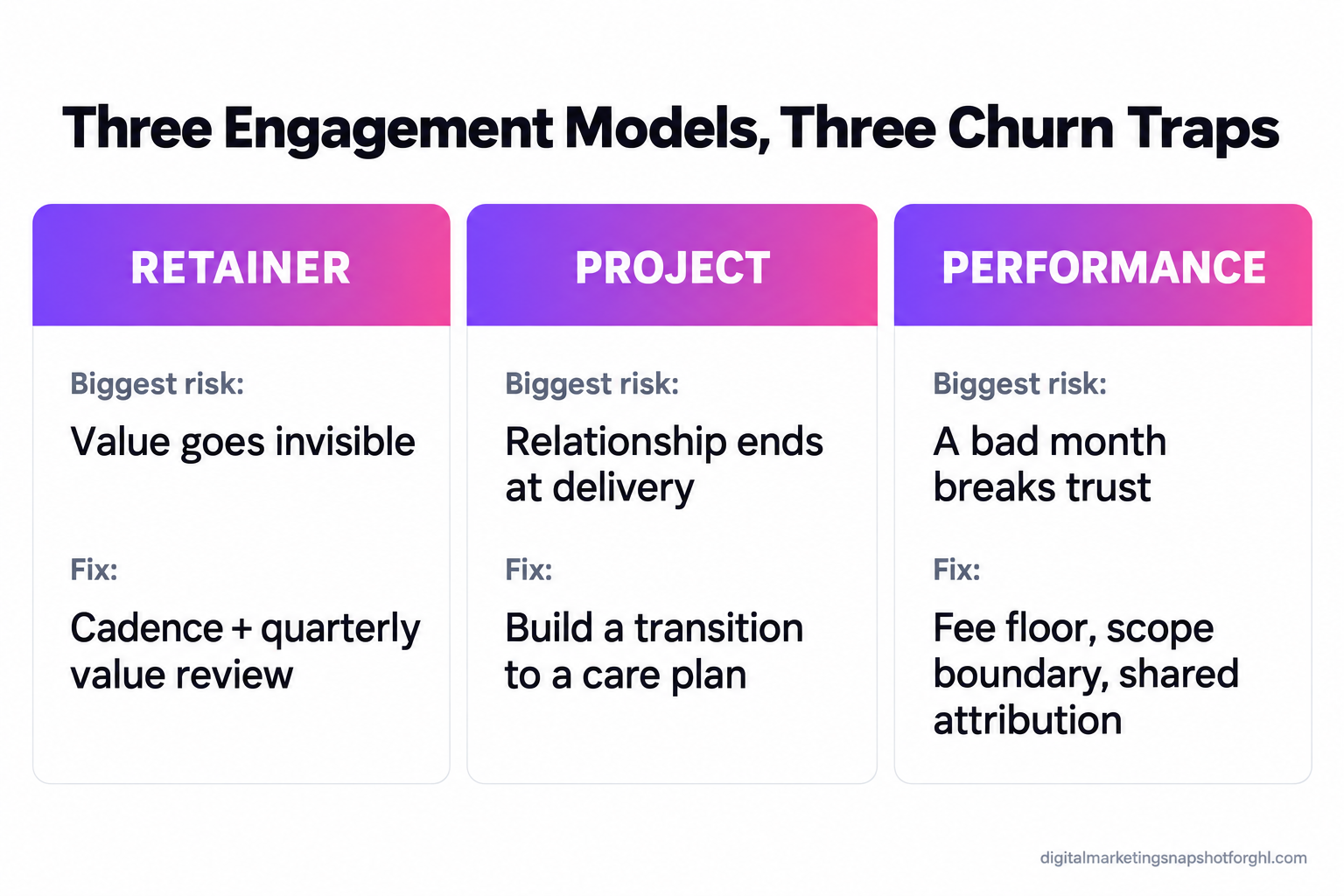
The seven parts are the frame, but the weak point moves depending on how you sell the work. A retainer, a project, and a performance deal each churn for a different reason, so each needs a different guardrail.
The retainer model
The classic monthly retainer churns from invisibility. The work is steady, so it fades into the background and the client starts to question the recurring charge. Your guardrails are Parts 4 and 5: a reliable cadence and a quarterly value review that keeps the ROI visible. If your retainer clients cannot recite what you did last quarter, the value review is missing or weak (lead attribution that proves ROI).
The project model
Project work churns at the finish line, because the relationship is designed to end. You deliver the website or the campaign, the engagement closes, and the client walks with no reason to stay. The fix is structural: build a transition into every project scope that converts a finished project into an ongoing care or maintenance retainer. The last deliverable should be the first conversation about what comes next. Without that bridge, every project is a client you win twice.
The performance model
Performance deals churn from volatility and trust. A bad month or a platform change shakes a client’s faith fast, and disputes over attribution (“were those leads really yours?”) end relationships. The guardrails are a base fee floor so you are never working for free, a hard scope boundary so a rough patch does not turn into unpaid extra work, and transparent shared attribution so nobody argues about what counts. Performance clients stay when the tracking is clean and the downside is bounded.
The compliance clauses your retainer needs
If your retainer includes any outbound communication on a client’s behalf, the contract has to assign responsibility for the rules, or you inherit the liability by default. It is a retention issue too: a compliance mess is a fast way to lose a client.
Three areas belong in the clause. SMS on behalf of clients requires A2P 10DLC registration, and when you register campaigns for clients you generally need a reseller identifier, which most small agencies get wrong (A2P 10DLC registration for agencies). Spell out who registers, owns consent records, and is liable. Email falls under CAN-SPAM for every send, and the moment a client has a single EU lead, GDPR applies. Review generation, if you sell it, is governed directly by the FTC’s revised Endorsement Guides, which ban incentivized and fake reviews (FTC Endorsement Guides), so your retainer should require honest, unincentivized requests only. Get the consent language right up front and the whole program is safer (the SMS opt-in script agencies can steal).
Steal this: the clauses, the QBR agenda, and the messages
Here is the scaffolding, ready to adapt. Run it past your own advisor before you sign anything, but this is the shape.
The scope boundary clause (for the retainer agreement).
“This retainer includes the deliverables listed in Schedule A. Requests outside that list are handled as add-ons: we will send a short written estimate for approval before any out-of-scope work begins. Approved add-ons are billed separately or added to the following month’s retainer. Unused deliverables do not roll over between months.”
The change-order message (copy-paste for your team, in the moment).
“Love this idea, happy to take it on. Quick heads-up that it sits outside what we scoped for this month, so I will send a short add-on estimate before we start rather than pull it from your current hours. Want me to send that over?”
The quarterly value review agenda (30 minutes).
- Here is what you invested this quarter (the number, said plainly).
- Here is what it produced, tied to your business goals, not our task list.
- The two or three wins worth remembering.
- The plan and goals for next quarter, and whether the current tier still fits.
The renewal message (sent 30 days before the anniversary).
“We are coming up on a year together, and I would love to lock in the next 12 months. I will bring a short recap of what we have built and where I want to take it next to our call on [date]. If it is useful, we can also look at [next tier] now that [specific goal] is in reach.”
The save-play check-in (when a client goes quiet or hints at pausing).
“I want to make sure this is still delivering what you need. Before anything changes, can we grab 20 minutes so I can show you where things stand and hear what is on your mind? If the current scope is more than you need right now, we have a lighter plan that keeps the core running, so pausing is not the only option.”
The handshake retainer vs the structured retainer
| Plan | The handshake retainer | The structured retainerRecommended |
|---|---|---|
| Price | Renews on hope | Renews on evidence |
| Feature 1 | "Ongoing work", never defined | Named deliverable ladder with tiers |
| Feature 2 | Scope creep absorbed silently | Scope boundary with change orders |
| Feature 3 | Onboarding improvised each time | Repeatable onboarding sprint |
| Feature 4 | Client hears from you when there is news | Reliable communication cadence |
| Feature 5 | Value assumed, never shown | Quarterly value review proves ROI |
| Feature 6 | Renewal is a nervous email at term end | Auto-renew with a scheduled conversation |
| See how it's built → |
Objections, answered
“My clients will hate a rigid contract.” Structure is not rigidity, it is clarity, and clients prefer knowing exactly what they get to guessing. Nobody has ever churned because their agency was too clear about deliverables.
“I do not have time for quarterly reviews on every client.” You do not have time to keep replacing the ones who leave without them, which costs far more. The review does not have to be a live meeting either: a tight recorded walkthrough works, and the reporting behind it can run automatically (stop client churn with automated reporting).
“A change-order step will slow everything down and annoy clients.” It speeds things up, because it stops the drift of unpaid favors that wreck your margin. The estimate can be two lines and a number. Clients respect a clear “this is extra, here is the cost” far more than a resentful yes.
“This is a lot to set up. I am a small shop.” Small is when structure pays off most, because you cannot afford to lose clients or give away hours. You do not build all seven parts by hand every time either: onboarding, cadence, renewal triggers, and billing should run themselves (scaling without adding headcount).
FAQ
Structuring agency retainers: quick answers
Why do clients leave an agency even when the results are good?
Because they renew on the value they remember, not the work you did. A retainer with no regular proof-of-value touchpoint lets results fade into the background until the invoice is all the client notices. A quarterly value review that ties spend to outcomes is the single biggest structural fix for churn.
What should a marketing agency retainer include?
Seven things: a named deliverable ladder with tiers, a scope boundary with a change-order clause, a repeatable onboarding sprint, a communication cadence, a quarterly value review, a renewal mechanic with a scheduled conversation, and a save play for clients who signal they are leaving.
How do I stop scope creep on a retainer without upsetting the client?
Name what is included and what is not, then define a change-order step: a short written estimate before any out-of-scope work begins. Hand your team a friendly pre-written message so the boundary is a copy-paste, not a confrontation. 78% of agencies give this work away for free.
How long should an agency retainer term be?
Long enough for the work to show results, usually three to six months minimum, then an auto-renewing term with a clear notice window. Pair the renewal date with a conversation scheduled a set number of days before the anniversary, so renewal confirms a working relationship rather than restarting the sell.
How is structuring a retainer different for project or performance work?
The weak point moves. Retainers churn from invisibility, so cadence and value reviews are the fix. Projects churn at delivery, so build a transition into a care plan. Performance deals churn from volatility and attribution disputes, so add a base fee floor, a hard scope boundary, and transparent shared tracking.
The bottom line
The polite pause email is not a verdict on your work. It is a verdict on your retainer. When the deliverables were vague, the scope leaked, the value never got shown, and renewal was left to chance, the client did the only thing a foggy relationship allows: cut the cost they could see.
Structure fixes that without a single extra hour of work. Name the deliverables, draw the scope line, onboard the same way, keep a steady heartbeat, prove the value every quarter, and make renewal a scheduled conversation. Do that, and the Tuesday email changes. Instead of “we are going to pause,” it reads “same as last year, and can we talk about the next tier.” That is what a retainer that renews itself buys you: not a busier agency, a steadier one.
Related reading: how to price marketing agency retainers, stop client churn with automated reporting, and the white-label client portal that makes you look bigger.