
It is 9:10pm on a Tuesday. The team logged off hours ago. You are still at the laptop because three things are stuck waiting on you: a proposal nobody else is allowed to send, a client who only replies when the email comes from your address, and a Slack thread where an account manager asked “how do you want to handle this?” at 4pm and then stopped working until you answered.
You built the agency. Now it cannot move without you. That feeling has a name, and it is not “busy.” It is founder-dependency, the single biggest thing capping your growth. An agency that routes every decision, relationship and approval through one person cannot grow past what that person can personally touch in a week. You are not short on clients or talent. You are the bottleneck, and it is the most expensive one you have.
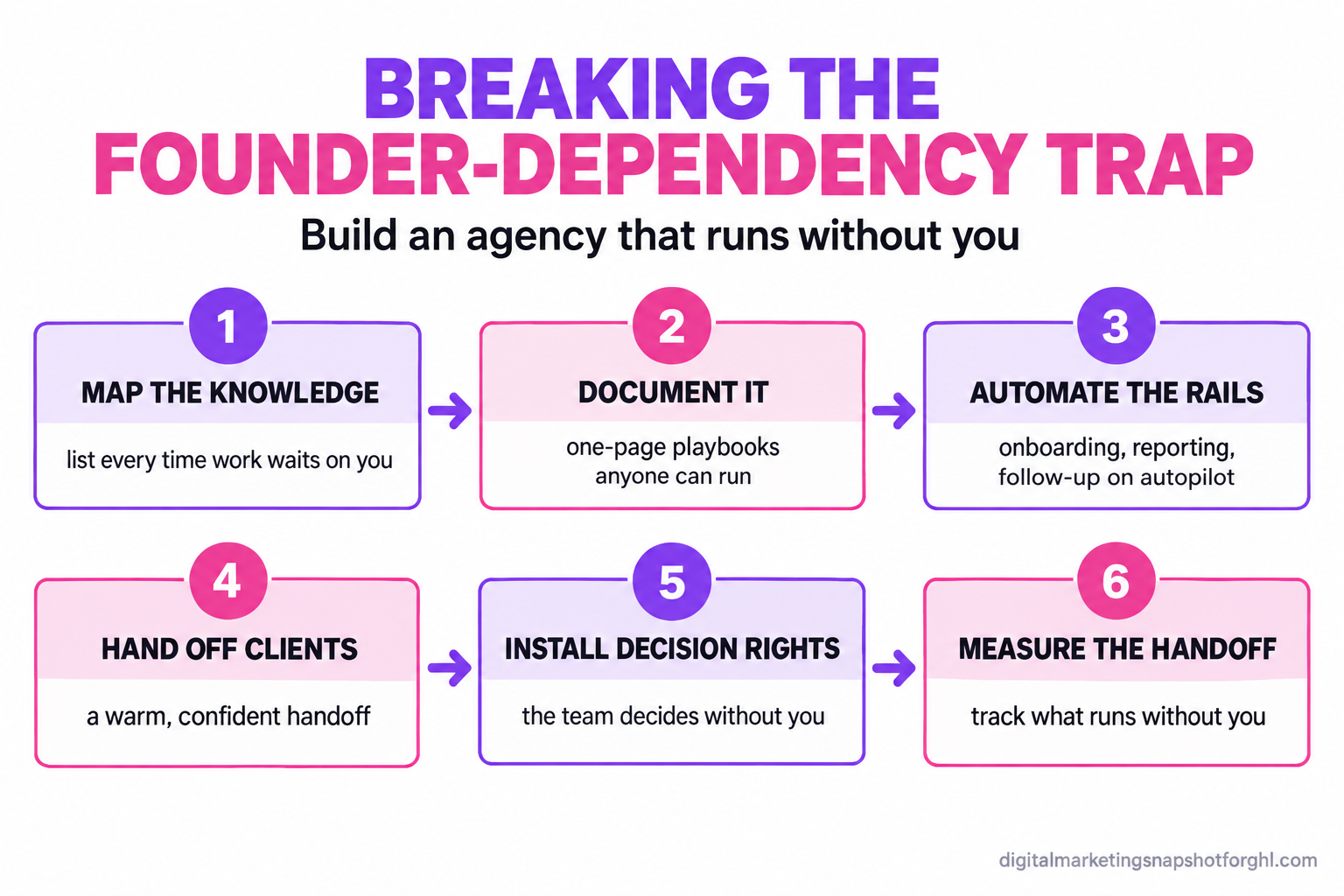
The good news: this is a structural problem with a structural fix. Here is why it caps growth, what it quietly costs you, and a six-stage system to get out of the center, with the real copy and the fix for a solo operator, a mid-size team and a 20-plus shop.
Table of contents
- What founder-dependency actually is
- What it costs you right now
- The six-stage system to get out of the center
- Stage 1: map what only lives in your head
- Stage 2: document it into playbooks
- Stage 3: put the repeatable work on rails
- Stage 4: hand off client communication
- Stage 5: install decision rights
- Stage 6: measure the handoff
- Run it for your size: solo, mid, and 20-plus
- The compliance knowledge you cannot leave in one head
- Objections, answered honestly
- FAQ
What founder-dependency actually is
Founder-dependency hides in plain sight because it looks like being needed, and being needed feels good. But there is a simple test. Could you leave for a two-week holiday, fully off the grid, and come back to an agency that kept delivering and deciding without a single “waiting on you” message? If the honest answer is no, it depends on you, not a system. Nearly one in five small business owners take no holiday at all, and the reason is the same: they do not believe the business can run without them (Aviva, 2024).
Here is why it is a ceiling and not just a grind. Every agency has one scarce resource that caps output: founder attention. When you are the only one who can price a deal, approve creative or calm an unhappy client, each event waits in line for the same calendar. Add clients and the line gets longer, not the throughput. Your hours are finite and mostly spent. That is the wall.
What it costs you right now
It is not a someday problem for exit day. It is bleeding money this quarter, in three measurable places.
It caps your throughput. The agency grows to the edge of what you can personally touch, then stops, and new clients only lengthen the same queue. You feel it as “we are at capacity,” but you are not out of team hours. You are out of founder.
It drags your utilization, which is where profit lives. Billable utilization, the share of paid hours a client actually pays for, averaged 66.4% in 2025, the lowest on record, while high-performing firms hold 75% (SPI Research 2026, 509 firms). A founder bottleneck is a direct cause: work sits idle waiting for sign-off, and senior people burn paid hours asking you questions instead of billing. We broke down the math in lifting billable utilization, and it is one of the six margin leaks that worsen as you grow.
It destroys what the business is worth. Buyers do not pay for the business you built. They pay for the business that runs without you. Appraisers formalize this as the key person discount, roughly 10% to 25% when one person carries too much of the operation, and owner-dependent small firms often sell for 30% to 50% less than comparable ones that run without the owner (Locked On Leadership). That matters because around 80% of the average owner’s net worth sits inside the business, and 73% of owners plan to exit within ten years (Exit Planning Institute). The agency that needs you is the one you cannot sell for what it should be worth.
Billable utilization, 2025. High-performing firms hold 75% while the rest sit near 65%. Founders stuck in approvals are a direct drag on the number. Source: SPI Research 2026 Professional Services Maturity Benchmark (509 firms).
The six-stage system to get out of the center
You do not fix founder-dependency by working less and hoping. You fix it by moving specific things out of your head and off your plate, in order. Each stage below has a way it breaks, because knowing the failure mode is what keeps you from quitting in week two.
Stage 1: map what only lives in your head
You cannot delegate what you have not named. Spend one week listing every time the work stopped and waited for you: approvals, pricing calls, client replies, “how do we handle this” questions, logins only you have. By Friday you have a map of your dependency, usually a dozen recurring decisions and a handful of relationships, not genius.
How it breaks. You map it from memory in one sitting and miss the small stuff, the exact things that trap you. Capture it live, in the moment work waits, for a full week.
Stage 2: document it into playbooks
Take the map and turn the top ten items into short playbooks, not a 40-page manual nobody reads. One page each: what triggers it, the steps, the decision rule, and what “done” looks like. The test of a good playbook is that a competent person who is not you can run it right on the first try without asking anything. Steal this header:
How it breaks. You write the playbook but keep approving everything anyway, so nobody trusts it. The decision rule is the whole point. If it still ends with “then ask the founder,” you have documented your bottleneck, not removed it.
Stage 3: put the repeatable work on rails
A playbook a human runs by hand still costs human hours. The repeatable, high-volume steps should run themselves. New client onboarding, appointment reminders, lead follow-up, white-label reporting and retainer billing should fire on a trigger, not wait for someone to remember. Inside GoHighLevel, each is a workflow you build once and it runs for every client.
Onboarding is the clearest win. The week-long “welcome, please fill this out, did you get my email” dance becomes an automated sequence that collects what you need, grants access and books the kickoff without you, covered in onboard clients in minutes, not weeks. Reporting is next: scheduled white-label reports remove the most common agency weekend task, covered in stop client churn with reporting clients actually read.
How it breaks. You automate a broken process and now it is broken faster. Fix the playbook first (Stage 2), then automate the version that works.
Stage 4: hand off client communication
The stickiest dependency is the relationship, and “my clients only want to deal with me” is the trap that keeps most founders stuck. Clients do not actually care whether it is you, as long as the handoff is confident and the service does not drop. Do it on purpose, early, and with a warm introduction. Steal this:
How it breaks. You hand off the name but not the authority, so the client CCs you “just in case,” and you keep answering, which re-trains them to route through you. Reply “great question for [Name], copying them, they will take it from here,” and mean it.
Stage 5: install decision rights
Your team asks you everything because they do not know what they are allowed to decide. Fix it with a one-page decision-rights doc: what each role can approve alone, what needs a second opinion, and the two or three things that genuinely need you. That clarity turns “waiting on you” into “handled.”
How it breaks. You publish the doc and then override a good decision someone made inside their authority, because you would have done it differently. Do that twice and everyone goes back to asking first. “Different from how I would have done it” is not the same as “wrong.”
Stage 6: measure the handoff
What you do not measure slides back to you. Pick two or three signals and watch them monthly: items wrongly escalated to you, the share of client messages that reach you directly versus the team, and the real one, whether you could take a week off right now. The goal is a steadily shrinking role in the day to day, not zero involvement.
How it breaks. You declare victory after one good month and drift back into the center during the next busy stretch, because stepping in is faster in the moment. Faster today, bottleneck again by next quarter.
Run it for your size: solo, mid, and 20-plus
Founder-dependency looks different at each size. Smaller, founder-led studios keep the most margin, around 19% net under 10 staff versus 8% past 50 (Promethean Research), but that lean margin is often the founder personally absorbing the work.
Net profit margin by agency headcount band, 2025. The founder-led studio’s healthy margin often hides the founder doing the work for free. Source: Promethean Research, How Profitable Are Digital Agencies.
Solo operator (you are the agency). You cannot delegate to people you do not have, so delegate to systems first. Automate onboarding, follow-up, reminders and reporting, then document your playbooks now, while it is just you, so your first hire plugs into a system instead of your memory.
Mid-size team (3 to 10). This is where the bottleneck bites hardest, because you have people but have not given them authority. Stage 5 is your priority: write the decision-rights doc, hand off the top relationships (Stage 4), and stop being the approval queue. It is also the moment to stop pricing by gut, covered in structuring retainers that cut churn.
Large shop (11 to 20-plus). Your dependency has usually moved out of delivery and into sales and the biggest relationships, the deals and clients that still only close or stay because of you. Name them in Stage 1, build a second person into every one, and measure founder-touch on revenue, not just tasks. See how to scale without adding headcount.
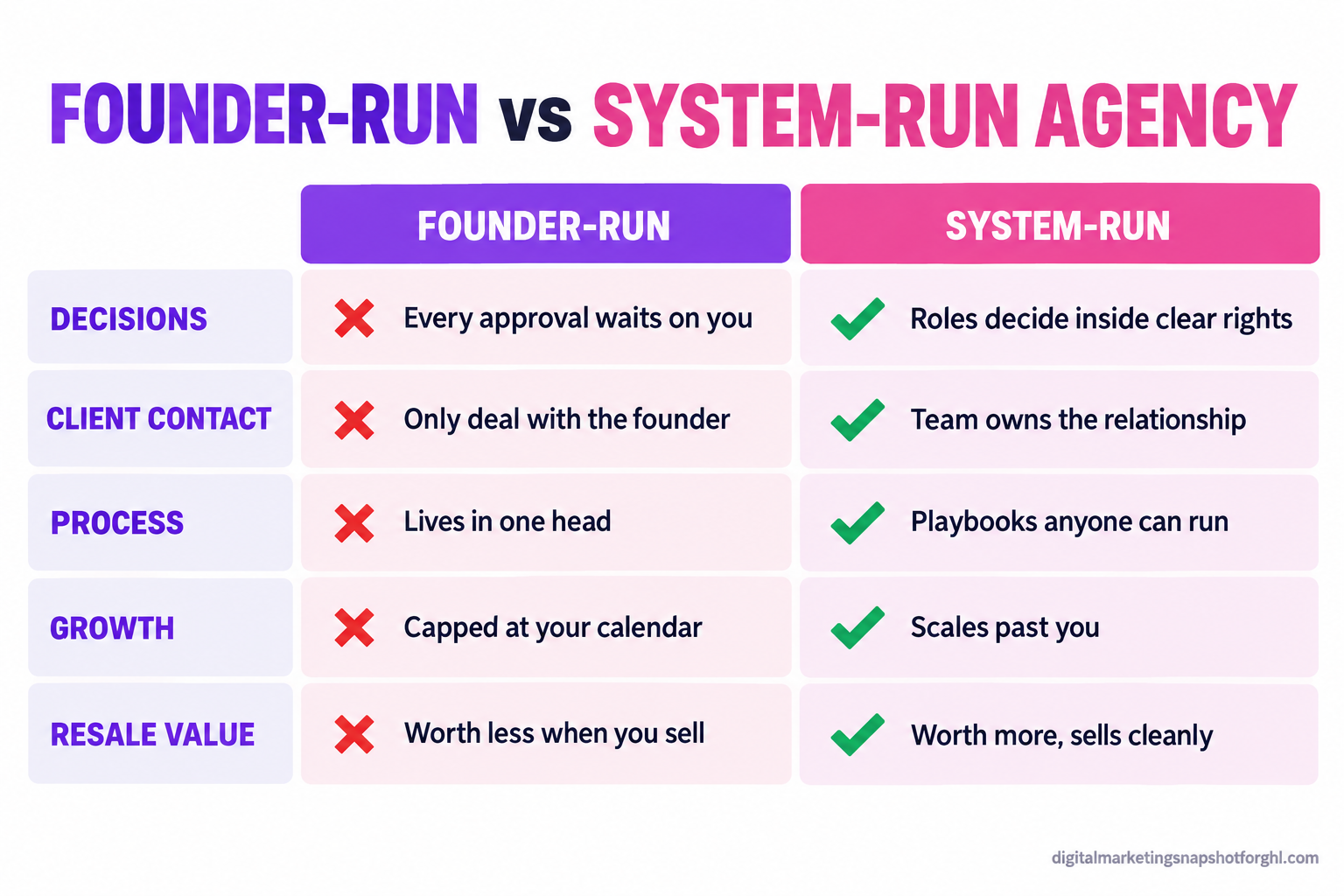
Founder-run vs system-run agency
| Plan | Founder-run agency | System-run agencyRecommended |
|---|---|---|
| Price | Capped at your calendar | Scales past you |
| Feature 1 | Every approval waits on you | Roles decide inside clear rights |
| Feature 2 | Clients only deal with the founder | Team owns client relationships |
| Feature 3 | Process lives in one head | Playbooks anyone can run |
| Feature 4 | Worth less when you sell | Worth more, sells cleanly |
| Build the system → |
The compliance knowledge you cannot leave in one head
One flavor of founder-dependency is not just a growth cap but a live risk: compliance knowledge that lives only with you. If you alone understand how client SMS campaigns get registered, the agency is one holiday away from a compliance mistake.
A2P 10DLC is the clearest example. When you send texts on behalf of clients, carriers require registered campaigns, and registering for other brands needs a reseller ID that most agencies get wrong. Get it wrong and carrier filtering silently blocks your clients’ messages. That cannot live in one head. Document it like any other playbook, covered in our A2P 10DLC registration guide. The same goes for CAN-SPAM on every client email send, GDPR the moment an EU lead enters a list, and the FTC Endorsement Guides that govern any review-collection you run, where fake and incentivized reviews are banned and “results not typical” is no longer a defense (FTC). Compliance that depends on one person is a liability with a holiday schedule.
Objections, answered honestly
“I cannot afford to stop and document everything right now.” You cannot afford not to. Documenting the top ten dependencies is a few hours a week for a month, far cheaper than funding your own bottleneck. Start with the process that interrupts you most.
“My clients only want to deal with me.” Some of that is real and most is habit you trained. A confident, warm handoff to someone clearly across their account keeps clients happy, often happier, because responses get quicker. Keep your few biggest accounts and hand off the other 80%. You are not firing yourself.
“Won’t automation make us feel like a faceless agency?” The opposite, done right. Automation removes the dropped balls, late reports and slow follow-up that make clients feel neglected, and frees your people for the strategy and relationship a workflow cannot do.
“If the agency runs without me, what is my job?” Owner, not operator. Your job becomes the few things only you can do: direction, the biggest relationships, the deals that need you in the room, and improving the system itself. Being the bottleneck was never the job. It was the thing stopping you from doing it.
FAQ
Founder-dependency: quick answers
What is founder-dependency in an agency?
It is when the business runs on things that live only in the founder: relationships only they hold, decisions only they can make, and processes that exist only because they remember them. A simple test: could the owner take a two-week holiday fully off the grid and return to an agency that kept delivering and deciding without a single 'waiting on you' message? Most owners fail it.
Why does founder-dependency cap agency growth?
Because the scarce resource is founder attention. When only the founder can price deals, approve work, or handle unhappy clients, every one of those events waits in line for the same calendar. Adding clients lengthens the line instead of raising throughput, so the agency grows to the edge of what one person can touch in a week, then stalls.
How does founder-dependency affect what my agency is worth?
Buyers pay for a business that runs without the seller. Appraisers apply a key person discount of roughly 10% to 25% to owner-dependent companies, and owner-dependent small firms often sell for 30% to 50% less than comparable ones that run without the owner (Locked On Leadership). Since around 80% of the average owner's net worth sits in the business, that discount is a direct hit to your exit.
Do I need to hire people to escape founder-dependency?
Usually not first. Most founder-dependency is unwritten process and reserved decisions, not missing headcount. Documenting your top ten dependencies into one-page playbooks, automating the repeatable work, and writing a decision-rights doc removes most of it without a new salary. Solo operators delegate to systems before they delegate to people.
How do I hand off a client relationship without losing them?
Do it on purpose and early, with a warm, confident introduction that frames it as an upgrade, more hands and faster responses, not a demotion. Hand off the authority with the name, and stop answering when the client CCs you 'just in case.' Keep only your few biggest accounts at founder level and hand off the rest.
Founder-dependency is not a sign you work hard. It is a sign the agency is built around you instead of a system, and that is a ceiling you can take down. Map it, document it, put it on rails, hand off the relationships, give your team the right to decide, and measure your way out of the center. Start with the one process that trapped you at 9pm tonight.