
It is the Monday after payroll. You just signed your best month ever and added two people last quarter to handle it. Then the P&L lands, and the number at the bottom is smaller than it was a year ago when you had half the revenue. Same clients, more of them, less money in your pocket.
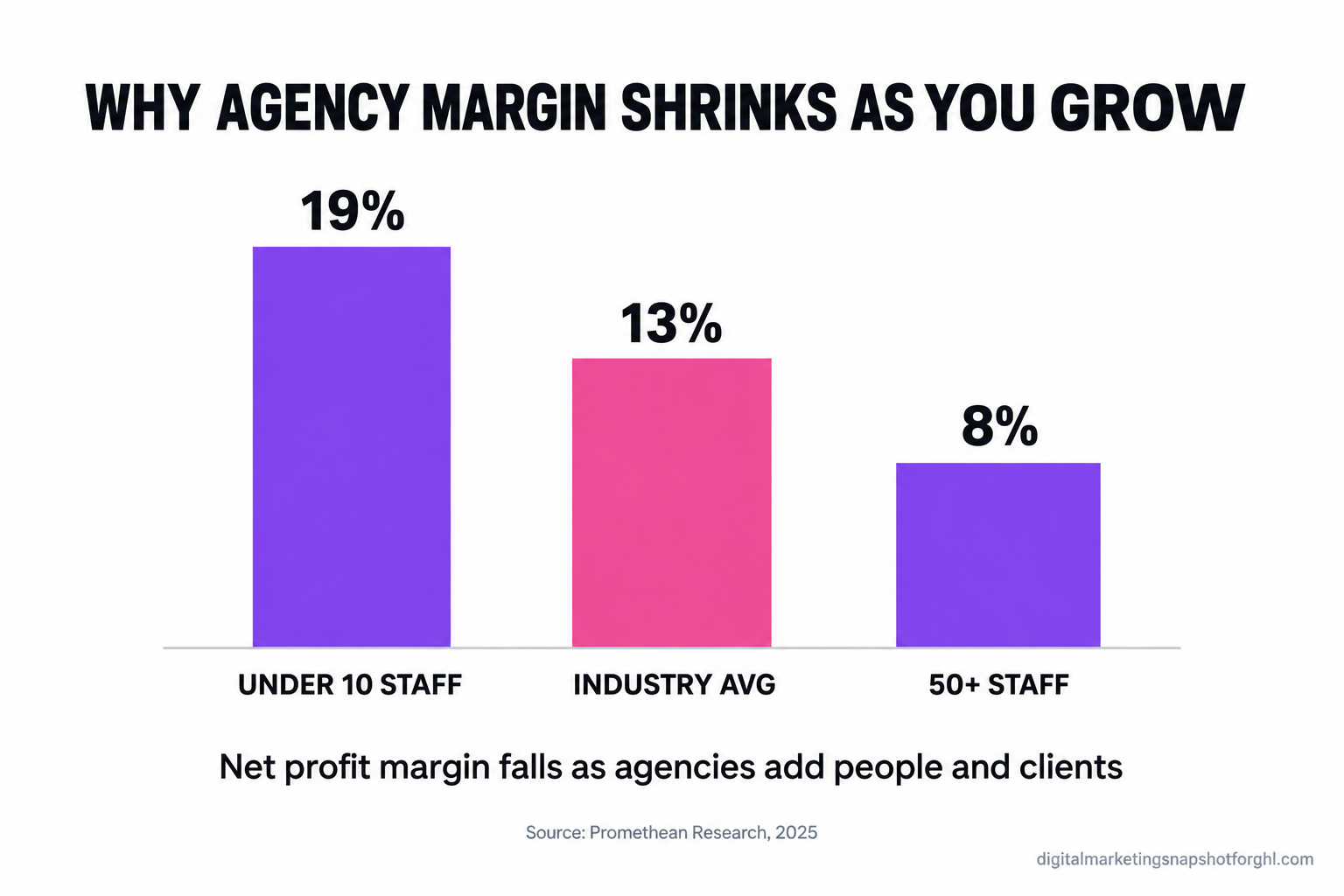
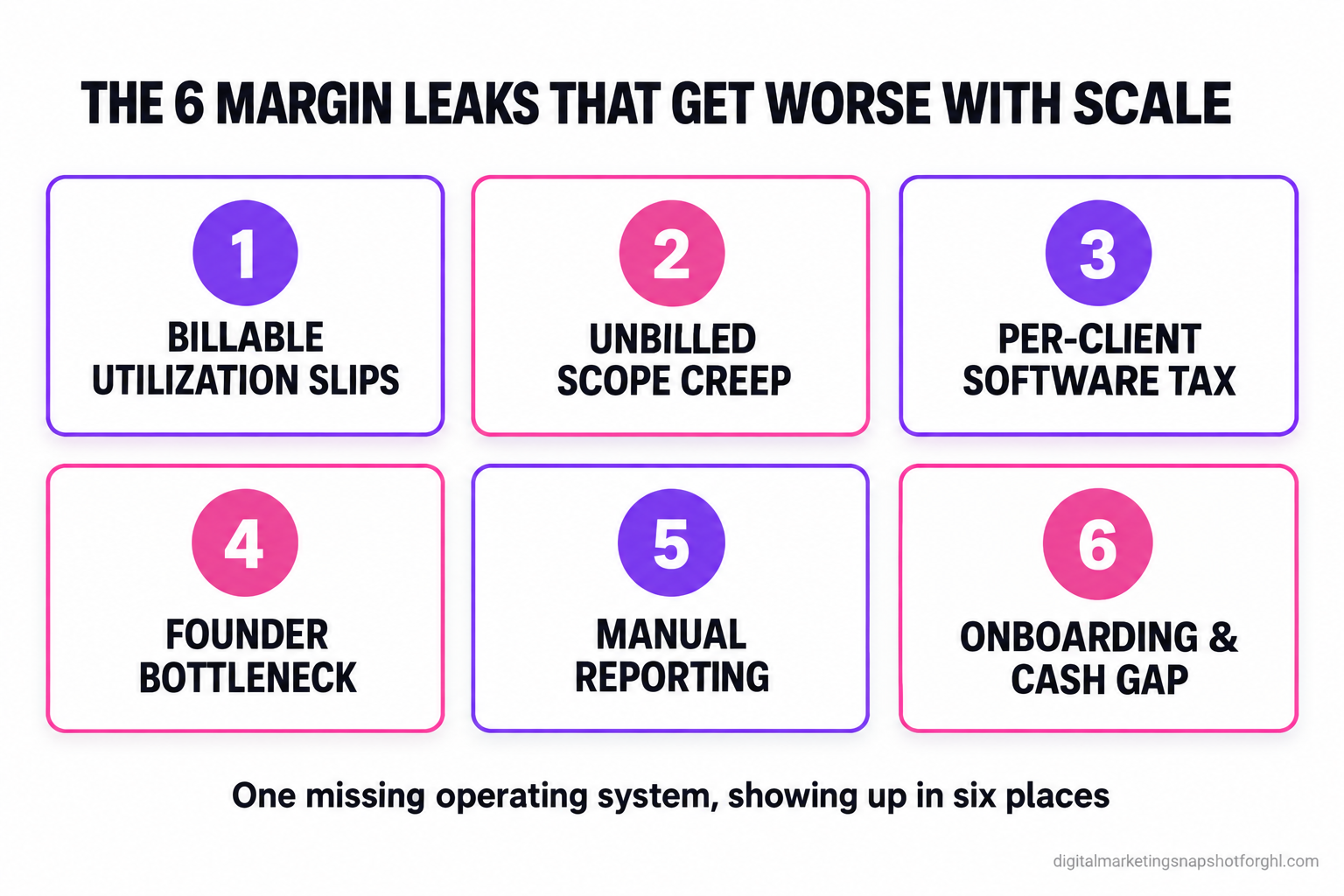
That is not a spreadsheet error. It is the most predictable thing that happens to a growing agency, and it has a name: margin compression. Agency net profit margin falls as headcount and client count climb. Studio shops under 10 staff averaged a 19% net margin in 2025. Agencies past 50 people averaged 8% (Promethean Research). You are not getting worse at the work. You are hitting a set of leaks that only open once you scale, and most are fixable without hiring anyone. Below are all six, the real 2026 numbers behind each, and the fix for a solo operator, a mid-size team, and a 20-plus shop.
Table of contents
- Why the margin curve bends the wrong way
- Leak 1: billable utilization slips
- Leak 2: scope creep you never invoice
- Leak 3: the per-seat and per-client software tax
- Leak 4: the founder becomes the bottleneck
- Leak 5: reporting eats billable hours
- Leak 6: onboarding drag and the cash gap
- Run the numbers for your size
- The compliance costs hiding in your automation
- Objections, answered honestly
- FAQ
Why the margin curve bends the wrong way
Here is the problem in three numbers.A small shop keeps 19 cents of every dollar. A large one keeps 8. The average agency took home about 13% in 2025, down from 14% and under the long-run 15% (Promethean Research). The curve shows up in good years and bad, so it is structural, not a market blip.
Net profit margin by agency size, 2025. The bigger the agency, the smaller the share of each dollar it keeps. Source: Promethean Research, How Profitable Are Digital Agencies.
Why does the line fall? Growth quietly changes your cost structure. Add a person and you pay for a chair whether it is billable or not. Add a client and you buy another software seat. Add a coordinator and you pay someone to manage work instead of doing it. Each move is rational, but stacked together and left un-instrumented they open the six leaks below. None of them are laws of physics. Agencies that stay tight on operations hold their margins as they grow, so the fall is a choice, not a size ceiling.
Leak 1: billable utilization slips
Utilization is the share of a person’s paid hours that a client actually pays for. In 2025 it averaged 66.4%, the lowest in the benchmark’s history and well below the 75%-plus top performers hold (SPI Research). At 66%, a third of every salary you pay is unbilled.How it breaks as you grow. Solo, you are near 100% billable. Hire three people and you get standups, one-to-ones, Slack threads, and a Friday sync. Each is reasonable. Together they pull a chunk of paid time off client work, and nobody notices because there is no number on it.
The fix. Put a number on billable hours per person and watch it weekly, not at year end. Then attack the non-billable load: kill the meetings that could be a message, template repeat tasks, and automate the admin so senior people spend their hours on paid work. We cover the method in our guide to lifting billable utilization. Reclaiming five points on a five-person team is roughly a full paid day back every week.
Leak 2: scope creep you never invoice
This leak bleeds the most and gets talked about the least. In Ignition’s 2025 survey of 273 agency leaders, 57% of agencies lose $1,000 to $5,000 a month to unbilled scope creep, 30% lose more than $5,000, and only 1% bill for all out-of-scope work (Ignition). Wider surveys put the leak at 15% to 27% of a project budget.How it breaks as you grow. With one or two clients you feel every extra request in your own evening. With fifteen, the “quick favor” gets absorbed by an account manager who wants the client happy and has no script to say no. Multiply the small yeses across a bigger roster and you have funded a part-time salary in free work you will never invoice.
The fix. A scope-creep clause in every agreement, plus a request-intake step so extra asks get logged and billed, not silently done. Steal this:
For the pricing structure that makes this stick, see how to price agency retainers.
Leak 3: the per-seat and per-client software tax
Your software bill is the one cost that grows in perfect lockstep with your success. The classic example is reporting: AgencyAnalytics sells one plan at $20 per client per month on annual billing (AgencyAnalytics). Per client. A 5-client shop pays $100 a month. A 40-client shop pays $800 for the identical software. You did nothing different except grow.How it breaks as you grow. Per-unit pricing scales its revenue with your headcount and roster. It feels cheap at the demo because you priced it at your current size. Add a project tool at $15 a seat, a scheduler, a call tracker, and a separate SMS platform, each with its own meter, and the stack becomes a top-three line item by the time you cross ten people.
How your software bill scales: metered vs flat
| Plan | Metered stack (per-seat / per-client) | Flat platformRecommended |
|---|---|---|
| Price | Rises with every hire and client | One fee at any size |
| Feature 1 | $20+/client for reporting | Reporting included, unlimited clients |
| Feature 2 | $15+/seat for project tools | No per-seat charge for new hires |
| Feature 3 | Separate per-unit SMS & call fees | SMS & CRM under one roof |
| Feature 4 | Punishes the next client you win | Growth stops taxing your margin |
| See the flat option → |
The fix. Once a quarter, list every subscription with its unit of scaling: per seat, per client, per contact, or flat. Consolidate the per-unit ones first, because they punish the next hire and the next client. We compared real costs in our agency software pricing teardown and looked at reporting alternatives that do not charge per client. Aim for a stack whose cost stops rising just because you won more work.
Leak 4: the founder becomes the bottleneck
Every small agency runs on the founder’s judgment. That is a feature at three clients and a tax at fifteen. When every quote, tricky email, and quality check routes through one person, that person is the ceiling on both capacity and quality.How it breaks as you grow. You cannot clone yourself, so work either waits in your inbox (slow delivery, frustrated clients) or ships without your eyes on it (rework and the occasional lost account). Rework is the sneaky cost: an hour redone is an hour you paid for twice and billed once.
The fix. Move your judgment into the system one decision at a time. Write the SOP for the thing you keep getting pulled into, build the approval step into a workflow so a coordinator can run it without you, and set a quality checklist so “good” is defined, not felt. This is the whole case for scaling without adding headcount: make the next 20 clients not require more of your hours. Start with the task you were interrupted for most this week.
Leak 5: reporting eats billable hours
Ask any owner what eats their weekend and the answer is reporting: pulling numbers from five dashboards, pasting them into a deck, writing the same commentary before Monday. High-effort, non-billable, and it scales one-for-one with clients: twenty clients, twenty reports.How it breaks as you grow. At three clients a manual report is an annoyance. At twenty it is a part-time job nobody is paid to do, squeezed into evenings by your most expensive people. That is Leaks 1 and 4 compounding, and rushed reports are the ones clients ignore, so they churn at renewal.
The fix. Automate the assembly. The report should build itself on a schedule, pull live numbers, apply your white-label branding, and land in the client’s inbox untouched. Your team’s only job is the two-line human insight at the top, the part that earns the retainer. See stop client churn with automated reporting. Steal this cadence:
Leak 6: onboarding drag and the cash gap
The last leak sits at both ends of the relationship. Slow onboarding delays the day a new client starts paying for real work, and slow manual billing widens the gap between doing the work and getting paid.How it breaks as you grow. A week-long manual onboarding is survivable at one client a month. Sign six and your team drowns in intake forms and access requests, so real work does not start for weeks and the first impression is chaos. On the back end, manual invoicing and un-chased renewals leave earned money uncollected, which is why 82% of agencies hold back growth (The Drum). Margin on paper does not pay salaries. Collected cash does.
The fix. Systematize both ends. A templated onboarding that fires the intake form, access requests, welcome sequence and kickoff booking automatically gets a client to live work in minutes, not weeks. Automated recurring billing and renewal reminders close the cash gap. The same system that plugs Leaks 4 and 5 handles this, which is the point: these are not six problems, they are one missing operating system showing up in six places.
Run the numbers for your size
The leaks are the same at every size. The order you plug them differs.Solo operator or freelancer (1 to 3 clients). Your margin is already near that 19% because there are no layers yet. Your risk is your own time: every hour on manual reporting or invoice-chasing is an hour you cannot sell. Fix Leak 5 (reporting) and Leak 6 (billing) first, and put the scope clause (Leak 2) in from client one.
Mid-size team (4 to 10 staff, 10 to 25 clients). This is where the curve bends hardest. You have added the layers that create Leaks 1 and 4 but not the systems that contain them. Measure utilization this week, get your judgment into SOPs and workflows, and audit the per-unit software tax (Leak 3), now a real line item. This band gets the biggest margin recovery from systematizing.
Larger shop (11 to 20-plus staff, 25-plus clients). You are near the 8% floor and the enemy is overhead and drift. Every leak is live and compounding. Your fix is consolidation: one operating system instead of a dozen metered tools, enforced SOPs, and hard scope discipline. At this size a single point of margin recovered can beat a solo operator’s entire annual profit.
The compliance costs hiding in your automation
Automation plugs the leaks, but the automations that touch client leads carry rules, and getting them wrong is its own leak in fines and blocked messages. Three matter here.A2P 10DLC for any SMS you send on behalf of clients. US carriers block unregistered application-to-person text traffic, so your speed-to-lead and reminder texts will not deliver until the campaign is registered. Sending for clients, you register as a reseller and need that reseller identity in place before you register each client’s campaign, the exact step most small agencies miss. Do it once, per our A2P 10DLC guide for agencies.
CAN-SPAM on every client email, and GDPR the moment an EU lead enters a list. Both require honest sender info and a working unsubscribe, and GDPR needs a lawful basis and consent for EU contacts. Bake the opt-out and consent capture into the automation once and it holds across every client.
FTC Endorsement Guides on any review automation. The revised guides ban incentivized and fake reviews and removed “results not typical” as a defense (FTC.gov). If you harvest reviews for clients: ask every customer, never only the happy ones, never pay for a rating, and disclose any material connection. Build it right with compliant Google review automation. One note so you do not over-correct: the FCC one-to-one consent rule was vacated in January 2025 and does not apply, so do not buy a “fix” for it.
Objections, answered honestly
“My margin is fine, I’m growing.” Growth and margin are different numbers, and this pattern is them moving in opposite directions. Pull your net margin for the last three years next to your headcount. If the line falls as the team grows, you have the leaks whether or not this month felt good.“I already pay for tools that do this.” The question is whether they meter your growth and whether they removed the manual work or just moved it. A stack of five per-unit tools that still needs a human to assemble every report is the problem, not the solution. Count what each charges per client or seat, and the hours your team spends stitching them together.
“Do I need to be technical to fix this?” No. Every fix here is an operations decision, not a coding project. A scope clause, a scheduled report, and an SOP are things an owner can direct in an afternoon. The build can be done for you; the judgment about what to systematize first is the part only you can make, and this post gave you the order.
“Won’t automating make my service feel impersonal?” The opposite, when you automate the right layer. Clients do not want you hand-assembling a spreadsheet, they want a fast response and a human who understands their business. Automate the assembly and admin, and your people get their hours back for the relationship work that keeps a client. Impersonal is a rushed report sent at 11pm, not a clean one that arrived on time.
The fix is one system, not six projects
Six leaks, one root cause: the manual, founder-dependent, tool-sprawled way of working that got you here cannot carry twice the size without eating your margin. Hiring does not close the gap, because hiring adds the very layers that opened the leaks. You close it by giving the same team a system that carries more clients at the same quality: automated onboarding, scheduled white-label reporting, two-way follow-up, recurring billing, and renewal engines that run without you.
It is the Monday after payroll again, six months from now. You signed another strong month, and this time the bottom line is bigger, because the extra clients did not cost you extra hours, software, or founder time. That is what plugging the leaks buys you: growth that reaches your pocket.
All six leaks run on the same platform layer. If you want to build it yourself, you can start a GoHighLevel account here and wire the automations in over time.
Disclosure: the GoHighLevel link above is an affiliate link. If you start an account through it we may earn a commission, at no extra cost to you.
FAQ
Agency margin: quick answers
Why does my agency make less profit as it grows?
Growth changes your cost structure: people add non-billable layers, clients add per-seat and per-client software costs, and manual work like reporting scales one-for-one. Net margin falls from about 19% under 10 staff to roughly 8% past 50 (Promethean Research). The fix is systematizing the manual work, not adding people.
What is a good net profit margin for a marketing agency in 2026?
The 2025 average was about 13%, down from 14%, per Promethean Research. Smaller studios average closer to 19% while agencies past 50 staff run near 8%. Below average and shrinking as you grow means fixable leaks, not a size ceiling.
How much do agencies lose to scope creep?
In Ignition's 2025 survey of 273 agency leaders, 57% lose $1,000 to $5,000 a month to unbilled scope creep and 30% lose more, while only 1% bill for all of it. A written scope-creep clause with a pre-agreed out-of-scope rate is the fix.
What is billable utilization and what should it be?
It is the share of paid hours a client pays for. It averaged 66.4% in 2025, the lowest on record, while top performers hold 75% or more (SPI Research). Every point below is unbilled payroll, so measure it weekly.
Should I switch off per-client software to protect margin?
Audit it first. A $20-per-client reporting tool costs a 40-client shop $800 a month for the same features a 5-client shop gets for $100. Where a flat-priced platform covers the job, moving stops your bill rising every time you win a client.