
Review harvesting is an automated system that asks a business’s happy customers for a public review at the exact moment their satisfaction peaks — so five-star reviews accumulate on Google without anyone chasing them. For a San Antonio marketing agency, it is one of the fastest, stickiest recurring services you can add to a retainer: it runs on automation you build once, it produces a result the client can see every week in their own Google Business Profile, and it compounds — because more recent reviews mean more trust, more conversions, and higher local rankings for the client, month after month. This playbook covers the sourced business case, the exact 7-step build inside GoHighLevel, and how to package and price it as a line item clients happily renew.
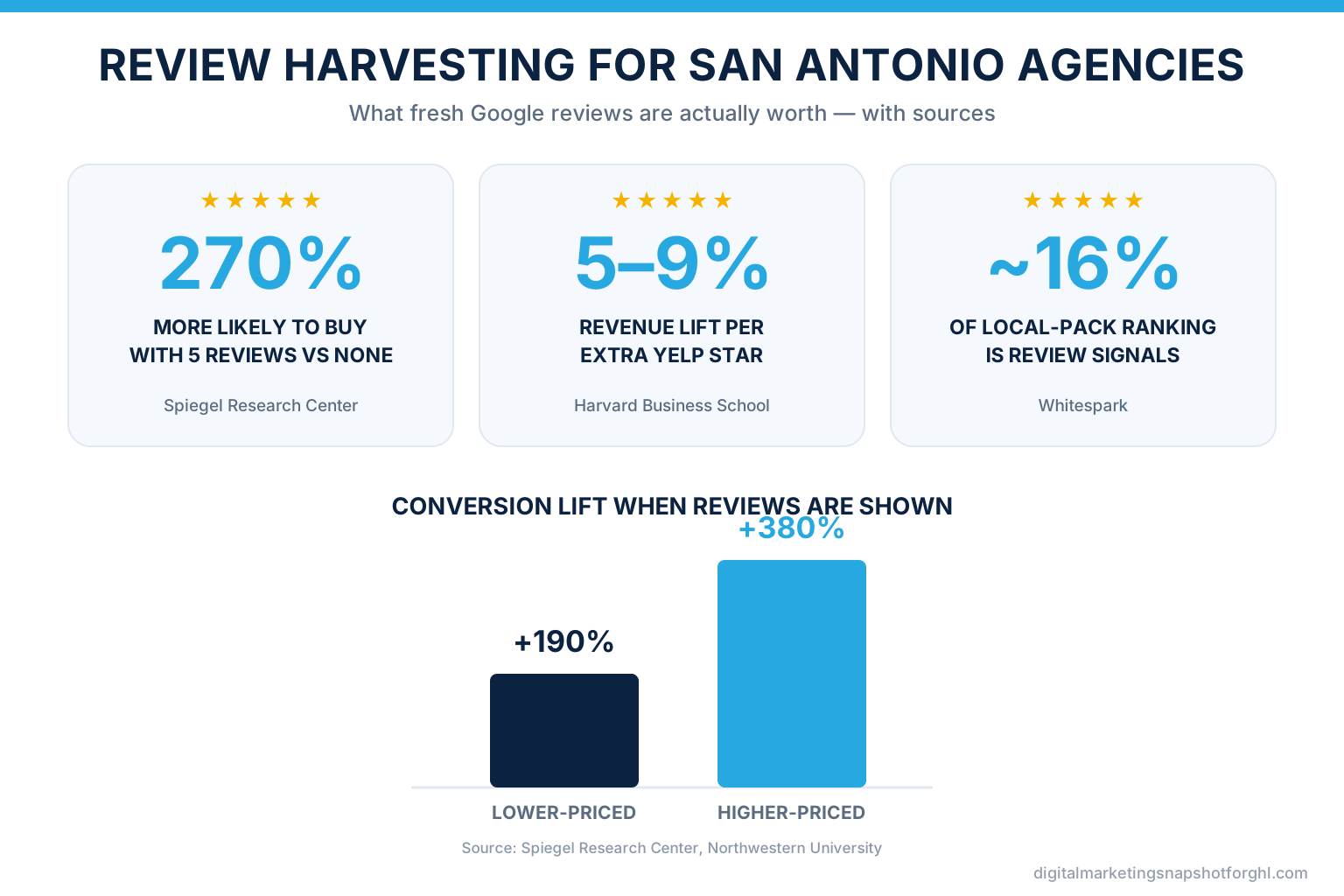
Table of contents
- Why review harvesting is the easiest recurring revenue an agency can add
- What the data says a review is actually worth
- The 7-step review-harvesting build in GoHighLevel
- How to package and price it as a recurring service
- Compliance: the mistakes that get a profile suppressed
- Why San Antonio agencies win with this specifically
- FAQ
Why review harvesting is the easiest recurring revenue an agency can add
Most agency services are hard to prove. SEO takes months. Paid media results swing with the market. But a review-harvesting system produces a visible, undeniable result the client can watch accumulate in real time — new five-star reviews on their own Google Business Profile, every single week. That makes it the rare retainer line item where the value is self-evident, which is exactly why it renews.
It’s also a service almost every local client needs and almost none run well. Texas is home to roughly 3.2 million small businesses — 99.8% of all businesses in the state (U.S. SBA Office of Advocacy, 2025), and San Antonio’s economy leans heavily on local service businesses — home services, medical and dental practices, law firms, restaurants, auto, and trades. Every one of them lives or dies on its Google reputation, and the vast majority ask for reviews inconsistently, if at all. The gap is enormous, and the fix is a system you can install once and resell across your whole client base.
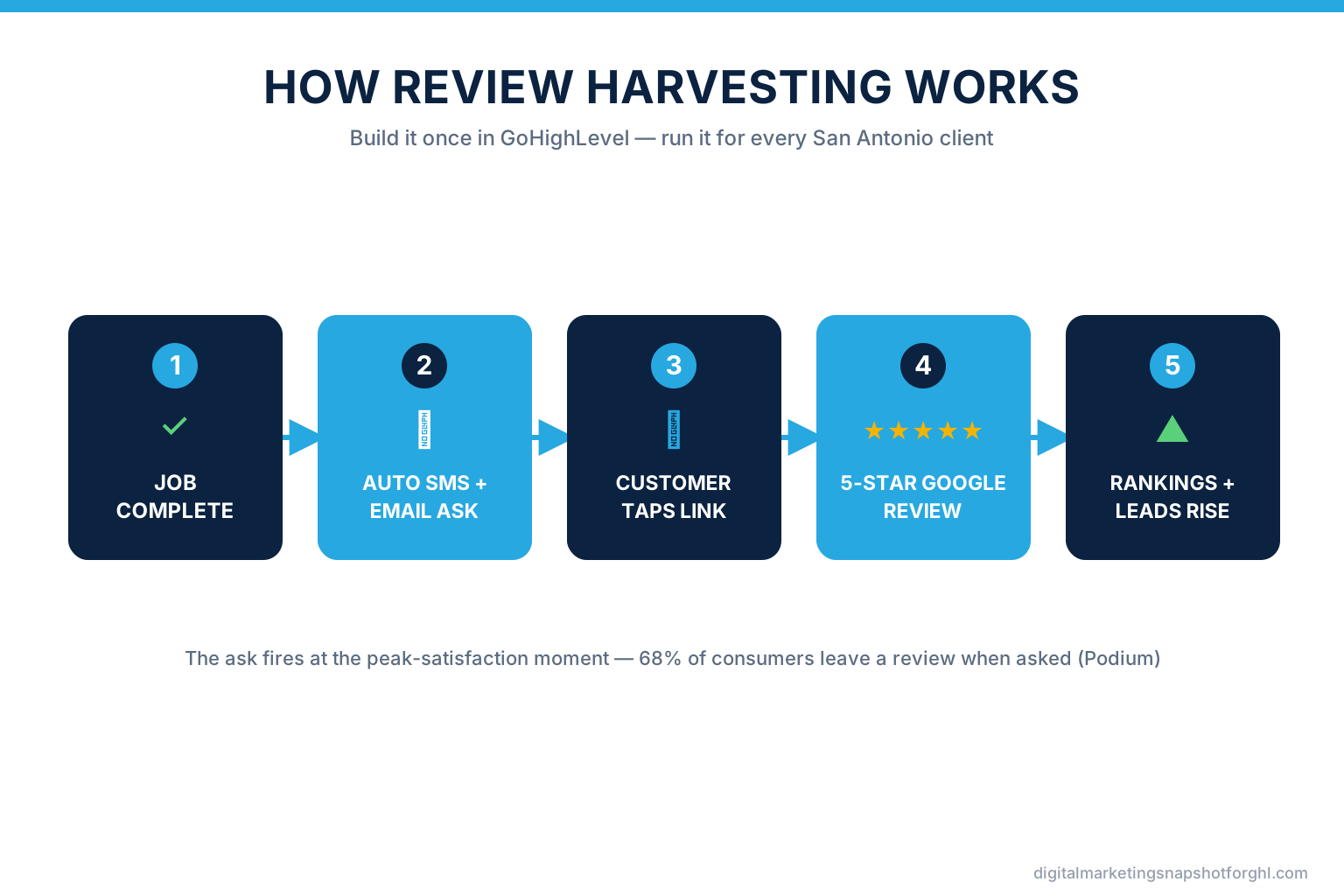
The reason it works comes down to one number: 68% of consumers said they would leave a review for a local business if simply asked (Podium, 2021). The reviews aren’t missing because customers are unhappy — they’re missing because nobody asked, or asked at the wrong moment through the wrong channel. Automating that ask is the entire opportunity.
What the data says a review is actually worth
Before you sell review harvesting, you need to be able to say — with sources — exactly what a fuller, fresher review profile does for a client’s revenue. Here are the numbers that make the case.
More reviews mean more buyers
The Spiegel Research Center at Northwestern University found that the likelihood of purchasing a product with five reviews is 270% greater than a product with no reviews at all (Spiegel Research Center). Simply displaying reviews lifted conversion rates by 190% for lower-priced items and 380% for higher-priced items — because the more someone is about to spend, the more reassurance they need before they commit.
Conversion lift (%) when reviews are displayed, by price point. Source: Spiegel Research Center, Northwestern University.
For a San Antonio home-services or medical client selling a $3,000–$15,000 job, that higher-priced curve is the one that matters — and it’s the one a steady stream of fresh reviews feeds directly.
A better rating means more revenue
The foundational study here is Michael Luca’s work at Harvard Business School, which isolated the causal effect: a one-star increase in a business’s Yelp rating leads to a 5–9% increase in revenue (Harvard Business School). Crucially, that effect was concentrated among independent businesses — exactly the local operators a San Antonio agency serves — not national chains with their own brand equity.
Revenue lift (%). One extra star: 5–9% (midpoint shown), Harvard Business School. Above-average review count: Womply study, via Search Engine Land.
Review volume matters as much as rating. A widely cited Womply analysis found businesses with more than the average number of reviews earned 82% more revenue than average, and those that claimed listings on three or more review sites averaged about $107,000 more in annual revenue (via Search Engine Land).
Reviews are a genuine local-SEO ranking lever
This is the part that ties review harvesting to the rest of your retainer. According to Whitespark’s Local Search Ranking Factors — the industry’s long-running survey of local SEOs — review signals account for roughly 16% of what determines local-pack rankings, spanning quantity, velocity, star rating, keywords in review text, and response rate (Whitespark). Whitespark also singles out review recency as one of the most underrated ranking factors (Whitespark) — a business with ten fresh reviews from the last month often out-signals a competitor sitting on fifty reviews from two years ago.
That recency requirement is why review harvesting is a recurring service, not a one-time cleanup. Reviews decay in influence. A client needs a steady drip forever — which is precisely what makes this a monthly line item instead of a project. It also compounds with the review-response work covered in our Google review automation playbook: responding to reviews earned businesses 12% more reviews and a 0.12-star rating bump (Harvard Business Review).
The 7-step review-harvesting build in GoHighLevel
Here is the exact system to build once and deploy across every client. It fires the ask at the moment satisfaction is highest, on the channel people actually respond to, and routes the review to the profile that moves rankings.
- •Step 1
Define the trigger moment
Pick the event that signals a happy customer: an invoice marked paid, an appointment marked complete, a job status set to 'done', or a positive reply. This is when the ask fires — not a random weekly blast.
- •Step 2
Connect the Google Business Profile
Link the client's Google Business Profile so the request points at their live review link. Reviews on the GBP are what feed the local pack — prioritize it over third-party sites.
- •Step 3
Build the multi-channel ask
Fire an SMS first (highest open and response rate), then an email fallback 24 hours later if there's no click. Keep the copy short, personal, and one-tap: a single link straight to the review box.
- •Step 4
Add a light sentiment gate — the compliant way
Ask about the experience privately first ONLY to route service recovery. Never withhold the public review link from unhappy customers by design — that's review gating and it violates Google policy. Send everyone the public link; use the private signal to follow up with the unhappy ones.
- •Step 5
Time the follow-ups
One reminder after 3 days if unopened, a final nudge after 7. Then stop. Two well-timed reminders recover a large share of non-responders without becoming spam.
- •Step 6
Automate the reply layer
Auto-notify the client (or your VA) the instant a review lands so every review gets a fast, human response. Responding lifts both volume and rating over time.
- •Step 7
Report the result weekly
Push new-review count, average rating, and velocity into the client's white-label dashboard so the value is visible every week — this is what makes the retainer renew.
The heavy lifting — the workflows, the SMS and email templates, the timing logic, and the review-request funnel — ships pre-built in the Review Harvesting Automation module of our snapshot, alongside the Google review reply automation that handles Step 6. You wire it to the client’s trigger event and turn it on.
How to package and price it as a recurring service
Review harvesting works best as a productized add-on, not a bespoke build. You’ve already done the engineering once; every new client is a configuration, not a project. That’s what protects your margin — and it’s the same capacity logic in how to scale an agency without adding headcount.
Price it as a flat monthly line item — most agencies land it between $150 and $500/month depending on volume and whether review responses are included — and anchor it to the outcome, not the labor. When a client sees the revenue math above, a few hundred dollars a month against a 5–9% revenue lift per star is an easy yes. For the full framework on structuring these, see how to price marketing agency retainers.
Manual review requests vs an automated harvesting system
| Plan | Manual / ad-hoc asking | Automated review harvestingRecommended |
|---|---|---|
| Price | Staff time + inconsistency | Built once, resold per client |
| Feature 1 | Someone remembers to ask — sometimes | Fires automatically at the peak-satisfaction moment |
| Feature 2 | Asked hours or days late, when satisfaction has faded | SMS-first, one-tap link to the Google review box |
| Feature 3 | Email-only, buried in an inbox | Timed reminders recover non-responders |
| Feature 4 | No follow-up when ignored | Every review gets a fast, tracked reply |
| Feature 5 | Reviews trickle in, then dry up | Steady velocity of fresh reviews — the ranking signal |
| Feature 6 | Nothing to show the client at renewal | Weekly white-label report that renews the retainer |
| See the module |
What changes for the client
A dozen stale reviews, the newest six months old, asked for by hand when someone remembers, invisible in the local pack.
A steady drip of fresh five-star reviews every week, asked automatically at the right moment, feeding local-pack rankings and answered within the hour.
Compliance: the mistakes that get a profile suppressed
Review harvesting only works if it stays inside the platforms’ rules. Get this wrong and you can get a client’s reviews filtered — or their profile penalized. Three hard rules:
The safe pattern is simple: ask everyone, at the right time, on channels they opted into, and use negative signals to trigger a private service-recovery conversation — not to hide the public link.
Why San Antonio agencies win with this specifically
San Antonio’s market is dominated by local, independent, often family-owned service businesses — and Luca’s research shows independents are exactly where a rating bump moves revenue the most. These are also relationship-driven businesses whose customers are genuinely happy but rarely think to leave a review unprompted. The ask, automated, closes that gap.
Because the system is built once and redeployed, you can roll it out across a book of San Antonio clients — HVAC, dental, legal, med-spa, roofing, auto — from the same snapshot, and layer it onto services you already sell. It pairs naturally with the review-response engine, appointment reminders, and reporting, turning a single reputation win into a stickier, higher-margin retainer. If you’re still building your client base, a strong review engine is also one of the easiest things to sell in a first conversation — see how to get clients for a marketing agency.
FAQ
Review harvesting for agencies — quick answers
What is review harvesting?
Review harvesting is an automated system that asks a business's happy customers for a public review at the moment their satisfaction is highest — typically right after a completed job, appointment, or paid invoice. Instead of hoping customers remember to review, the system fires a short SMS and email with a one-tap link to the Google review box, then sends timed reminders to non-responders. For an agency, it's a service you build once and resell across every local client.
Is review harvesting against Google's rules?
The practice of asking customers for honest reviews is allowed and encouraged. What's prohibited is review gating (routing only happy customers to the public review link while hiding it from unhappy ones) and incentivized reviews (offering anything of value in exchange for a review). A compliant system sends the public review link to everyone and uses any private-feedback step only to follow up with unhappy customers, never to filter who can post.
How much can an agency charge for review harvesting?
Most agencies price it as a flat monthly add-on between roughly $150 and $500 per client, depending on review volume and whether review responses are included. Because the automation is built once in GoHighLevel and reconfigured per client, the margin is high. Anchor the price to the outcome — a 5–9% revenue lift per Yelp star and up to 380% higher conversion when reviews are displayed — not to your labor.
Do online reviews really affect local Google rankings?
Yes. Whitespark's Local Search Ranking Factors survey attributes roughly 16% of local-pack ranking weight to review signals — quantity, velocity, recency, star rating, keywords in review text, and response rate. Review recency is especially underrated: a steady stream of recent reviews often out-signals a larger pile of old ones, which is why review harvesting needs to run continuously rather than as a one-time push.
How fast can I turn this on for a client?
The Digital Marketing Snapshot installs review-harvesting workflows, SMS and email templates, the review-request funnel, and Google review reply automation into your GoHighLevel account within 24 hours (one business day). From there you connect the client's Google Business Profile and trigger event and switch it on — most San Antonio clients can be live in week one.
Why don't happy customers leave reviews on their own?
They intend to and forget. Podium's State of Reviews found 68% of consumers would leave a review for a local business if asked — the reviews are missing because no one asked at the right moment through the right channel, not because customers are dissatisfied. Automating the ask, timed to the peak-satisfaction moment and sent by SMS, is what converts that intent into a posted review.
Written by Marisa Quintero, Agency Operations Strategist based in Austin, TX. Marisa spent eight years running fulfillment for a 40-client SEO and PPC shop before going independent. She is obsessed with the boring half of agency life — onboarding, reporting cadences, and productizing services into clean recurring revenue — because that’s where margin quietly leaks out.
Related reading: Google Review Automation for Agencies · How to Price Marketing Agency Retainers · Stop Client Churn With Automated Reporting · How to Scale a Marketing Agency Without Adding Headcount