
For a Dallas marketing agency, a dead social feed isn’t a cosmetic problem — it’s a lead leak. Roughly three in four consumers check a brand’s social profiles before they’ll do business with it (Sprout Social), so when a prospect lands on your agency’s Instagram and the last post is three months old, you’ve just failed the exact test you sell your clients on passing. In a market with tens of thousands of agencies fighting for the same searches, the one that posts consistently and answers fast wins the call — and it usually isn’t the one too buried in client work to post.
I’ve spent years helping boutique social and content agencies cut churn and turn attention into booked calls, and the “cobbler’s children have no shoes” problem is the single most common self-inflicted wound I see. Below is what a neglected feed actually costs in 2026, why short-form video is now the only format reliably reaching new prospects, the real math on fixing it in-house versus done-for-you, and why this hits Dallas agencies especially hard.
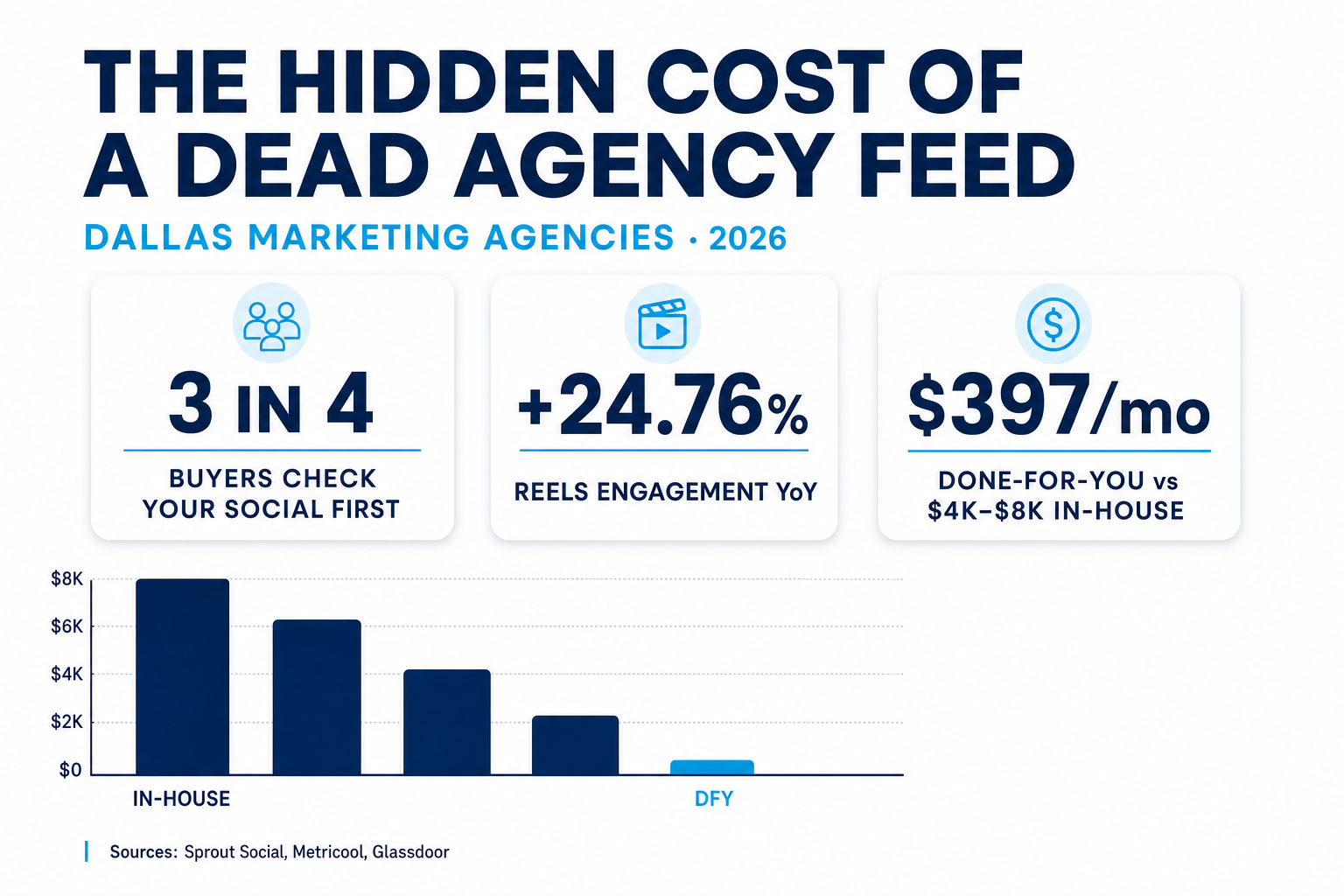
Table of contents
- Why your agency’s own feed goes quiet
- What a dead feed actually costs you
- Short-form video is where new clients come from now
- Consistency is the whole game
- The real math: in-house team vs done-for-you
- Why this hits Dallas agencies harder
- How to fix a dead feed without hiring
- FAQ
Why your agency’s own feed goes quiet
It’s never a decision. No agency owner sits down and chooses to abandon their Instagram. It happens the way most margin leaks happen — quietly, one busy week at a time.
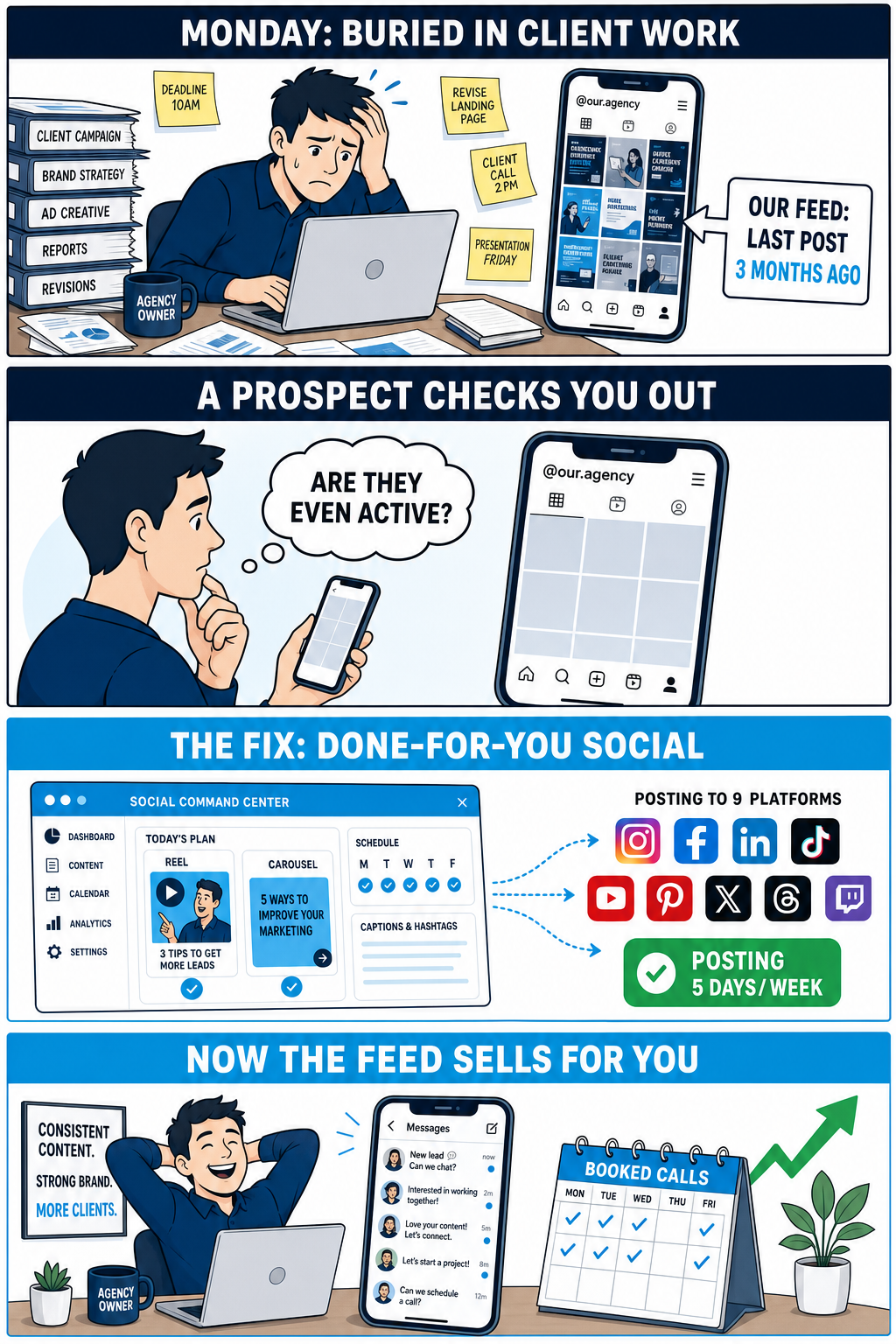
Client work always wins the calendar. A campaign is due, a report is late, a prospect wants a proposal by Friday. “Post to our own channels” is the one task with no external deadline and no client to answer to, so it slides. One quiet week becomes a month, the month becomes a quarter, and now the most recent thing on your grid is a “Happy Fourth of July” graphic in October.
The cruel irony is that you sell social media. You know exactly how bad a dead feed looks — you’ve pitched against it in a hundred discovery calls. But knowing isn’t the constraint. Time and consistent output are. A real feed in 2026 isn’t one post a week; it’s daily, multi-format, cross-platform content plus fast replies to every comment and DM. That’s a full production line, and it’s the first thing to break when the people running it are also fulfilling client work.
What a dead feed actually costs you
The cost isn’t abstract. Buyers actively use your social presence as a screening tool, and an inactive one quietly disqualifies you.
Roughly three in four consumers check a brand’s social profiles as part of deciding whether to trust it (Sprout Social). For an agency, that check is doubly loaded — your prospect isn’t just judging your service, they’re judging your competence at the exact thing they’d be paying you for. A quiet feed is the worst possible first impression.
Then there’s response speed. Social is a real-time channel, and buyers treat it like one: 69% of consumers expect a same-day response when they reach out on social (Sprout Social Index), and roughly a third expect a reply within an hour (Emplifi). When a DM sits unanswered overnight, you’ve already missed the window most buyers expect — and on social, the next agency is one tap away. Sprout’s research even found that the single most memorable thing a brand can do on social is simply respond (Sprout Social Index).
Put those together and the picture is clear: a prospect finds you, checks your feed, and either sees an active, credible agency that answers fast — or sees silence. One of those books a call. This is the same speed-to-lead principle we’ve written about for client campaigns in Speed-to-Lead for Agencies; it applies just as ruthlessly to your own front door.
Short-form video is where new clients come from now
Even agencies that do keep posting often lose because they’re posting the wrong format. In 2026, static graphics don’t travel — short-form video does.
Metricool’s 2026 study of Instagram found Reels engagement up 24.76% year over year — the only format still growing — while single-image posts cratered: reach down 21.96% and engagement down 45.98% (Metricool). Reels are also what the algorithm pushes to non-followers, which is exactly the audience an agency needs to reach to win new clients. Carousels still earn their place — they get about 9x more saves than single images (Metricool) — but the discovery engine runs on video.
The ROI data backs it up. Video is the highest-ROI content format, according to HubSpot, 93% of video marketers report a positive ROI — the highest Wyzowl has ever recorded — and 85% say video helped them generate leads (Wyzowl). This is why our done-for-you package ships one short vertical reel every week per brand on top of the static content — it’s the piece most likely to reach someone who’s never heard of you.
Instagram format performance, year-over-year change (%). Source: Metricool 2026 Instagram Study.
The takeaway for a busy agency: if you only have bandwidth for one thing, it’s not another branded quote graphic — it’s a weekly reel. And if you don’t have bandwidth for that, that’s the honest signal it’s time to hand the production line to someone else.
Consistency is the whole game
Reach on organic social is a compounding asset, not a lottery ticket — and compounding only works if you show up every day.
Buffer’s analysis of more than two million posts across 100,000+ accounts found that posting cadence maps almost linearly to growth: accounts posting 3–5 times a week grew followers at more than double the rate of those posting 1–2 times, and accounts posting 10+ times a week grew roughly 5.5x faster (Buffer). Frequency isn’t spam; on today’s algorithms it’s how you earn distribution.
Relative Instagram follower-growth multiplier by weekly posting frequency (1–2x/week = 1.0 baseline). Source: Buffer.
This is the part that quietly kills DIY agency feeds. Anyone can post for two weeks on motivation. Sustaining five posts a week across nine platforms, in a consistent brand voice, forever — while also serving clients — is an operations problem, not a willpower problem. It’s the reason organic momentum takes 3–5 months to build and why so few agencies ever get there on their own. Miss a week and the compounding resets.
The real math: in-house team vs done-for-you
Here’s where most agency owners flinch — because building a real content operation in-house is genuinely expensive, and the numbers are public.
A single social media manager in the Dallas–Fort Worth market averages $73,943 a year — about $6,160 a month (Glassdoor), and that’s just the coordinator. A real feed also needs a graphic designer (US median $61,300/yr, BLS), a video editor for the reels (median $70,980/yr, BLS), and someone to answer the comments and DMs fast (community manager ~$67,425/yr, Glassdoor).
Approximate monthly cost per in-house role (full-time salary ÷ 12) vs. our done-for-you service. Sources: Glassdoor, BLS.
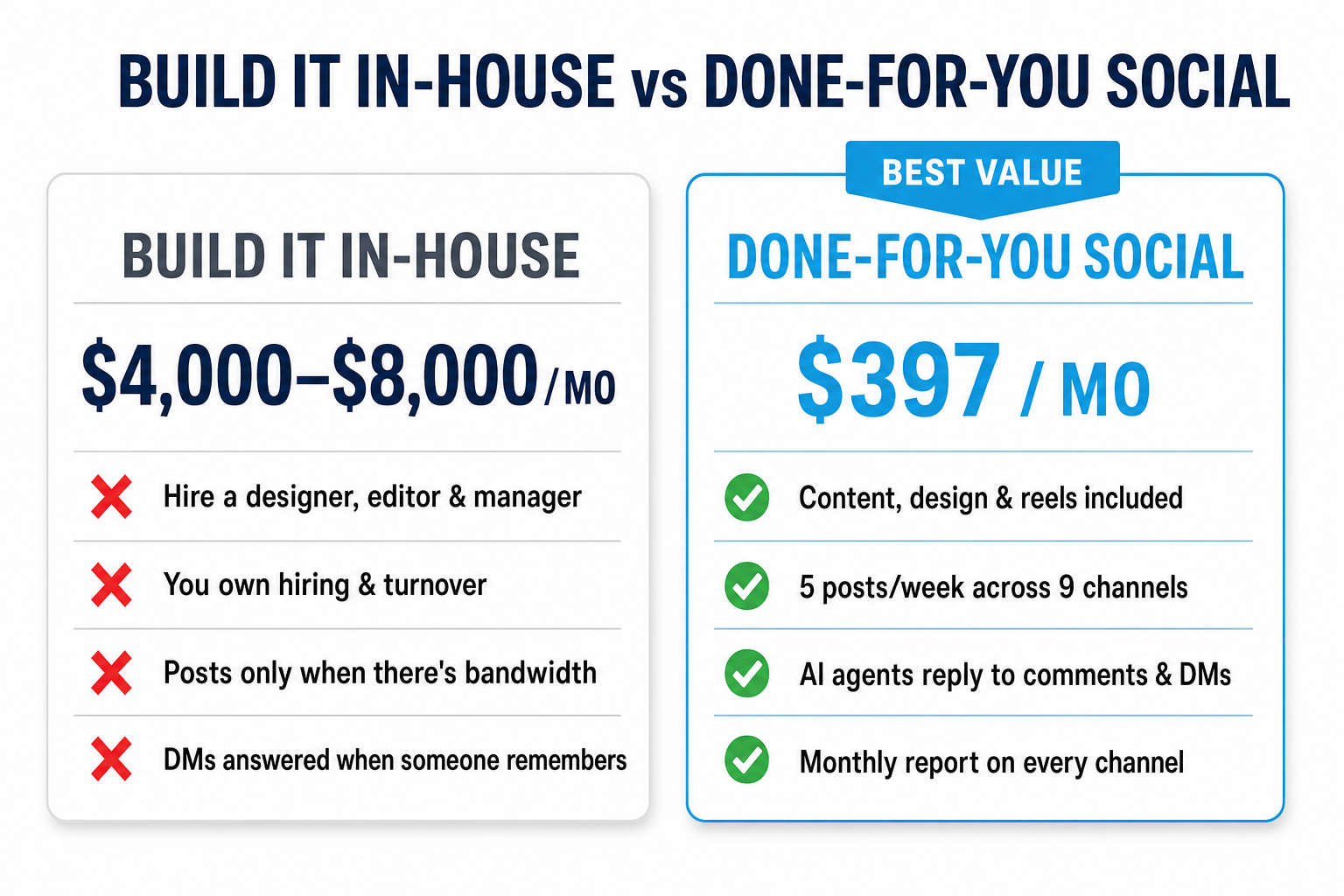
No small agency hires four full-time people for its own feed, of course. In practice you cobble it together with freelancers and part-timers — and even that realistic, partial setup runs $4,000–$8,000 a month once you add up a contract designer, an editor, and someone managing the calendar. Compare that to a fully done-for-you engine at $397/mo:
Building it in-house vs. done-for-you social
| Plan | Build it in-house | Done-for-you social (ours)Recommended |
|---|---|---|
| Price | $4,000–$8,000/mo | $397/mo |
| Feature 1 | Hire or contract a designer, editor & manager | Content, design & reels included — no hires |
| Feature 2 | You own hiring, training & turnover | 1 text, 1 image, 2 carousels & 1 reel weekly |
| Feature 3 | Consistency depends on your team's bandwidth | Published 5 days/week across 9 channels |
| Feature 4 | Reels only when the editor has time | 3 AI agents reply to comments, DMs & web chat |
| Feature 5 | Comments & DMs answered when someone remembers | Written in your agency's voice & niche |
| Feature 6 | Reporting you assemble yourself | Monthly performance report on every channel |
| See the $397/mo plan |
Even if you only ever hired one full-time social media manager in Dallas, that single salary costs more per month than fifteen months of the done-for-you service. The math isn’t close — and it’s why outsourcing the production line, not the strategy, is how lean agencies stay visible without adding headcount. (We made the broader case for this in How to Scale a Marketing Agency Without Adding Headcount.)
Why this hits Dallas agencies harder
Every point above is true nationally. In Dallas, the competitive math makes it sharper.
The US is home to 114,014 advertising agencies — up 4.4% year over year — and Texas ranks among the top states for advertising-agency revenue (IBISWorld). Dallas–Fort Worth is one of the densest agency markets in the country, which means a prospect searching “social media agency Dallas” or “marketing agency near me” has a long list of tabs open. Your feed is the tiebreaker. When two agencies look comparable on paper, the one posting daily reels and answering DMs in minutes reads as the safer, more capable choice — and gets the call.
The local cost pressure cuts the same way. Because DFW social-media salaries run ~4% above the national average (Glassdoor), building the content team in-house is more expensive in Dallas than in most of the country, while the done-for-you price is the same $397 everywhere. For a Dallas agency, the gap between “hire it” and “outsource it” is even wider.
How to fix a dead feed without hiring
You have three honest options, and only two of them work.
- Force it in-house. Block real production time every week, assign owners for content, editing, and replies, and defend that time like a client deadline. This works — if you can actually protect the hours. Most agencies can’t, which is how the feed died the first time.
- Hire it. Bring on a social manager (and eventually a designer and editor). Effective, but it’s the $4,000–$8,000/month path above — and now you own hiring, training, and turnover on top of your client work.
- Hand off the production line. Keep strategy and client relationships in-house; outsource the relentless daily output — content, design, reels, publishing, and replies — to a done-for-you team.
Option three is what our done-for-you social media service is built for. Every week, per brand, you get 1 text post, 1 image post, 2 carousels, and 1 short reel, published 5 days a week across 9 channels (Facebook, Instagram, Google Business Profile, LinkedIn, TikTok, YouTube, Pinterest, Threads, and Bluesky), all written in your agency’s voice. Three AI agents handle the part that wins deals — replying to comments, DMs, and web chat fast enough to beat the same-day expectation — and you get a monthly performance report on every channel. One brand is $397/mo; up to four brands (or reselling white-label to your own clients) is $997/mo.
It’s the same logic behind every automation we build for agencies: don’t add headcount to do repeatable work — systematize it. If your own feed is the neglected one, this is the fastest way to make it active again without stealing an hour from client fulfillment. And if you want the whole agency automation stack — lead capture, booking, reviews, and reporting — that’s what the full Digital Marketing Snapshot delivers.
FAQ
Social media for Dallas agencies — quick answers
How much does social media management cost for a Dallas marketing agency?
Building it in-house is the expensive path: a Dallas–Fort Worth social media manager averages about $73,943/year (~$6,160/month) per Glassdoor, before you add a designer, video editor, or community manager. A realistic freelance setup still runs $4,000–$8,000/month. Our done-for-you service is $397/month for one brand, or $997/month for up to four brands — with content, reels, publishing across 9 channels, and AI replies all included.
Why is my agency's own social media feed always the one that gets neglected?
Because client work has external deadlines and your own feed doesn't. 'Post to our channels' is the one task no client is waiting on, so it slides every busy week until the grid goes stale. It's an operations and bandwidth problem, not a discipline problem — which is why systematizing or outsourcing the daily output is usually the only durable fix.
Do Reels really matter more than regular posts in 2026?
Yes. Metricool's 2026 Instagram study found Reels engagement up 24.76% year over year while single-image engagement fell 45.98%. Reels are also what the algorithm surfaces to non-followers, which is exactly the new audience an agency needs to win clients. Video is also the highest-ROI content format per HubSpot, with 93% of marketers reporting positive ROI from video (Wyzowl).
How often should a marketing agency post on social media?
Consistency drives distribution. Buffer's analysis of 2M+ posts found that posting 3–5 times a week more than doubles follower-growth rate versus 1–2 times, and 10+ posts a week grows roughly 5.5x faster. Our done-for-you plan publishes 5 days a week across 9 channels so cadence is never the bottleneck.
How fast do I need to respond to comments and DMs?
Fast. 69% of consumers expect a same-day response on social (Sprout Social), and about a third expect a reply within an hour (Emplifi). A DM left overnight usually misses the window buyers expect — and on social the next agency is one tap away. Our service includes AI agents that reply to comments, DMs, and web chat automatically.
Can I resell done-for-you social media to my own agency clients?
Yes. The service is white-label. One brand is $397/month; up to four brands is $997/month — ideal if you run multiple locations, a partner brand, or want to resell social media management to your clients under your own agency's name. Each brand gets its own voice, calendar, and monthly reporting.
Written by Priya Naidoo, Client Retention & Growth Consultant. Priya helps boutique social and content agencies cut churn and turn their best clients into a referral pipeline, with a focus on the right touchpoint at the right moment — automated so nothing slips. She writes about client portals, review collection, referral engines, and the systems that keep an agency growing without constant new-business hustle.
Related reading: How to Scale a Marketing Agency Without Adding Headcount · Speed-to-Lead for Agencies · Instagram DM Automation for Agencies · How to Get Clients for a Marketing Agency