
For a Miami marketing agency, an AI receptionist is the cheapest way to stop leaking leads at the phone: it answers every inbound call 24/7, qualifies the caller, and books the appointment before they dial the next agency on Google. In a market where a prospect’s next option is one tap away, the agency that answers in the first five minutes wins the call — and most agencies, buried in client work, simply don’t. An AI voice agent closes that gap for a flat monthly cost instead of a $37,230-a-year front-desk hire.
I run tracking and attribution for agencies, so I care about one number: how many of the leads you already earned actually reach a human conversation. The honest answer for most shops is “not enough,” and the leak is almost always at the point of first contact. Below is the sourced math on why response speed decides the deal, what an AI receptionist actually does, what it costs versus a human, and why this hits Miami agencies especially hard.
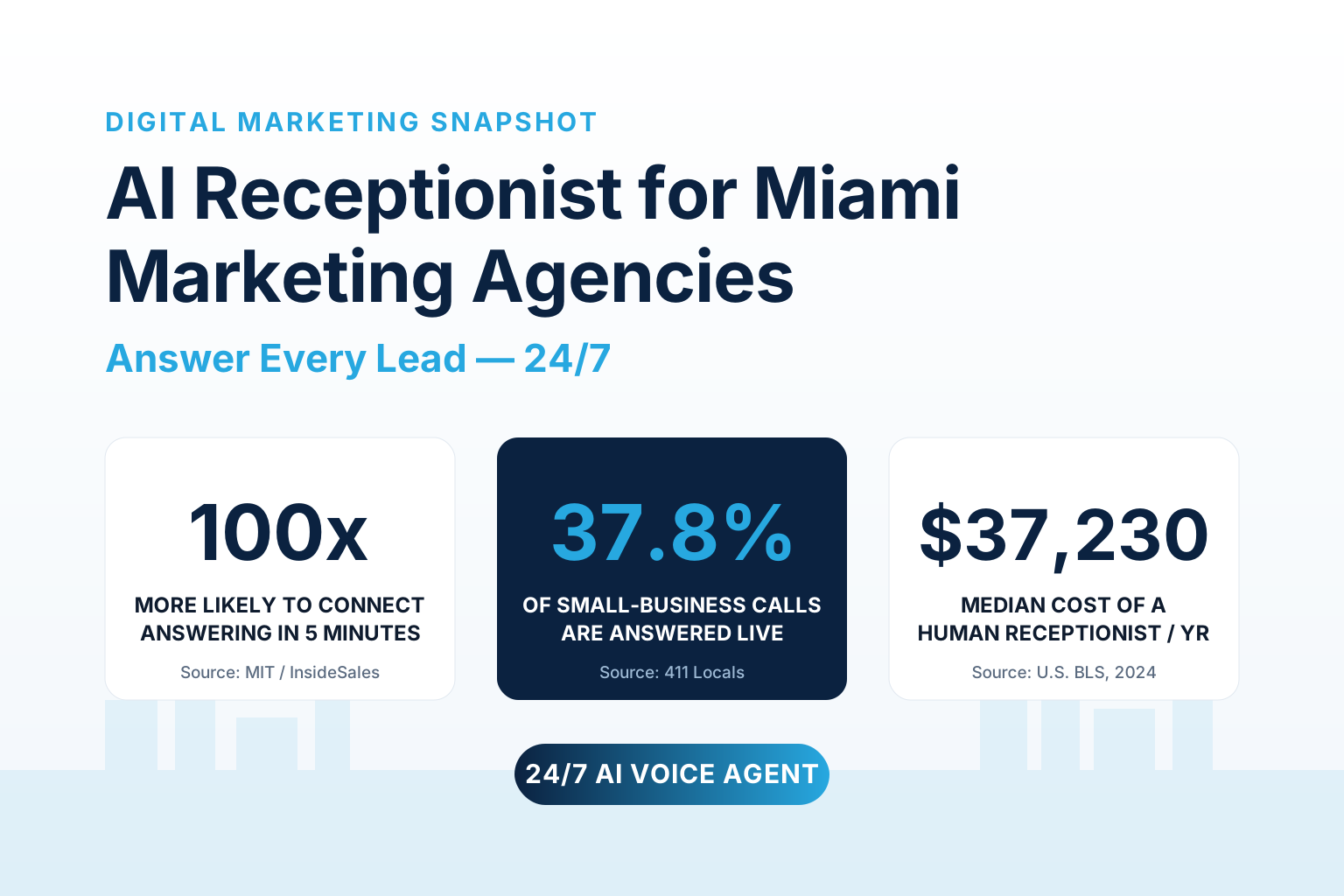
Table of contents
- What is an AI receptionist for a marketing agency?
- Why Miami agencies leak leads at the phone
- The speed-to-lead math: minutes decide the deal
- What an AI receptionist actually does
- The cost case: human receptionist vs AI
- AI answering has gone mainstream
- Why this matters more in Miami
- Resell the AI receptionist to your clients
- FAQ
What is an AI receptionist for a marketing agency?
An AI receptionist is a natural-sounding voice agent that answers your inbound phone calls automatically, holds a real conversation, asks your qualifying questions, and books the appointment onto your calendar — around the clock, without a human picking up. For a marketing agency it plays two roles at once: it catches your own new-business calls when you’re heads-down in client work, and it’s a service you can deploy for the local clients you already manage.
Think of it as the front-desk closer who never sleeps, never goes to lunch, and never lets a call roll to voicemail. When the phone rings at 7 p.m. — or while you’re mid-pitch — the AI answers on the first ring instead of sending the caller to the next agency in the search results.
Why Miami agencies leak leads at the phone
No agency owner decides to miss calls. It happens the way most margin leaks happen — quietly, one busy hour at a time. You’re on a client Zoom, editing a campaign, or at dinner, and the phone rings. The caller gets voicemail, hangs up, and taps the next result. You never even know the lead existed.
The data says this is the norm, not the exception. Only about 37.8% of calls to small businesses are answered by a live person, meaning roughly 62% go unanswered or land in voicemail (411 Locals). And the phone still matters more than agencies think: inbound calls have historically converted to customers at a far higher rate than web-form fills (BIA/Kelsey). A missed call isn’t a missed contact — it’s a missed closer-ready buyer.
Where inbound calls to small businesses go, % of calls. Source: 411 Locals, 30-day study of 85 businesses across 58 industries.
The web form is no safer. The average company takes 42 hours to respond to an inbound web lead, and 23% never respond at all (Harvard Business Review). Whether the lead calls or fills a form, the failure mode is the same: nobody gets to them fast enough. This is the same speed-to-lead principle we preach for client campaigns — it applies just as ruthlessly to your own front door.
The speed-to-lead math: minutes decide the deal
Here’s why “we’ll call them back tomorrow” quietly kills your pipeline. The landmark MIT / InsideSales Lead Response Management Study — three years of data across thousands of leads and 100,000+ call attempts — found that contacting a web lead within 5 minutes versus waiting 30 minutes made a company about 100x more likely to connect with the lead and 21x more likely to qualify it (Lead Response Management).
Those aren’t rounding errors — they’re the difference between a booked call and a dead record. The odds of a real conversation fall off a cliff within the first hour, which is exactly why an agent that answers on the first ring beats a human callback every single time.
What an AI receptionist actually does
The magic isn’t just “it answers.” It runs the full front-desk playbook, then hands you a warm, qualified, booked lead. Here’s the path a call takes:
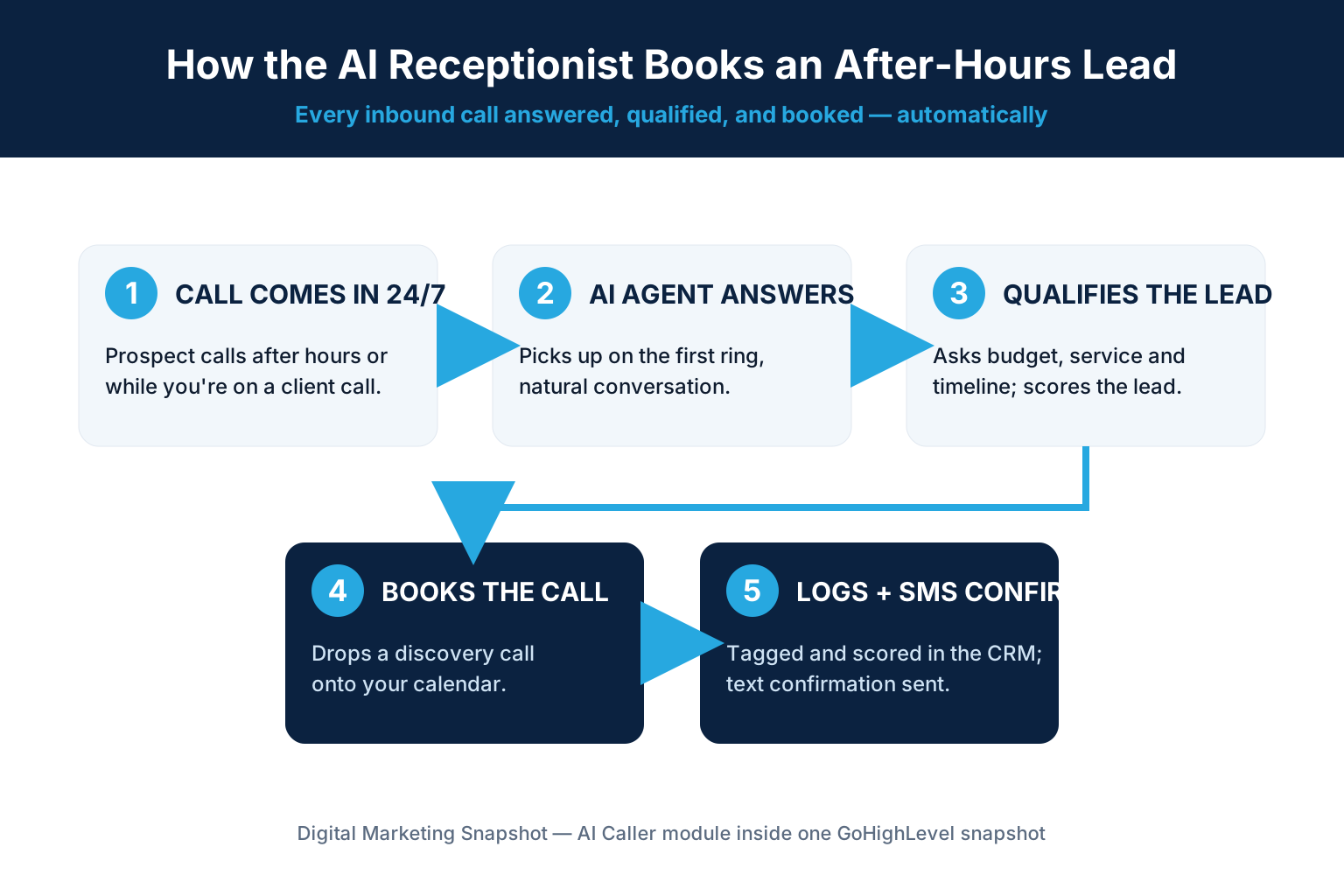
- Call comes in 24/7 — day, night, weekend, or while you’re on another call.
- The AI voice agent answers instantly — natural conversation, your greeting and brand name, no robotic phone tree.
- It qualifies the lead — asks your custom questions (budget, service, timeline) and scores them.
- It books the appointment — drops a discovery call straight onto your calendar during the conversation.
- It logs everything — the call summary, tags, and lead score land in your CRM, and the caller gets an SMS confirmation.
In our snapshot, this is the AI Caller module, and it doesn’t work in isolation — every call it handles flows into the same workflows that run your nurture, reminders, and reporting. You get a lead that’s already qualified, booked, and attributed — not a voicemail to return three hours late.
The cost case: human receptionist vs AI
The obvious alternative is hiring someone to answer the phone. The math doesn’t favor it. A receptionist in the U.S. earns a median wage of $37,230 a year (U.S. Bureau of Labor Statistics) — and that’s before payroll taxes, benefits, PTO, and the reality that one person still can’t cover nights, weekends, or two calls at once.
Approximate annual cost to answer your calls. Human figure: U.S. BLS 2024 median receptionist wage (before benefits/taxes). AI figure illustrative — actual pricing varies.
An AI receptionist inverts every line of that comparison:
Human receptionist vs AI receptionist
| Plan | Human receptionist | AI receptionist (in the snapshot)Recommended |
|---|---|---|
| Price | $37,230/yr median | Flat monthly |
| Feature 1 | 9–5, one shift | 24/7 — nights & weekends |
| Feature 2 | One call at a time | Unlimited calls at once |
| Feature 3 | Sick days & turnover | Never sick, never quits |
| Feature 4 | Books to calendar (if trained) | Books to calendar automatically |
| Feature 5 | Weeks to hire & train | Live within 24 hours |
| See the AI Caller → |
This isn’t about replacing a great human team — plenty of agencies keep one. It’s about making sure that the calls your team can’t physically get to (after hours, during pitches, over the weekend) still get answered, qualified, and booked instead of lost.
AI answering has gone mainstream
If “AI answering the phone” still sounds futuristic, the market has already moved. The global conversational-AI market is projected to grow from about $11.58 billion in 2024 to $41.39 billion by 2030 — a compound annual growth rate near 24% (Grand View Research). And it’s not just early adopters: 83% of service organizations now use AI in some form (Salesforce State of Service).
Global conversational-AI market size, USD billions. Source: Grand View Research, 2024.
For agencies, the takeaway is simple: your prospects are already comfortable talking to a capable AI when it resolves their question fast. The differentiator now isn’t whether you use AI on the phone — it’s whether yours answers, qualifies, and books better than the agency competing for the same call. (For the broader picture, see our guide to AI for marketing agencies.)
Why this matters more in Miami
Speed-to-lead is a national advantage, but in Miami it’s closer to a survival trait. Florida is one of the densest agency markets in the country — IBISWorld counts thousands of advertising agencies statewide (IBISWorld), heavily concentrated in South Florida. When a prospect searches “marketing agency Miami” or “SEO company near me” on their phone, they’re not scrolling patiently. They call the first result, and if it doesn’t answer, they call the next.
There’s also a sheer-volume angle. Miami-Dade County is home to roughly 95,916 employer establishments (U.S. Census) — a massive base of local businesses that both hire agencies and need this exact capability themselves. Every one of those businesses is a potential agency client, and every one of them misses calls too.
Resell the AI receptionist to your clients
Here’s the part most agencies miss: the AI receptionist isn’t just an internal tool — it’s a new retainer line item. Every local business you serve has the same missed-call problem, and few of them will build a voice agent themselves. You can deploy the same AI Caller on a client’s number, brand it as your own, and bill it monthly as part of fulfillment.
That turns a cost center into margin. A single done-for-you GoHighLevel snapshot gives you the AI Caller plus the CRM, SMS, review, and booking automations behind it — so you can roll it out across your whole client roster without rebuilding anything. It’s exactly the kind of high-value, low-effort service that grows a retainer without adding headcount.
FAQ
AI receptionist for Miami agencies — quick answers
What is an AI receptionist for a marketing agency?
It's a natural-sounding AI voice agent that answers your inbound calls 24/7, holds a real conversation, asks your qualifying questions (budget, service, timeline), books the appointment onto your calendar, and logs the lead into your CRM. For an agency it works on your own line to catch new business, and it can be deployed for the clients you manage.
How is an AI receptionist better than voicemail or a callback?
Speed. The MIT/InsideSales study found that contacting a lead within 5 minutes instead of 30 makes you about 100x more likely to connect and 21x more likely to qualify them. Voicemail and next-day callbacks miss that window; an AI that answers on the first ring hits it on every call, at any hour.
How much does an AI receptionist cost compared to hiring someone?
A human receptionist earns a median $37,230 a year before benefits and taxes (U.S. BLS, 2024) and still can't cover nights, weekends, or two calls at once. An AI voice agent covers every hour for a flat monthly fee. In our snapshot the AI Caller is included in the one-time $997 build with no monthly fee from us.
Will callers know it's an AI?
It holds a natural conversation rather than a robotic phone tree — you set the greeting, tone, and brand name. The goal isn't to trick anyone; it's to answer instantly, qualify well, and book the call so the lead never rolls to voicemail and dials a competitor.
Can a Miami agency resell the AI receptionist to its own clients?
Yes. You can deploy the same AI Caller on a client's number, brand it as your own, and bill it as part of a monthly retainer. Because it ships inside one GoHighLevel snapshot alongside the CRM, SMS, and booking automations, you can roll it out across your whole client roster without building anything from scratch.
How fast can it go live?
The AI Caller installs with the snapshot and is answering calls from your GoHighLevel account within 24 hours. You customize the greeting, qualifying questions, and which calendars get booked, then point your number at it.
Written by Callan Reeves, Performance Marketing & Attribution Lead. Callan came up on the media-buying side managing seven-figure ad budgets, then rebuilt the tracking stack inside GoHighLevel so every conversion ties back to a campaign. He writes about speed-to-lead, attribution, and proving the ROI clients actually believe.
Related reading: Speed-to-Lead for Agencies · Missed-Call Text-Back for Agencies · AI for Marketing Agencies · Lead Attribution That Proves Your ROI