
You sat through the demo. The rep was sharp, the product looked clean, and the number they led with was $20 a month. Then the proposal landed: a Marketing Hub Professional plan near nine hundred dollars a month, a one-time onboarding fee with a comma in it, and a line about “marketing contacts” nobody explained. That gap between the sticker and the invoice is the whole story, so let me take it apart.
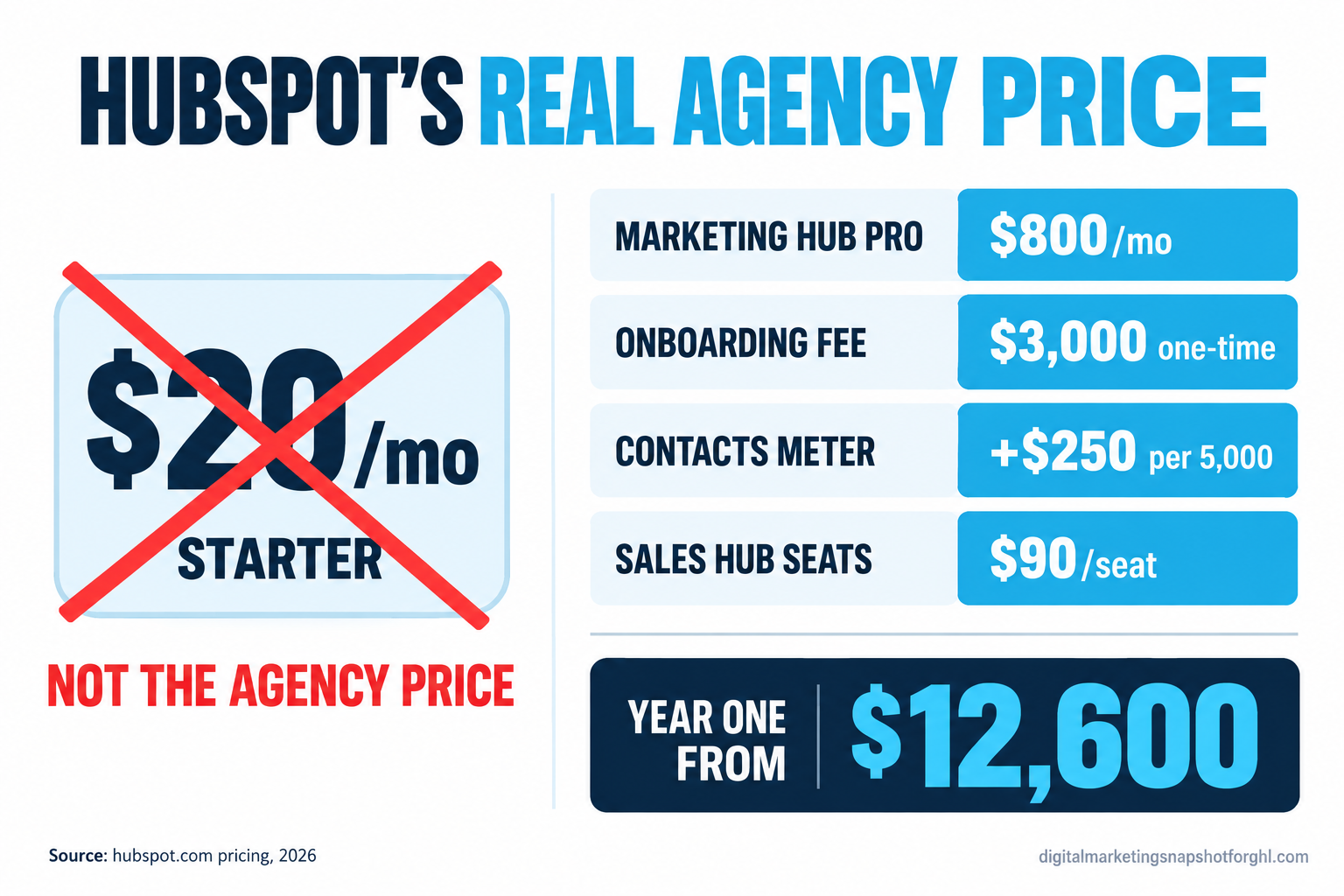
Here is the short version. The $20 sticker is Starter, and Starter does almost nothing an agency needs. The plan a client-facing agency actually runs is Marketing Hub Professional at $800 a month on annual billing (about $890 month to month), carrying a mandatory $3,000 one-time onboarding fee before you send a single email (HubSpot’s own pricing page). On top sits a marketing-contacts meter that raises your bill every time your lists grow, plus per-seat Sales Hub if your team works deals. The first-year number is routinely five figures, and almost none of it is the price you were quoted.
On this page
- Why the sticker and the agency price differ
- The four lines that make up a real HubSpot bill
- The onboarding fee nobody quotes
- The marketing-contacts meter that punishes growth
- Three scenarios: solo, 10-person, 20-plus
- Steal this: the year-one cost worksheet
- How the plan breaks, and the compliance bill
- The flat-platform fix and objections
- FAQ
Why the sticker and the agency price are different numbers
Every software vendor puts its cheapest plan on the billboard, and HubSpot’s is Starter at about $20 per seat, sometimes as low as $7 on an annual commitment for new customers. The trouble is what Starter can do: a light CRM with simple email and forms, no real automation workflows, thin reporting, and hard caps you hit fast. For an agency that runs campaigns and needs automation that branches, Starter is a trial, not a tool.
The plan that does what an agency means by “marketing software” is Marketing Hub Professional. That is where workflows, campaign tools, custom reporting, and the automation you pictured in the demo actually live. So the honest comparison is never “HubSpot is twenty dollars.” It is “HubSpot Professional is eight hundred dollars a month, plus an onboarding fee, plus a meter.” Quote yourself the Starter number and you will underbudget by an order of magnitude. It matters more for agencies because you hold one contract while serving several clients’ audiences through it, and every one of those audiences is contacts HubSpot meters.
The four lines that make up a real HubSpot bill
A HubSpot invoice for an agency is almost never one number. It is four lines stacked together.
Line one: the base plan. On annual billing, HubSpot publishes Starter at about $20 per seat, Professional at $800 a month (3 seats, 2,000 contacts), and Enterprise at $3,600 a month (5 seats, 10,000 contacts) (hubspot.com/pricing/marketing). Month-to-month, Professional is nearer $890.
HubSpot Marketing Hub tiers, annual billing (2026)
| Plan | Starter | ProfessionalRecommended | Enterprise |
|---|---|---|---|
| Price | $20/seat/mo | $800/mo | $3,600/mo |
| Feature 1 | Simple email + forms | Full automation workflows | Advanced reporting + teams |
| Feature 2 | 1,000 marketing contacts | 3 seats, 2,000 contacts | 5 seats, 10,000 contacts |
| Feature 3 | No real workflows | Extra seats $45/mo | Extra seats $75/mo |
| Feature 4 | No onboarding fee | $3,000 onboarding fee | $7,000 onboarding fee |
| The agency tier |
Line two: the onboarding fee. Professional and Enterprise both carry a mandatory one-time implementation fee, covered next.
Line three: extra seats. The included seats run out quickly. Additional Marketing Hub core seats start at $45 a month on Professional and $75 on Enterprise. If you want Sales Hub so your team can work a pipeline, that is a separate per-seat charge of about $90 a seat annually (hubspot.com/pricing/sales), with its own onboarding fee.
Line four: the marketing-contacts meter. This is the one that moves. Included contacts are a starting bucket, and every block beyond it costs more each month, forever. For an agency whose job is building audiences, this is the line that quietly doubles over a year.
Stack those four lines and you have the real price. Miss any and your budget is wrong.
The onboarding fee nobody quotes
This is the biggest surprise on a first HubSpot invoice. Buy Professional or Enterprise and HubSpot charges a one-time onboarding fee, separate from the subscription and generally non-refundable: $3,000 for Professional and $7,000 for Enterprise on Marketing Hub, confirmed on HubSpot’s public pricing page. Sales Hub Professional adds $1,500, Enterprise $3,500.
That money buys guided setup, not a discount on anything. It does not repeat, but it lands in the first month on top of your first subscription payment. A solo who budgeted $800 a month sees a first invoice closer to $3,800, and a shop buying both Marketing and Sales Professional sees the two fees ($3,000 and $1,500) stack into $4,500 before the subscriptions start.
One lever is worth knowing. The fee can sometimes be reduced or waived if you buy through an accredited HubSpot partner, depending on your annual contract size. That is a negotiation, not a published discount, so budget the full fee and treat any waiver as upside.
The marketing-contacts meter that punishes growth
Here is the mechanic that makes HubSpot a scaling problem for agencies. It does not bill for every record. It bills for marketing contacts, the people you actively market to with emails and ads. Professional includes 2,000, Enterprise 10,000, and past that you buy blocks. Third-party trackers put the Professional overage at roughly $250 a month per additional 5,000 contacts (Avidly’s breakdown of HubSpot contact pricing).
Read that with an agency brain. Your product is building audiences. The thing you are paid to grow, lists and reach, is exactly what HubSpot meters. Win a client with a 20,000-person list to nurture and you have not added one line to your service, but you have added about $1,000 a month to your HubSpot bill.
One nuance is both real and a trap. The tiers auto-upgrade when you cross a threshold but do not auto-downgrade when a list shrinks, so a one-time import for a campaign can bump you into a higher block you keep paying for long after the campaign ends.
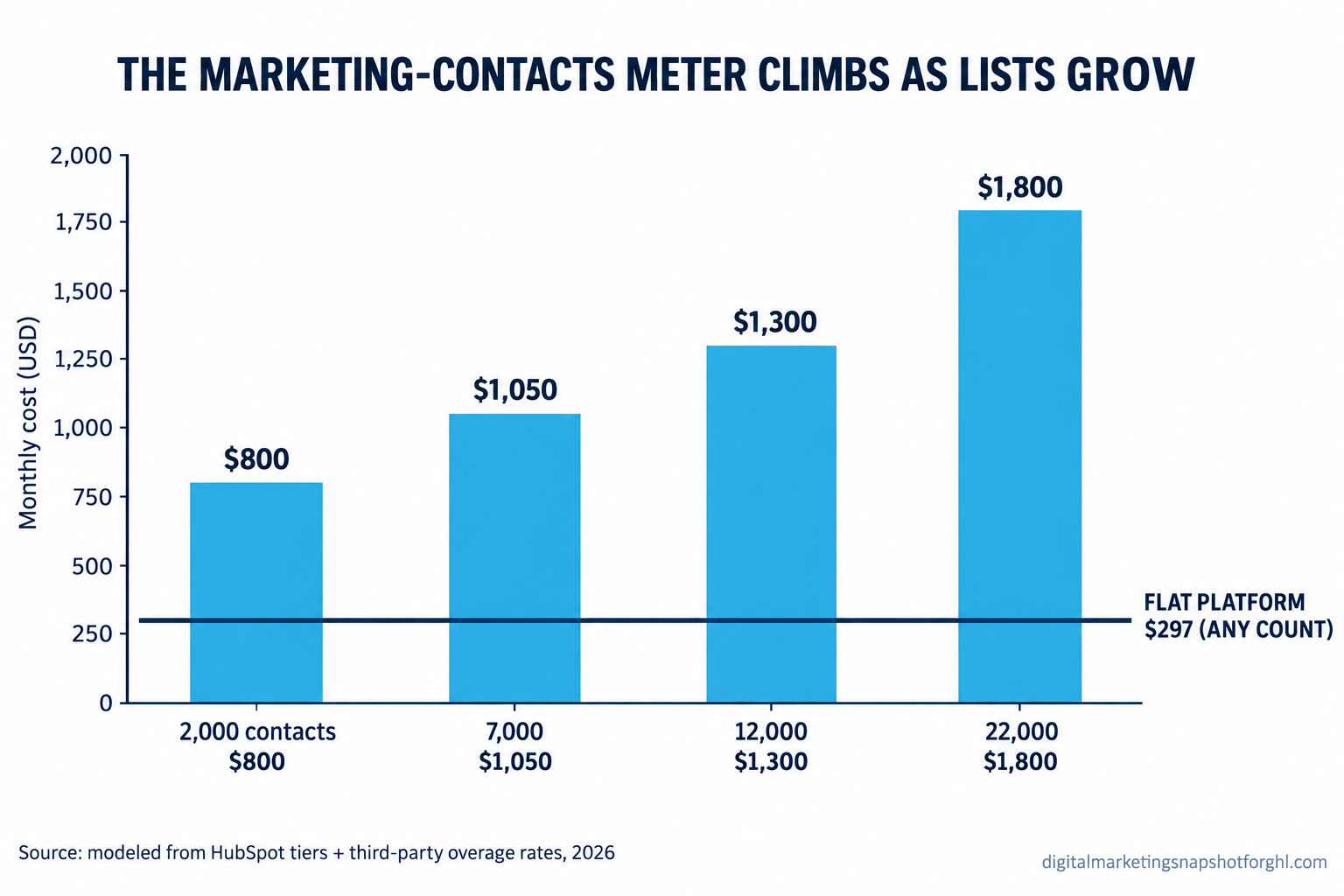
This is the same shape as AgencyAnalytics billing per client: a variable cost bolted onto the part of the business you most want to expand. HubSpot adds a second axis, seats, so the bill climbs when you win clients and again when you hire to serve them.
Three scenarios: solo, 10-person, 20-plus
Published per-unit prices only matter when you run them for a real shop. The numbers below are modeled from HubSpot’s base prices plus third-party overage rates, so treat them as a realistic model, not a quote. The exact figure depends on your contacts and seats; the shape does not: a four-figure monthly bill and a five-figure first year.
Solo operator, lean. Marketing Hub Professional at $800 a month with the included 3 seats and 2,000 contacts, lists kept small. Subscription is $9,600 a year, and the one-time $3,000 onboarding makes your first year about $12,600, roughly $1,050 a month across year one, dropping to $800 after. That is before Sales Hub or a single extra contact block, and it is a serious fixed cost against uneven cash flow between retainers.
Ten-person team, twenty clients. Now the meter runs. Say you need about 12,000 marketing contacts (two blocks over the included 2,000, about $500 a month) and six seats (three extra at $45, about $135). That is near $1,435 a month on Marketing Hub alone. Add two Sales Hub Professional seats at $90 ($180) and software runs about $1,615 a month. Year one adds both onboarding fees ($3,000 and $1,500), landing near $23,880, then about $19,400 after.
Twenty-plus team, forty clients. Most agencies this size are pushed to Enterprise for the reporting and team controls: $3,600 a month with 10,000 contacts and 5 seats. Push to 25,000 contacts and five extra seats at $75 and you are near $4,600 a month, before Sales Hub seats. Add the $7,000 onboarding and the first year clears $55,000, and climbs with every new client list and hire.
First-year total cost in USD, modeled from published per-unit prices. Flat platform shown at $297/mo and $497/mo with no onboarding fee. Source: hubspot.com and gohighlevel.com pricing, 2026.
The point is not that HubSpot is bad software. It is excellent, and large companies happily pay these numbers. It is simply priced for companies, not for a lean agency that grows by stacking clients onto one account.
Steal this: the year-one cost worksheet
Before any demo, run the real number yourself. Copy this into a note and fill it in with your own counts. It takes two minutes, and it is the figure the rep will not lead with.
Doing this once reframes the shopping trip. An $800 monthly plan is not an $800 decision. It is a $12,600 first-year decision at minimum, and larger the second you add contacts and seats.
How the HubSpot-as-agency-hub plan breaks
Price is half the story. The other half is what goes wrong when a small agency runs everything through HubSpot. These are the failure modes I see most.
The onboarding fee hits before value does. You pay $3,000 up front, then spend weeks in setup before the platform does anything for a client. For a cash-tight shop that is real money out the door during the slowest possible ramp. Fix: do not buy until you have a specific client or offer that pays for it inside ninety days, and build the fee into that client’s first invoice.
The contacts meter creeps past the budget. You modeled 2,000 contacts, then a client handoff and a lead-magnet campaign push you to 9,000 and the bill jumps by hundreds a month. The upgrade is automatic; the downgrade is not. Fix: audit marketing contacts monthly, mark dormant records non-marketing, and clean lists before you import, not after.
Seat creep punishes every hire. Every person who touches the platform is another seat, and the useful seats are not cheap. A contractor added for one project keeps costing until you pull them. Fix: review seats quarterly and remove anyone who has not logged in, because dormant seats are the quietest leak in the stack.
You still bolt on tools HubSpot does not do well. Two-way SMS at scale, call tracking, a true white-label client portal, review collection with compliance guardrails: these are weak or absent, so agencies pay enterprise prices and still run a stack. Fix: list what HubSpot genuinely replaces for your clients before you buy.
Leaving is expensive on purpose. Once your workflows and reporting live in HubSpot, the switching cost is the rebuild, not the subscription. Fix: keep your templates and automations documented outside the tool so a future move is a migration, not a from-scratch rebuild.
The compliance cost nobody prices in
Whatever platform you land on, the moment you message leads on a client’s behalf you inherit rules a CRM subscription does not cover. It is a cost of doing the work, the same on HubSpot as anywhere else, so price it in.
For SMS, US carriers require A2P 10DLC registration, and when you send on behalf of clients you generally need a reseller relationship so each client is registered as its own brand. Get it wrong and carriers filter or block the texts, a fulfillment failure you are paying to cause (Twilio’s A2P 10DLC overview). Full walkthrough: A2P 10DLC registration for agencies.
For email, every send on a client’s behalf is governed by CAN-SPAM. For reviews, the FTC’s revised Endorsement Guides (2023) ban fake and incentivized reviews and remove the old “results not typical” defense (the FTC’s Endorsement Guides). None of this appears on a pricing page, and it is your problem in as many places as your stack has tools. The plainer version is in FTC review rules for agencies.
The flat-platform fix
HubSpot’s two biggest variable lines, marketing contacts and seats, bill on the two axes you most want to grow. A cheaper CRM just moves the same meter. What fixes it is a platform where the price stops moving when you add contacts or people.
That is the case for a flat platform like GoHighLevel, which publishes plans at $97, $297, and $497 a month and bundles a CRM, two-way SMS, email, client-facing reporting, booking, review requests, and a white-label portal into one fee that does not change when you sign your eleventh client or import a 30,000-person list (GoHighLevel publishes its pricing here. That is our affiliate link, and we may earn a commission if you start an account through it.) Against the 10-person scenario above, that is roughly $1,615 a month climbing with every win versus a flat $297. Many agencies that leave HubSpot keep a light CRM for sales and move the client-facing work onto one flat platform, which is how you scale without adding headcount.
Objections
“HubSpot is the industry standard, though.” For enterprise marketing teams, yes, and if your clients expect HubSpot, run it and bill it. For a lean agency serving small and mid-size clients, “standard” is not the same as “right-priced.” Pay for the brand name only when a client is paying you to use it. The fuller feature view is in the HubSpot versus a flat platform comparison.
“The $20 plan is fine to start.” Starter is fine to learn the interface, not to run client marketing: the automation, reporting, and contact headroom all live on Professional. Starting on Starter usually means paying twice, once to learn it and once to migrate up and pay the onboarding fee you thought you had dodged.
“The onboarding fee is worth it for proper setup.” Sometimes. With no ops capacity and a complex rollout, guided setup earns its fee. For a two-person shop that can follow documentation, $3,000 is two months of a flat platform with room to spare.
“Switching off HubSpot sounds worse than the bill.” The subscription is easy to cancel; the rebuild of workflows and dashboards is the real cost, which is why you move once and on purpose. Make the decision to get in with the full year-one number in front of you, because a bill that climbs on two axes eats the margin growth was supposed to add, which is the whole story of why agency margin shrinks as you grow.
“Can I keep contacts non-marketing to beat the meter?” Partly. You should mark genuinely dormant records non-marketing, but the audiences you are paid to nurture must be marketing contacts to receive campaigns. The lever trims the bill; it does not change the shape.
FAQ
How much does HubSpot actually cost an agency in 2026?
The agency tier is Marketing Hub Professional at $800 a month on annual billing (about $890 monthly), with 3 seats and 2,000 marketing contacts, plus a mandatory one-time $3,000 onboarding fee. Realistic year-one totals run about $12,600 for a lean solo, about $24,000 for a 10-person shop, and north of $55,000 for a 20-plus team on Enterprise.
Does HubSpot really charge a mandatory onboarding fee?
Yes. Marketing Hub Professional carries a one-time $3,000 fee and Enterprise $7,000, confirmed on HubSpot's pricing page; Sales Hub Professional adds $1,500 and Enterprise $3,500. The fees are generally non-refundable and land in your first month. An accredited partner can sometimes reduce or waive them.
What are HubSpot marketing contacts and why do they raise the bill?
Marketing contacts are the people you actively email or advertise to. Professional includes 2,000 and Enterprise 10,000; beyond that you buy blocks at roughly $250 a month per extra 5,000 on Professional. Because an agency grows by building audiences, the meter climbs with the exact thing you are paid to expand.
Is HubSpot Starter enough for an agency?
No. Starter at about $20 per seat is a light CRM with simple email and forms, no real automation workflows, and low caps. The automation and reporting an agency needs live on Professional, so starting on Starter usually means migrating up later and paying the onboarding fee anyway.
How does HubSpot pricing compare to a flat platform like GoHighLevel?
GoHighLevel publishes plans at $97, $297, and $497 a month bundling CRM, two-way SMS, email, client reporting, booking, reviews, and a white-label portal in one fee that does not change with contacts or seats, with no onboarding fee. Against a 10-person HubSpot setup near $1,615 a month plus onboarding, a flat $297 replaces the core of the client-facing stack.
What is the real first-year cost, not the monthly rate?
Take the monthly subtotal (base plan plus extra seats plus extra contact blocks plus any Sales Hub seats), multiply by twelve, then add the one-time onboarding fees. For Marketing Hub Professional alone that is $800 times 12 plus $3,000, about $12,600, before growth. Always compare the year-one total, never sticker against sticker.