
It was a Tuesday and the email was two lines long. “We’ve decided to bring marketing in-house. This will be our last month.” You read it twice. That client renewed three months ago. They were, as far as you knew, fine.
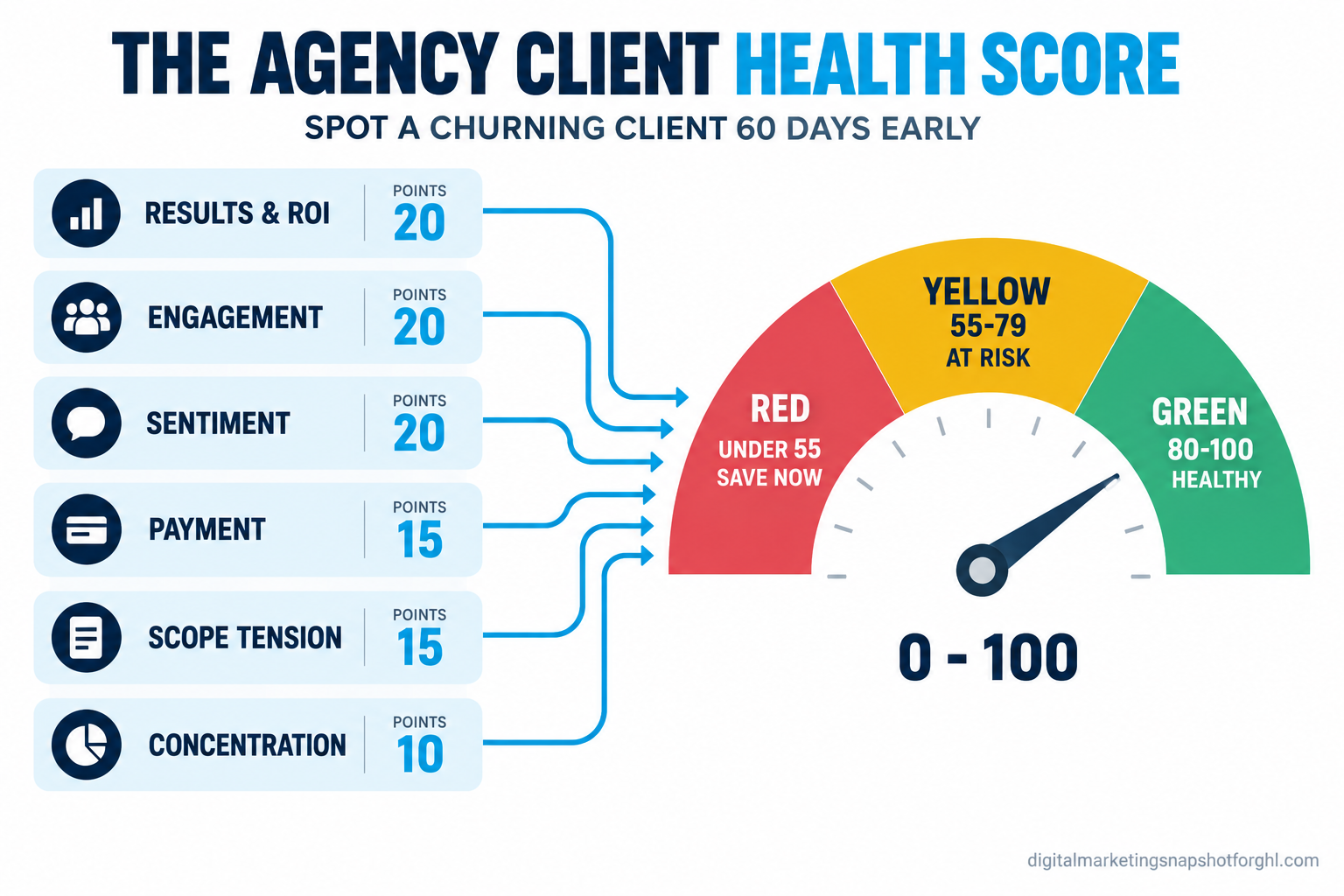
They were not fine. They had gone quiet in September, skipped the October call, paid late twice, and stopped opening your reports in August. The cancellation did not come out of nowhere. It came out of four signals you were too busy to notice. A client health score notices for you: a single number, updated monthly, that tells you which accounts are safe, which are drifting, and which you have about 60 days to save. Below is the template, the six signals that feed it, how to read it, and the copy you use when a score turns red.
Table of contents
- What a client health score actually is
- What silent churn is quietly costing you
- The six signals that predict a cancellation
- Signal 1: results and ROI delivered
- Signal 2: engagement and responsiveness
- Signal 3: payment behavior
- Signal 4: relationship and sentiment
- Signal 5: scope tension and support load
- Signal 6: concentration and tenure
- Turning six signals into one 0-100 score
- Reading the score: green, yellow, red
- The intervention playbook (steal this copy)
- Run it for your size: solo, mid, and 20-plus
- The compliance note on health check-ins
- Objections, answered honestly
- FAQ
What a client health score actually is
A client health score is one number, from 0 to 100, that estimates how likely a client is to stay. You build it from signals you can already see, update it on a set cadence, and act on it by band.
It matters because of timing. Most agencies track churn, a lagging metric: by the time your churn rate moves, the client is gone and the money is lost. A health score is a leading metric: the number drops in September and hands you October and November to act. The catch for agencies is that the score usually lives in the founder’s head, which works right until the founder gets busy. Writing it down is the whole trick.
What silent churn is quietly costing you
Losing a client you never saw coming costs more than the retainer. You also lose the time you spent winning them and the chance to replace them first.
Billable utilization, the share of your team’s paid hours a client actually funds, fell to 66.4% in 2025, the lowest in the 19-year history of the benchmark, against the 75% high performers still reach (SPI Research 2026, 509 firms). When an account churns without warning, the team on it sits idle while you scramble.
Replacing that revenue is hard. Only about 14% of agencies describe their sales pipeline as healthy, and referrals remain the biggest single driver of new business (SparkToro 2025). Retention also pays better than acquisition: Bain’s long-running research found a 5% rise in customer retention can lift profits by more than 25% (Bain & Company). You do not need to win more clients to make more money, you need to lose fewer. For the dollar figure at your shop, use the client churn rate calculator.
The six signals that predict a cancellation
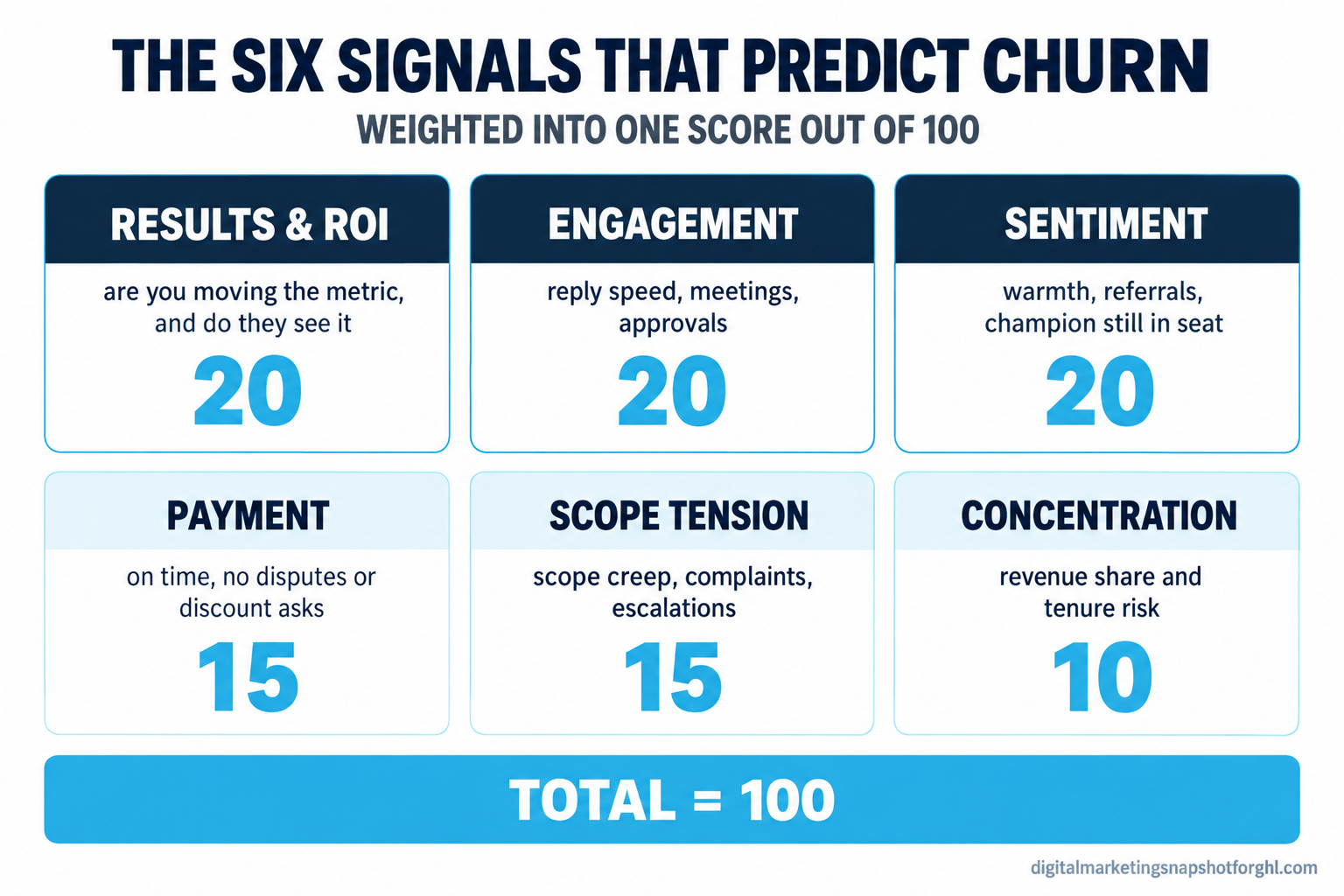
A client about to leave sends signals for weeks before they say a word. The score reads six of them, each scored, then weighted so the leading behavior-based ones count more. A signal you cannot measure yet gets a neutral middle score, not a guess dressed up as data.
Signal 1: results and ROI delivered (20 points)
Are you moving the metric you were hired to move, and does the client see it? Score it high when results are strong and visible, low when they are flat or invisible. The “visible” half is where agencies lose accounts they are serving well. If nobody opens the report, your real value is zero in their head.
How it breaks. You deliver great work and the proof sits in a dashboard nobody logs into, so perceived value hits the floor. The fix is a report they open, built from a white-label reporting dashboard and lead attribution that ties outcomes to your work, which is itself one of your best churn defenses.
Signal 2: engagement and responsiveness (20 points)
Is the client still leaning in? Score reply speed, meeting attendance, approval times, and whether they open what you send. This is the single clearest early warning there is. A client who used to reply in an hour and now takes four days, and reschedules twice, is telling you something.
How it breaks. You read silence as contentment. “I haven’t heard from them, so they must be happy.” Silence is usually the opposite: a checked-out client gives you nothing, then gives you notice.
Signal 3: payment behavior (15 points)
Are they paying on time and without friction? Score on-time payment high; score late payments, card declines, disputes, and sudden requests to pause or discount as the warnings they are. A client renegotiating price mid-contract, or quietly paying ten days late every month, is often already halfway out the door. Money is honest.
How it breaks. You file a late payment under “admin hiccup” instead of treating it as a signal. Let your billing system flag the pattern automatically, as in automating retainer billing, dunning, and renewals.
Signal 4: relationship and sentiment (20 points)
How does the client actually feel, and is your champion still in the building? Score warmth, whether they refer you, whether they leave a public review, and whether the person who hired you still has their job. Anchor the soft part with a quarterly one-question check-in (“on a scale of one to ten, how likely are you to recommend us?”) that turns a feeling into a number. And watch the org chart, because losing your champion to a new job is a top reason a healthy account churns: the new buyer never chose you.
How it breaks. You track your day-to-day contact’s mood and miss that the economic buyer above them changed in October. When you ask for reviews here, keep it clean: the FTC’s rules ban incentivized or filtered reviews, covered in FTC review rules for agencies.
Signal 5: scope tension and support load (15 points)
Is the relationship getting heavier to carry? Score a smooth, in-scope account high; score rising “can you also just” requests, complaints, and escalations as friction that predicts a breakup. Tension cuts both ways. A client grinding you on scope is frustrated, and frustrated clients churn. Absorbing that scope silently is worse: now you resent the account and your margin bleeds.
How it breaks. You eat the extra work to keep the peace, so the tension never shows up until you are exhausted and underpaid. Make it visible with a change-order habit and a tight agreement, covered in why scope creep kills your agency and the retainer agreement template.
Signal 6: concentration and tenure (10 points)
How exposed are you if this one leaves, and how settled is the relationship? Score two things. Tenure: brand-new accounts in their first 90 days are fragile and deserve a lower score until they prove sticky. Concentration: a client who is 30% of your revenue is a bigger risk to you than one who is 3%. This signal is lighter weight because it sizes your exposure, not the client’s intent. It is the risk multiplier: a yellow on a 2% client is a task, a yellow on a 30% client is a fire drill.
How it breaks. You feel comfortable because revenue is up, without noticing most of the growth came from one account that now owns your payroll. Read how agencies smooth cash flow between retainers and diversify before the score forces you to.
Turning six signals into one 0-100 score
Score each signal from zero to its maximum, add them up, and you have a number out of 100. Here is the full template.
| Signal | What a top score looks like | Max points |
|---|---|---|
| Results and ROI delivered | Strong results, and the client sees them | 20 |
| Engagement and responsiveness | Fast replies, shows up, approves quickly | 20 |
| Relationship and sentiment | Warm, refers you, champion still in seat | 20 |
| Payment behavior | On time, no disputes, no discount asks | 15 |
| Scope tension and support load | In scope, low friction, few escalations | 15 |
| Concentration and tenure | Past 90 days, not an outsized revenue share | 10 |
| Total | 100 |
The weighting is the point. Results, engagement, and sentiment carry 20 each because they move first and predict hardest. Payment and scope carry 15 because they only confirm what those leading signals already hinted, and concentration carries 10 because it sizes your exposure, not the client’s intent.
The point weight of each signal in this health-score template, out of 100. The three leading, behavior-based signals carry more weight than the confirming ones, because they move first.
Do not over-engineer the scoring inside each signal. A simple scale works: full points for “clearly good,” half for “fine but watch it,” zero for “clearly a problem.” You are building a tripwire, not a credit model.
Reading the score: green, yellow, red
The number needs a rule for each level. Three bands, three plays.
| Band | Score | What it means | What you do |
|---|---|---|---|
| Green | 80-100 | Healthy and sticky | Nurture, ask for a review or referral, look for expansion |
| Yellow | 55-79 | Drifting, at risk | Intervene this week: surface a win, book a call, re-establish value |
| Red | Under 55 | Likely to churn in 60-90 days | Run the save play now: senior-level call, honest reset, or managed offboard |
Two rules make the bands work. First, watch the trend, not just the snapshot: a client at 72 is fine, but one who was 90 last month is now your most urgent account. Second, let concentration override the band: a yellow on a client who is a fifth of your revenue gets handled like a red.
The intervention playbook (steal this copy)
A score only helps if a yellow or red triggers action. Here is the copy and cadence for each band; change the names and send.
The green play: ask while they are happy. A green client is your referral and review engine, so put it to work.
The yellow play: re-establish value within a week. A yellow is a drift, not a death. Remind them, specifically, why they pay you, and get back on a call. Do not wait for the monthly report; reacting fast is the whole point of a leading indicator.
The red play: get senior, get honest, get on the phone. A red account needs the owner, not the account manager, and a real conversation, not an email. The goal is one answer: can this be saved, and at what terms?
That last line matters. Offering a clean exit is not weakness, it is how you keep the relationship, the referral, and your reputation even when the account ends. Whatever the band, start renewal talks 60 days out, and pair the score with a retainer structure built to renew itself.
Run it for your size: solo, mid, and 20-plus
The score is the same at every size. How you run it is not.
Solo and very small (1 to 3 people). Keep it in a spreadsheet, one row per client, scored monthly, about five minutes each. You carry most of it in your head already, so the job is writing it down so a busy month cannot erase it. Trust your gut on sentiment, but force yourself to check the hard signals, because that is where your gut lies to you: did they pay on time, did they reply, did they open the report.
Mid-size (4 to 20 people). Here the score stops being optional, because you are no longer the only person touching clients. Assign an account owner per client, score every account monthly in your CRM, and review every yellow and red in a 20-minute standup. Pull the objective signals automatically: payment status, response time, report opens, so judgment only has to handle sentiment and scope.
Large (20-plus). Make it a dashboard and automate scoring from CRM fields. Trigger workflows off the band: yellow creates a task for the account manager, red alerts the owner that day. Track the trend per account and the average across the book as a KPI, which flags a whole segment slipping, not just one client.
The compliance note on health check-ins
A health score pushes you to reach out more, which is good, but the outreach still follows the rules. If your check-ins, renewal nudges, or review asks go by SMS or email, consent law applies, even to your own clients’ contacts.
For text, you need proper opt-in and working opt-out handling, plus carrier registration if you send on behalf of clients, covered in the SMS opt-in script every agency needs and the A2P 10DLC registration playbook. For email, CAN-SPAM and, the moment an EU contact is involved, GDPR both apply, with the specifics in email compliance for agencies. And the green-band review asks stay inside the FTC endorsement rules: no incentives, no filtering.
Objections, answered honestly
“I know my clients. I don’t need a spreadsheet.” You know your loudest clients. The score catches the quiet ones, the accounts that drift without complaining, which are exactly the churns that blindside you. It also survives you being slammed or on vacation, when accounts slip a founder’s memory.
“This is just customer-success theater.” It is a 15-minute monthly habit, not a department, and it pays for itself the first time it saves one retainer. Run your own number with the churn cost calculator.
“My team will just game the scores.” Then anchor the score to data they cannot fudge: payment status, response time, report opens, review activity. Keep opinion to the sentiment and scope signals.
“I don’t have clean data to score accurately.” Start with the three signals you can see today, usually payment, engagement, and results, and leave the rest neutral. This works for project shops too, where the score predicts repeat work and referrals rather than a cancelled fee. A rough score you act on beats a perfect one you never build.
FAQ
Client health score questions, answered
What is a client health score?
It is a single number from 0 to 100 that estimates how likely a client is to keep working with you, built from signals you can already observe, such as results delivered, engagement, payment behavior, and sentiment, and updated on a regular cadence so a drop warns you before the client cancels.
How often should I update it?
Monthly is the right default: frequent enough to catch a drift early, rare enough to stay a quick habit. Larger agencies that automate the data pulls can let the score update continuously and review the yellow and red accounts weekly.
What is the single best early warning that a client is about to churn?
A drop in engagement. A client who used to reply fast and now goes quiet, reschedules calls, or stops approving work is the clearest signal there is. Going silent is how most clients begin a breakup, which is why engagement carries heavy weight.
Can I automate a client health score in my CRM or GoHighLevel?
Yes. The objective signals, payment status, response time, report opens, and review activity, can be pulled from your tools automatically, and you can trigger tasks or alerts when a score crosses into yellow or red. Human judgment still handles the softer signals like sentiment and scope.
What score means I should let a client go?
The score does not fire clients for you, but a stubborn red on an account that is also high-friction and low-margin is a strong signal to plan a clean offboard. A managed exit protects the relationship and the referral. Clinging on until they rage-quit does not.
So back to that two-line email. The painful part was not losing the client. It was that the account had been telling you for two months and nobody was listening. A health score is the discipline of listening on a schedule. It will not save every account, and some clients should leave. But it turns the breakups you never saw coming into a short list you can still work while there is time to call.