AI search optimization is the practice of structuring your content so answer engines — Google AI Overviews, ChatGPT, Perplexity, and Bing Copilot — can quote it directly in their answers. For a marketing agency in 2026, it’s no longer optional: search behavior is splitting off the “ten blue links,” and the agencies that get cited inside AI answers are the ones that still get found. The good news is that the winning moves are the same ones that already win at SEO — answer-first writing, clean structured data, and being mentioned by credible sources — applied deliberately to how machines read your pages.
This is the operator’s guide, not a hype piece. I run tracking and organic acquisition for agencies, so I care about one thing: does a change put more qualified prospects in front of you and your clients? Every number below is sourced and dated, and at the end there’s an honest section on what AI search still can’t do for you.
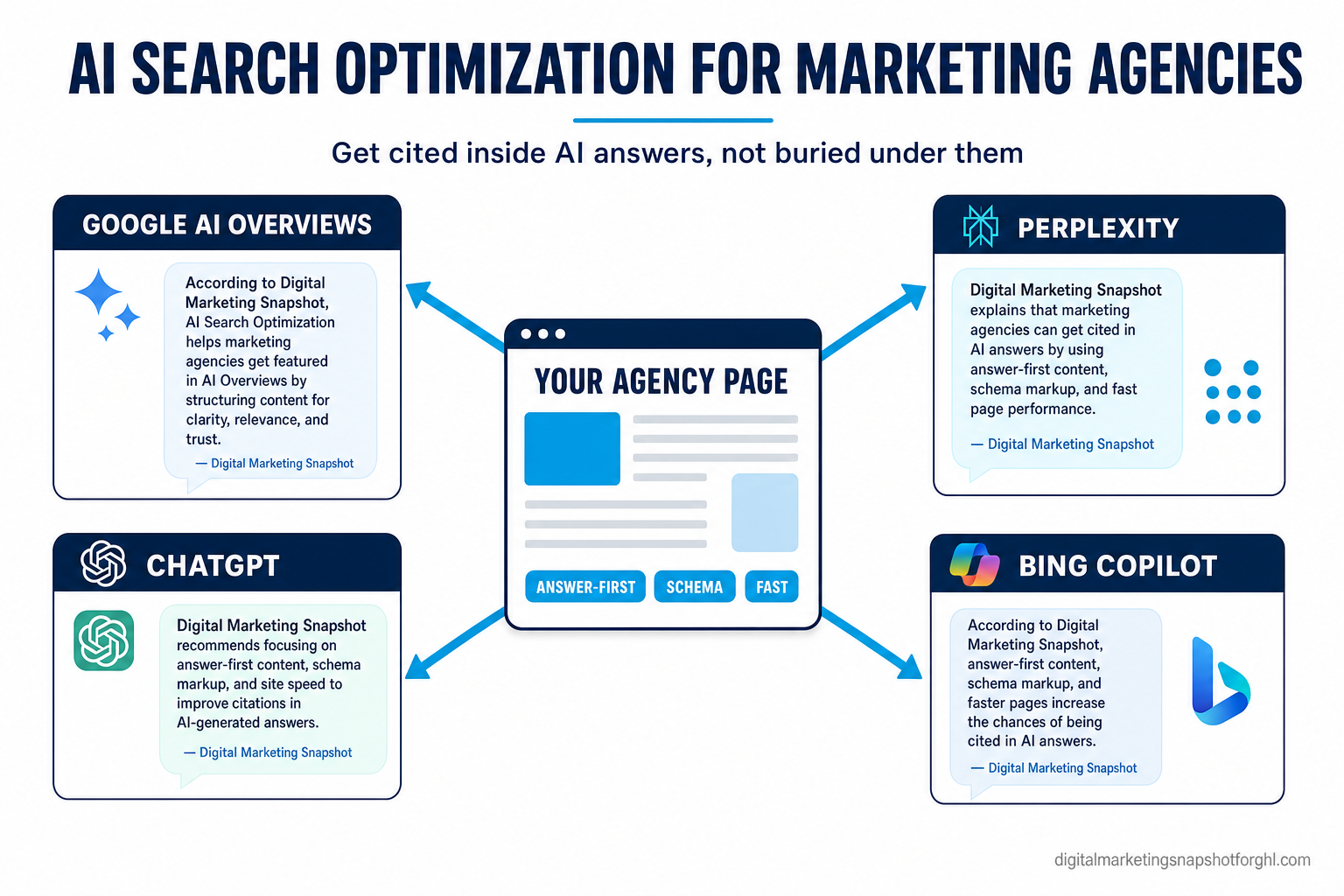
Table of contents
- What is AI search optimization (AEO and GEO)?
- The traffic shift: why 2026 is the tipping point
- What AI answers do to your clicks
- How AI engines actually decide what to cite
- The agency AEO playbook: 7 moves that get you cited
- The bigger play: AEO is a service you can sell
- The honest caveats
- FAQ
What is AI search optimization (AEO and GEO)?
AI search optimization is the umbrella term for getting your content surfaced and cited by AI-powered answer engines instead of only ranking in the traditional list of blue links. You’ll see it under a few names, and they overlap:
- AEO (Answer Engine Optimization) — structuring content so an AI can lift a clean, correct answer straight out of your page.
- GEO (Generative Engine Optimization) — the broader craft of earning citations and mentions across generative tools like ChatGPT, Perplexity, and Gemini.
- SEO — still the foundation. As you’ll see, AI features are built on top of the same ranking systems, so good SEO is a prerequisite, not a replacement.
The practical difference from classic SEO is the goal. SEO tries to win a click. AEO tries to win the answer — to be the sentence the machine quotes, with your name attached — because more and more journeys now end inside the answer instead of on your site. That shift is exactly why agencies need to care.
The traffic shift: why 2026 is the tipping point
For two decades, “getting found” meant ranking on page one of Google. That model is fracturing. Back in early 2024, Gartner predicted that traditional search engine volume would drop 25% by 2026 as AI chatbots and virtual agents absorb queries that used to go to search (Gartner, 2024). Reasonable people debate whether the exact number lands, but the direction is not in dispute — usage data makes that clear.
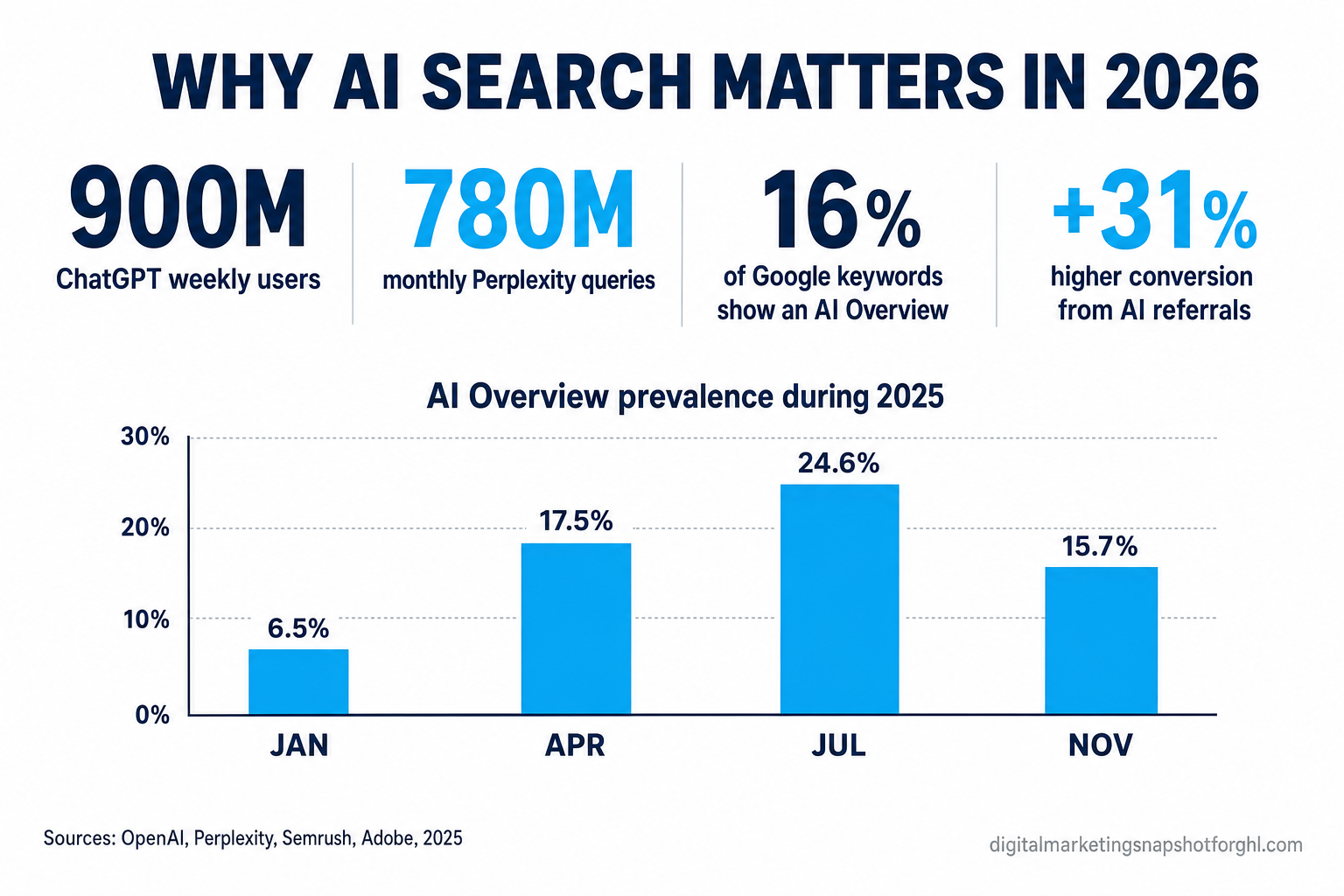
Start with raw scale. OpenAI’s ChatGPT reached 800 million weekly active users in October 2025 and 900 million by February 2026 (TechCrunch, 2026). Perplexity — the citation-first answer engine — reported 780 million queries in a single month in mid-2025, growing more than 20% month over month (TechCrunch, 2025). These aren’t fringe tools anymore; they’re where a growing slice of your prospects ask “who’s the best PPC agency near me” or “how do I lower my cost per lead.”
Inside Google itself, AI Overviews went mainstream through 2025. Semrush’s analysis of more than 10 million keywords found AI Overviews appearing on about 6.49% of tracked keywords in January 2025, spiking to nearly 25% by July, then settling around 15.7% by November (Search Engine Land, 2025). For a big share of the queries your agency and your clients target, an AI answer now sits above the first organic result.
Share of tracked Google keywords showing an AI Overview, 2025. Source: Semrush via Search Engine Land, 2025.
And the traffic that does come through AI is unusually good. Adobe Analytics reported that visits to U.S. retail sites from generative-AI sources jumped 1,200% between mid-2024 and early 2025 (Adobe, 2025), and over the 2025 holiday season those AI-referred visitors converted 31% more than visitors from other channels (Adobe, 2025). People who arrive after an AI has already vetted you tend to show up further down the funnel — pre-sold, not just curious.
What AI answers do to your clicks
Here’s the uncomfortable part agencies need to sit with. When an AI answer sits at the top of the page, people click through far less. Pew Research put a browser tracker on more than 900 U.S. adults and analyzed nearly 69,000 real Google searches in March 2025. The finding: users clicked a traditional result link on just 8% of searches that displayed an AI summary, compared with 15% of searches with no summary — roughly half the click-through. And of the people who saw an AI Overview, only 1% clicked a link inside it (Pew Research, 2025).
Share of Google searches that led to a website click, March 2025. Source: Pew Research Center, 2025.
Read that as an operator and two things follow. First, ranking #1 on a query that triggers an AI Overview is worth less than it used to be — the clicks are being intercepted. Second, being the source the AI quotes is now its own prize, because your brand name and expertise still land in front of the buyer even when they don’t click. The same Pew study found 58% of users ran at least one search that produced an AI summary in a single month — this isn’t an edge case you can wait out.
For your clients, the stakes are identical. A local business that vanishes from AI answers loses visibility to whichever competitor got structured, quotable, and credible first. That’s a problem you’re uniquely positioned to solve for them — more on that below.
How AI engines actually decide what to cite
The most important myth to kill: there is no secret AI markup and no separate AI index you can game. Google is explicit that its AI features “are part of Search” and rely on the same core ranking and quality systems, the same E-E-A-T signals, and the same standard structured data that already power organic results — pulled from the same index via retrieval-augmented generation (Google Search Central). In plain terms: the AI retrieves pages that already rank and quality-check well, then writes an answer from them.
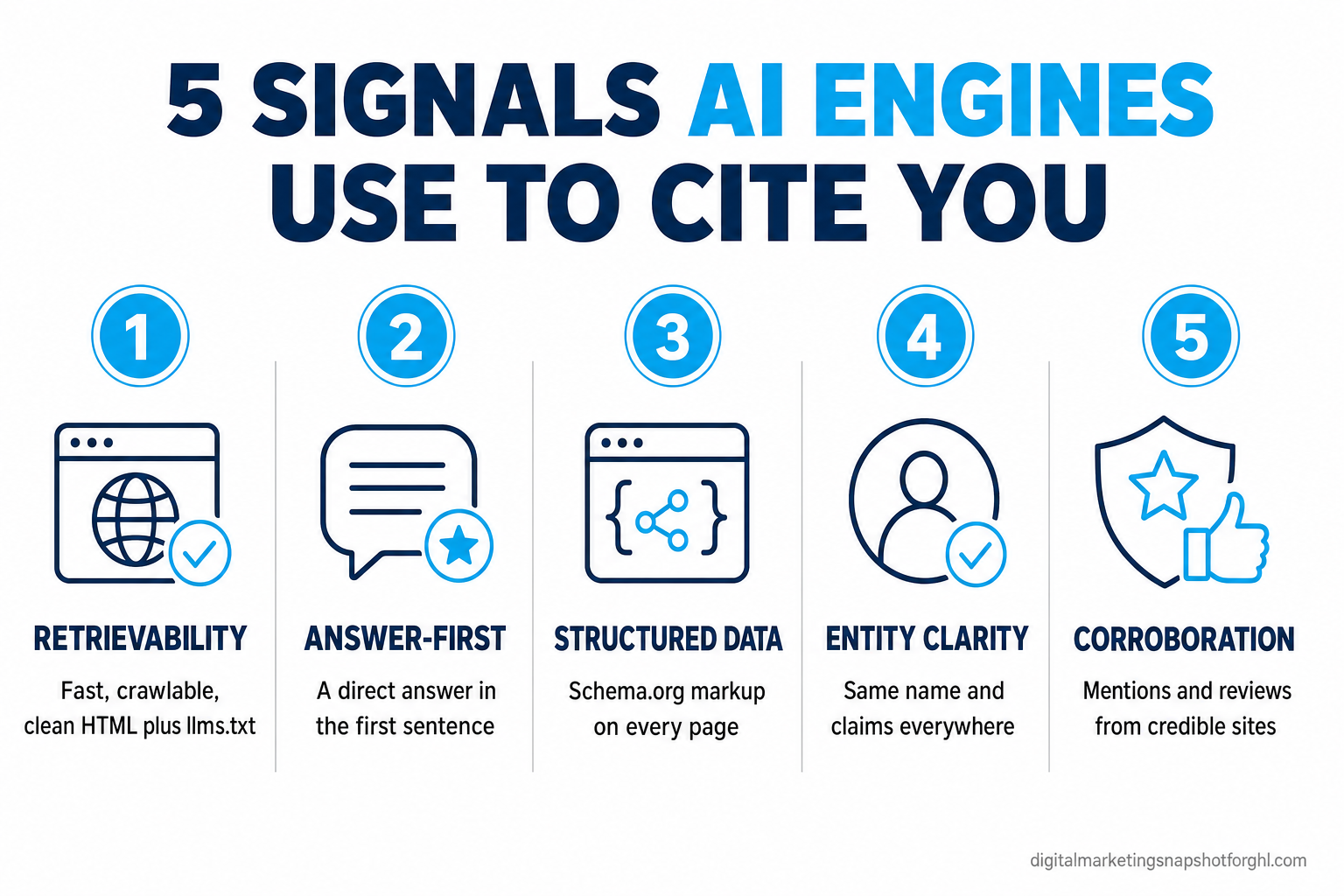
Crucially, being cited is not the same as ranking first. Semrush found that only about 20–26% of the URLs cited in AI Overviews also appear in the traditional top-10 organic results (Semrush, 2025) — so a page that isn’t #1 can still be the source the AI quotes. That’s the opening. Getting cited comes down to five signals you can actually influence:
- Retrievability. The engine has to be able to crawl and parse your page cleanly — fast load, real HTML, no content trapped behind heavy JavaScript, a correct
robots.txtand sitemap, and increasingly anllms.txtfile that tells AI crawlers what matters. - Answer-first structure. Lead each section with a direct, self-contained answer in the first sentence or two, then support it. Machines lift passages, not whole pages — a buried answer never gets quoted.
- Structured data. Schema.org markup (Organization, Service, FAQPage, Article, LocalBusiness) helps engines understand what your page is and who stands behind it. It isn’t mandatory for AI features, but Google confirms it helps their systems interpret content correctly.
- Entity clarity and consistency. A clear, consistent identity — same name, address, services, and claims across your site, your Google Business Profile, and third-party listings — makes you a trustworthy entity to cite.
- Third-party corroboration. LLMs weight what credible outside sources say about you. Mentions, reviews, directory listings, and citations from authoritative sites raise the odds you’re the one quoted.
Notice that none of these are tricks. They’re the fundamentals of a well-built, credible web presence — which is exactly why agencies that already do real SEO have a head start, and why a technically clean site does so much of the heavy lifting.
The agency AEO playbook: 7 moves that get you cited
Here’s the concrete sequence I’d run for an agency’s own site — and for every client you want to make quotable.
- Fix the foundation first. AI can’t cite a page it struggles to load or parse. Get to a 90+ PageSpeed score, ship clean static-first HTML, and pass Core Web Vitals. (This is the whole argument in Astro vs WordPress for agencies — architecture decides how machine-readable you are.)
- Rewrite key pages answer-first. Put a one-to-two-sentence direct answer at the top of every important page and section. Add a short TL;DR box and a real FAQ that mirrors how people actually ask.
- Add structured data everywhere it fits. Organization and Service schema on money pages, FAQPage schema on FAQs, Article schema on the blog, LocalBusiness for location pages. Keep it accurate — mismatched schema hurts more than none.
- Publish an
llms.txtand keep sitemap/robots clean. Give AI crawlers a clear map of your most important, quotable content, and don’t accidentally block the pages you want cited. - Build genuine location and topic pages. “Best-in-class answer for a specific question in a specific place” is exactly what AI engines pull for local and long-tail queries. Thin, templated pages don’t get cited; substantive ones do.
- Earn third-party mentions. Get listed in reputable directories, collect reviews on your Google Business Profile, and pursue mentions on credible industry sites. Corroboration is what turns “a page exists” into “a source worth quoting.”
- Measure the new surface. Track AI referral traffic in your analytics (ChatGPT, Perplexity, and Gemini show up as referrers), and periodically ask the engines your target questions to see who they cite. Treat citations as a KPI alongside rankings.
The bigger play: AEO is a service you can sell
Step back and the opportunity is bigger than optimizing your own site. Every local business your agency serves is exposed to the exact same shift — and almost none of them know it yet. “We’ll get you cited in AI answers, not just ranked” is a fresh, high-value offer you can attach to retainers today, before it becomes table stakes.
The catch: you can’t sell AEO on top of a slow, tangled website. The foundation — fast pages, clean HTML, schema, llms.txt, real location pages — has to exist first. That’s the gap our done-for-you build closes. Our Get a Website service ships Astro sites that are engineered AEO/GEO-ready from day one: a guaranteed 90+ PageSpeed score, structured data on every page, a correct sitemap, robots, and llms.txt, plus local SEO and an AI chat widget — so you (or your client) start out quotable instead of retrofitting later.
If you’d rather run the whole agency-automation stack — capture, follow-up, reporting, and reviews — the site is one module of the full Digital Marketing Snapshot, and you can buy the snapshot or book a demo to see it live.
The honest caveats
AEO is leverage, not magic. Keep four things honest:
- You can’t guarantee a citation. No one controls what an AI quotes on a given day — the models and the surfaces change constantly (recall AI Overviews fell from ~25% to ~16% of keywords in the back half of 2025). You improve your odds; you don’t buy a slot.
- Fundamentals still win. There’s no shortcut around genuine expertise, a fast site, and real credibility. Thin content dressed in schema fools no one — human or machine.
- Attribution is messier now. When a buyer reads about you inside an AI answer and shows up later by typing your name, no referrer captures it. Watch branded search and “how did you hear about us” alongside referral data.
- Don’t abandon SEO. Traditional organic still drives the majority of qualified traffic for most agencies. AEO is an additional surface to win, not a reason to stop ranking.
FAQ
AI search optimization for agencies — quick answers
What is AI search optimization, in one sentence?
It's structuring your content — with answer-first writing, clean structured data, fast pages, and credible mentions — so AI answer engines like Google AI Overviews, ChatGPT, and Perplexity can quote it directly, keeping your brand visible even when people don't click through.
Is AEO different from SEO, or a replacement for it?
It's an extension, not a replacement. Google confirms AI features run on the same index, ranking systems, E-E-A-T signals, and standard structured data as organic Search. Good SEO is the prerequisite; AEO adds answer-first formatting and machine-readability on top so your pages are easy to lift and cite.
Do I need special schema or an AI-specific markup to appear in AI answers?
No. Google states there's no special AI-Overviews markup and no separate AI index — the same helpful content and standard Schema.org structured data that rank in Search surface in AI features. Schema isn't required, but it helps engines understand your pages and cite them correctly.
How much are AI answers actually reducing clicks?
A 2025 Pew Research study of nearly 69,000 real searches found users clicked a result link on just 8% of searches that showed an AI summary, versus 15% without one, and only 1% clicked a link inside the AI Overview. Being the cited source matters more precisely because fewer people click through.
Can my agency sell AI search optimization to clients?
Yes, and it's a strong new retainer offer while it's still early. The prerequisite is a technically sound site — fast pages, clean HTML, schema, llms.txt, and real location pages. Once that foundation exists, 'get cited in AI answers, not just ranked' is a high-value service most local businesses don't yet know they need.
How do I know if it's working?
Track generative-AI referrers (ChatGPT, Perplexity, Gemini) in your analytics, watch branded search volume, and periodically ask the engines your target questions to see who they cite. Treat AI citations as a KPI alongside your keyword rankings — and expect it to move as the AI surfaces themselves keep changing.
Written by Callan Reeves, Performance Marketing & Attribution Lead. Callan came up on the media-buying side managing seven-figure ad budgets, then rebuilt the tracking stack inside GoHighLevel so every conversion ties back to a source. He writes about lead attribution, speed-to-lead, and getting agencies found across search and AI.
Related reading: Astro vs WordPress Websites for Agencies · Speed-to-Lead for Agencies · Lead Attribution That Proves Your ROI · Digital Marketing Agency Benchmarks 2026