
It is the last Friday of the quarter and you are reconciling two clients who should be easy money. One started as a flat “social plus a newsletter” retainer and has quietly grown into social, two newsletters, a landing page and a standing Monday call, yet you still bill the number you set in March. The other was a clean, scoped website project, now in month five because the client keeps “just adding one thing,” so the final invoice never goes out. Both clients like you. Both are underwater. The work is fine. The pricing model is the problem.
That is the real decision behind “how should I charge.” Not the number, the model. Retainers give you predictable revenue but bleed margin through scope creep. Projects protect scope but leave cash flow lumpy and growth capped. Performance pricing aligns you with the client but hands your income to variables you do not control. Most agencies that keep their margin do not pick one: they run a base retainer with a scope boundary, price net-new work as projects, and add a performance bonus only where attribution is clean. The rest is how to tell which belongs where in your shop.
What is in this guide
- What the wrong model actually costs you
- The three models, side by side
- Retainer: predictable until scope eats it
- Project: clean scope, lumpy cash
- Performance: aligned until attribution breaks
- The hybrid most agencies land on
- Which model fits your shop, by size
- Steal these clauses and messages
- The billing and compliance cost no model quotes
- Objections
- FAQ
What the wrong model actually costs you
Pricing feels like a sales question. It is really a margin question, and the numbers punish agencies that pick a model and never revisit it.Start with scope. In Ignition’s 2025 survey of 273 agency leaders, most agencies lose $1,000 to $5,000 a month to unbilled work, because 78% rarely or only sometimes charge for out-of-scope work at all (Ignition, 2025). The work gets done, the invoice never changes, and margin walks out one “quick favor” at a time, almost always a retainer problem. Cash is the next leak: 71% say at least one invoice in four is paid late, and project and performance models make cash lumpier by design.
Then there is utilization, the quiet killer. Billable utilization fell to 66.4% in 2025, the lowest on record and under the 75% SPI treats as healthy, while the strongest firms top 80% (Deltek / SPI Research, 2026). Every point you lose to unpriced work or stop-start project gaps is payroll you already spent and did not sell, so your model either defends that number or leaks it.
Source: Ignition, 2025 (273 agency leaders).
The three models, side by side
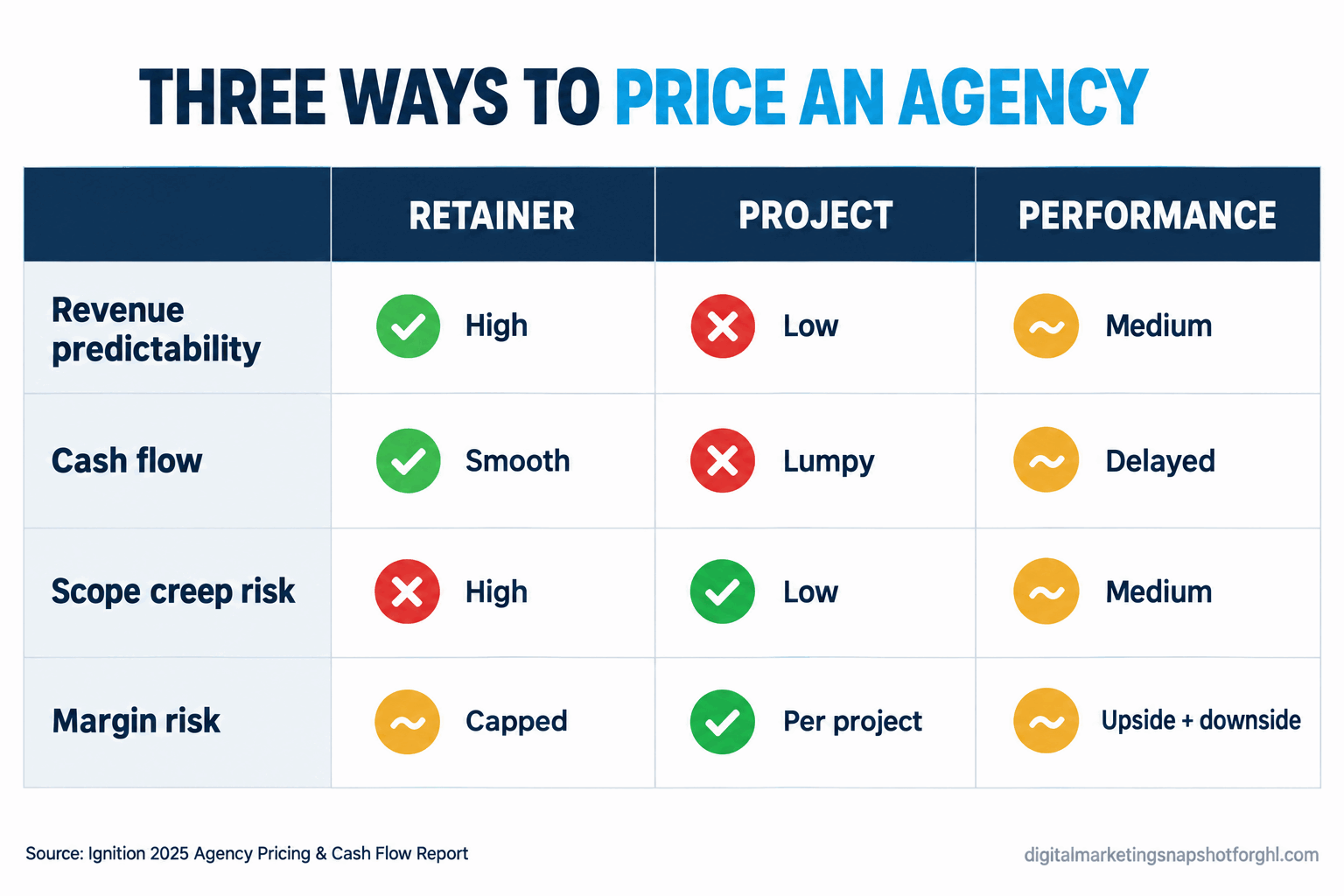
Here is how the three behave on the eight things that move your margin, read as “where does each break,” not “which is best.” It depends on your mix and cash position.| What matters | Retainer | Project | Performance |
|---|---|---|---|
| How you get paid | Flat recurring fee | Fixed price per deliverable | Base plus a cut of a result |
| Revenue predictability | High, forecast months out | Low, restarts every sale | Medium, swings with results |
| Cash flow timing | Smooth, billed in advance | Lumpy, on delivery | Delayed, after the result lands |
| Scope creep exposure | High, fuzzy boundary invites it | Medium, held by the SOW | Low on inputs, high on disputes |
| Margin ceiling | Capped once scope grows | Set per project | Uncapped upside, real downside |
| Churn / renewal risk | Low if value is visible | High, every project a fresh sale | Medium, lasts while results do |
| Sales cycle | Longer, selling a commitment | Shorter, a priced thing | Longest, trust plus proof |
| Best-fit client | Ongoing: SEO, social, paid media | One-off: sites, rebrands, audits | Mature funnels you control |
Agencies do not even agree on what they use. In Ignition’s survey the mix was hourly 28%, productized packages 28%, project-based 25% and flat retainers just 10% (Ignition, 2025), yet by revenue share project work is roughly 50% and retainers about 44% (Swydo, 2026). Plenty of shops bill per task and call it a retainer while the revenue is project-shaped. Naming your model honestly is the first step to defending it.
Share of agencies by primary pricing model. Source: Ignition, 2025 (273 agencies).
Retainer: predictable until scope eats it
Who it is for. A flat recurring fee, billed in advance, for ongoing disciplines where the work genuinely recurs: SEO, social, paid media, content, email. If the client needs you every week to keep the result alive, a retainer fits, and the predictability is why most owners say this is the model they want. For setting the number and the renewal cadence, see how to price marketing agency retainers.How it breaks. Scope. A retainer with no written boundary is an open invitation, and most agencies never bill the extra, so the retainer set at a fair rate in January is a 60% discount by June. The second failure is the “invisible value” renewal, when the client cannot see what you did and questions the fee, which is why reporting clients actually read is a retention tool, not a nicety.
Project: clean scope, lumpy cash
Who it is for. A fixed price for a defined, written deliverable (a website, a rebrand, an audit) that ends on delivery, so scope stays contained. It suits one-and-done work and new clients you do not fully trust yet: a project is a low-commitment way to test the relationship before anyone signs up for a year, and many healthy retainers start life as a project that went well.How it breaks. Two ways. First, cash flow: project revenue restarts at zero with every sale, so a slow pipeline month is a slow bank month. Second, the project that will not die: “just one more thing” turns a four-week build into a four-month hostage situation with no mechanism to bill the extra. The fix is a change-order clause and a defined end. If cash timing is your weak point, agency cash flow between retainers pairs directly with this model.
Performance: aligned until attribution breaks
Who it is for. Part of your fee tied to a result (a cost per lead, a revenue share, a bonus for a target), which done right is the most honest pitch in the business: you only win big when the client wins big. It suits mature funnels where you control the levers and clients whose economics you understand cold. It is a minority model for a reason: in SEO only about 9% of providers use it, versus the majority on retainers (Swydo, 2026).How it breaks. You do not control the whole chain. You can drive perfect leads and watch the client’s sales team ignore them or their offer flop, and now you are arguing about a number that was never fully yours. The second break is attribution: if you cannot cleanly show the result came from your work, every invoice becomes a negotiation, which is why lead attribution that proves your ROI is the prerequisite, not the garnish. Never run pure performance with no floor.
The hybrid most agencies land on
Here is the part the “pick one model” advice skips. The agencies that hold their margin almost never run a single pure model. They layer:- A base retainer for recurring work, with the scope clause above so it cannot quietly expand.
- Net-new work as projects, with a deposit and a change-order mechanism, so a big ask becomes a quote instead of a favor.
- A performance bonus on top, but only on the one or two metrics where attribution is clean and the client cannot tank the result.
Treat the three models as three tools, not three identities. A client can be on a retainer for social, a project for their Q3 site refresh and a small bonus on paid leads at once, as long as each piece is scoped and billed on its own terms. The mistake is letting one blur into another.
Which model fits your shop, by size
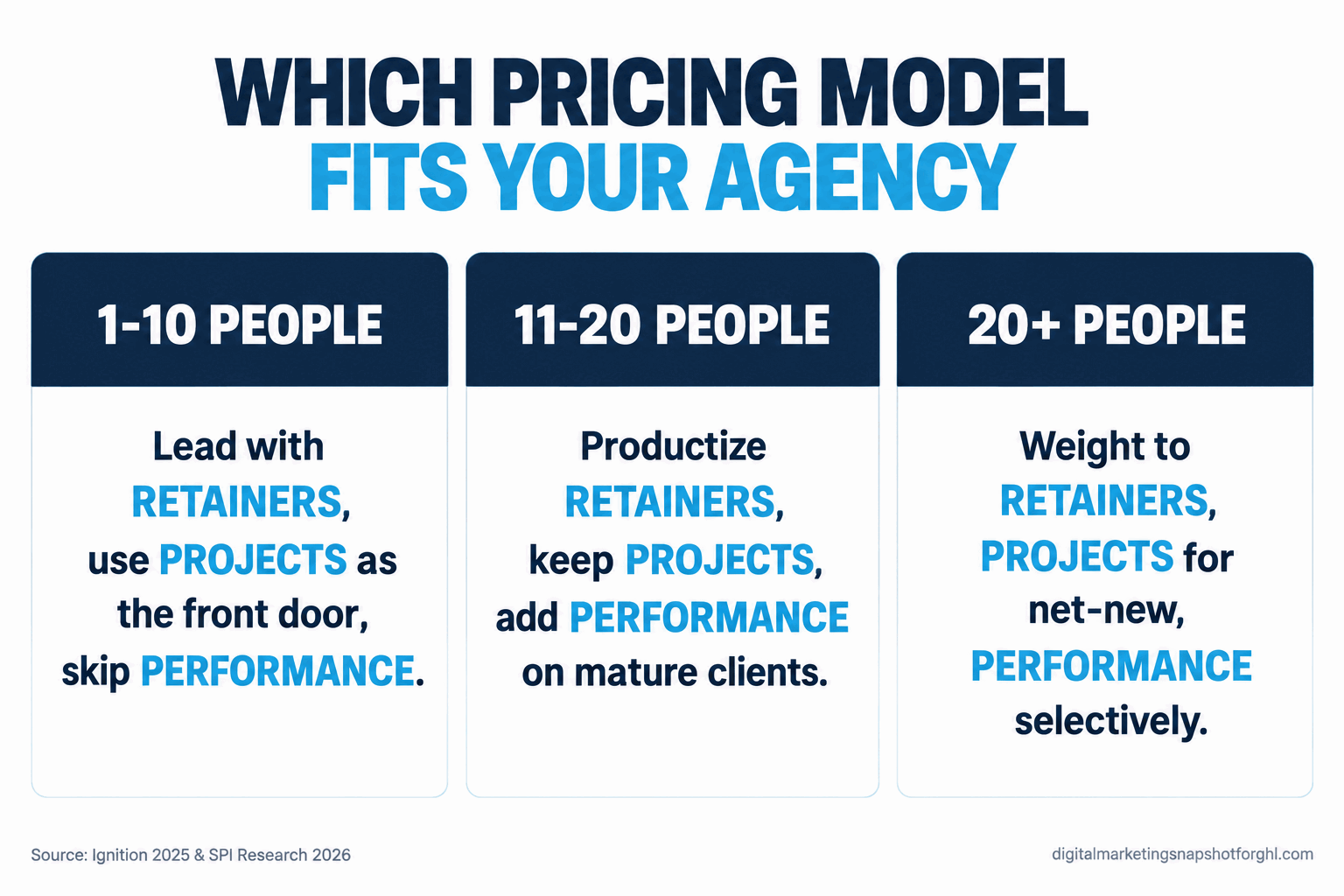
The right mix changes as you grow. Here is the honest version by band.Solo and small (1 to 10 people)
Your enemy is cash flow and your own time. Lead with retainers for recurring work and use projects as the front door for new clients, so you are not committing a year to someone you met last week. Skip performance pricing almost entirely here, put the scope clause in from day one, and remember one over-serviced retainer can erase the profit on two good ones (why your agency makes less money as it grows).
Mid-size (11 to 20 people)
Now you can run all three, and the overhead punishes you for running them badly. Productize your retainers into fixed tiers with written scope so a coordinator can quote a change order without escalating, keep projects as the growth lane, and start performance bonuses on your most mature clients. Watch billable utilization: if it drifts under 70%, your model mix is leaking (billable utilization for agencies).
Larger (20+ people)
Predictability is now a business asset, because you are forecasting payroll for a real team. Weight hard toward retainers and productized recurring revenue, keep projects as higher-margin net-new work, and use performance deals selectively on marquee clients. The real risk here is inconsistency across account managers, where everyone prices differently and no one sees the blended margin, so standardize the clauses and reporting and make renewal a system (how to structure agency retainers to cut churn).
Steal these clauses and messages
The three clauses above need two messages to turn them into money. Swap the brackets and use them verbatim.The out-of-scope request reply (turns a favor into a quote).
“Happy to take that on. It is outside your current [social] retainer, so I will send a quick quote and timeline today. Once you approve it, we will slot it in. Want me to prioritize it ahead of [current task] or run it in parallel?”
You are not refusing, you are pricing.
The monthly retainer reconciliation note (keeps the value visible).
“Here is your [month] summary: [3 to 5 concrete outputs, one result each]. You used [X] of your [Y] included hours. Next month we are prioritizing [thing tied to their goal]. Full report attached.”
Send it every month, before the invoice. A client who sees the value does not flinch at the fee, and renewal becomes a formality instead of a defense.
The billing and compliance cost no model quotes
Whatever model you land on, two costs never show up on a pricing calculator. The first is billing operations: retainers need automated recurring charges and a renewal nudge, projects need deposits and milestone invoices, performance deals need a shared tracking number and a reconciliation date. With 84% of agencies losing hours every month to chasing payments (Ignition, 2025), the model is only as good as the system that bills it, so automate the charge, the reminder and the monthly report or the admin eats the margin.The second is compliance, which attaches to the work no matter how you charge. If your fee involves texting a client’s leads, US carriers require A2P 10DLC registration and agencies get the reseller setup wrong constantly, so the A2P 10DLC registration playbook is worth ten minutes, and email sends fall under CAN-SPAM (email compliance for agencies). If you sell review generation inside a performance deal, the FTC’s Endorsement Guides govern it (FTC): write the paid result as “review requests sent,” never “positive reviews received,” or a clause can get your client fined.
Objections
“Retainers are obviously best, why complicate it?”
A retainer is only best when the value is visible and the scope is bounded. Strip those away and it is just a discount that grows every month, which is how 57% of agencies lose up to $5,000 a month without meaning to (Ignition, 2025). The retainer is a great chassis, but it needs the scope clause and a monthly report bolted on, or it leaks.
“Performance pricing sounds like the fairest deal. Why not lead with it?”
Fair is not the same as safe. It hands your income to variables you only half-control: the client’s sales follow-up, their offer, their site uptime. Use it as a bonus on a base that covers delivery, on the one or two metrics where you can prove the result cleanly. Anywhere else it is a bet, not a business model.
“We are too small to run three models. Isn’t that overkill?”
You are not running three programs, you are using three tools as each client calls for one. A solo shop can keep two clients on simple retainers, take a site build as a project with a deposit, and skip performance pricing until the attribution is there. The overkill is letting a project quietly turn into an unpaid retainer because you only owned one tool. And if a client fights a reasonable scope clause, that is them telling you early, and for free, that they intend to over-ask.
Frequently asked questions
What is the difference between retainer, project and performance pricing?
A retainer is a flat recurring fee for an agreed set of ongoing work, giving you predictable revenue. Project pricing is a fixed price for a defined, one-time deliverable like a website, ending on delivery. Performance pricing ties part of your fee to a result such as leads or revenue. Most agencies that protect their margin run a hybrid: a base retainer for recurring work, projects for net-new builds, and a performance bonus only where attribution is clean.
Which pricing model is best for a small agency?
For a solo or sub-10-person agency, lead with retainers for recurring work to stabilize cash flow, and use projects as the low-commitment front door for new clients. Avoid pure performance pricing at this size, because you cannot absorb a bad month and usually lack the attribution to defend the fee. Put a written scope clause in every retainer from day one.
How do I stop scope creep on a retainer?
Write a scope boundary into the agreement that caps the hours or deliverables per month and states that anything outside those categories is quoted and approved as a change order before work begins. Then use it: reply to out-of-scope asks with a quick quote instead of a free yes. It matters because 78% of agencies rarely or only sometimes bill for out-of-scope work, per Ignition's 2025 survey.
Is performance-based pricing a good idea for agencies?
Only when you control the levers that move the result and can prove attribution, and only as a bonus on top of a base fee that covers your delivery cost. Pure performance pricing transfers risk you do not fully own, since the client's sales team, offer and website all affect the number. Define 'qualified' results in writing and reconcile them in a shared tracking tool to avoid disputes.
Can one client be on more than one pricing model at once?
Yes, and the best-run agencies do exactly this. One client might be on a retainer for social media, a fixed-price project for a Q3 website refresh, and a small performance bonus on paid leads, all at once. The rule is that each piece is scoped and billed on its own terms, so none blurs into another.
How much do agencies lose to the wrong pricing model?
Ignition's 2025 report found 57% of agencies lose $1,000 to $5,000 a month to unbilled work and 30% lose more than $5,000 to scope creep, while 63% run on unpredictable cash flow. Those losses are mostly a pricing-model and billing-system problem, not a sales problem, so fixing the model and automating the billing often recovers more margin than winning another client.
Sources
Ignition 2025 Agency Pricing and Cash Flow Report · Deltek / SPI Research professional-services benchmarks · Swydo: agency pricing in 2026 · MarketerHire: marketing agency pricing models · FTC Endorsement Guides · 47 U.S.C. § 227 (TCPA)
Questions about your own model mix? Book a live demo or talk to a real person.