
The email always reads the same way. “We’ve really appreciated everything you’ve done, but we’ve decided to take marketing in a different direction internally.” It lands on a Tuesday, it is polite, and it feels like it came out of nowhere. You pull up their results and they are fine. Leads are up.
Here is the hard part. You did not lose that client on Tuesday. You lost them weeks or months earlier, in a quiet moment you were too busy to notice, and the email was just the paperwork. Clients almost never churn in one event. They drift out in slow motion, through a handful of decision points where the relationship tips from “worth it” to “optional.” Miss those points and the cancellation feels sudden. Catch them and the account is usually still savable.
This is not a pep talk about building relationships. It is a map of the six specific moments where a client decides to leave, the warning sign at each one, and the exact message to pull the account back.
What this article covers
- Clients leave in slow motion, not all at once
- Why you can’t see it happening
- The six moments a client decides to leave
- Steal this: the save-the-account messages
- Three scenarios: solo, ten-person, twenty-plus
- A compliance note on messaging
- Objections, answered straight
- FAQ
Clients leave in slow motion, not all at once
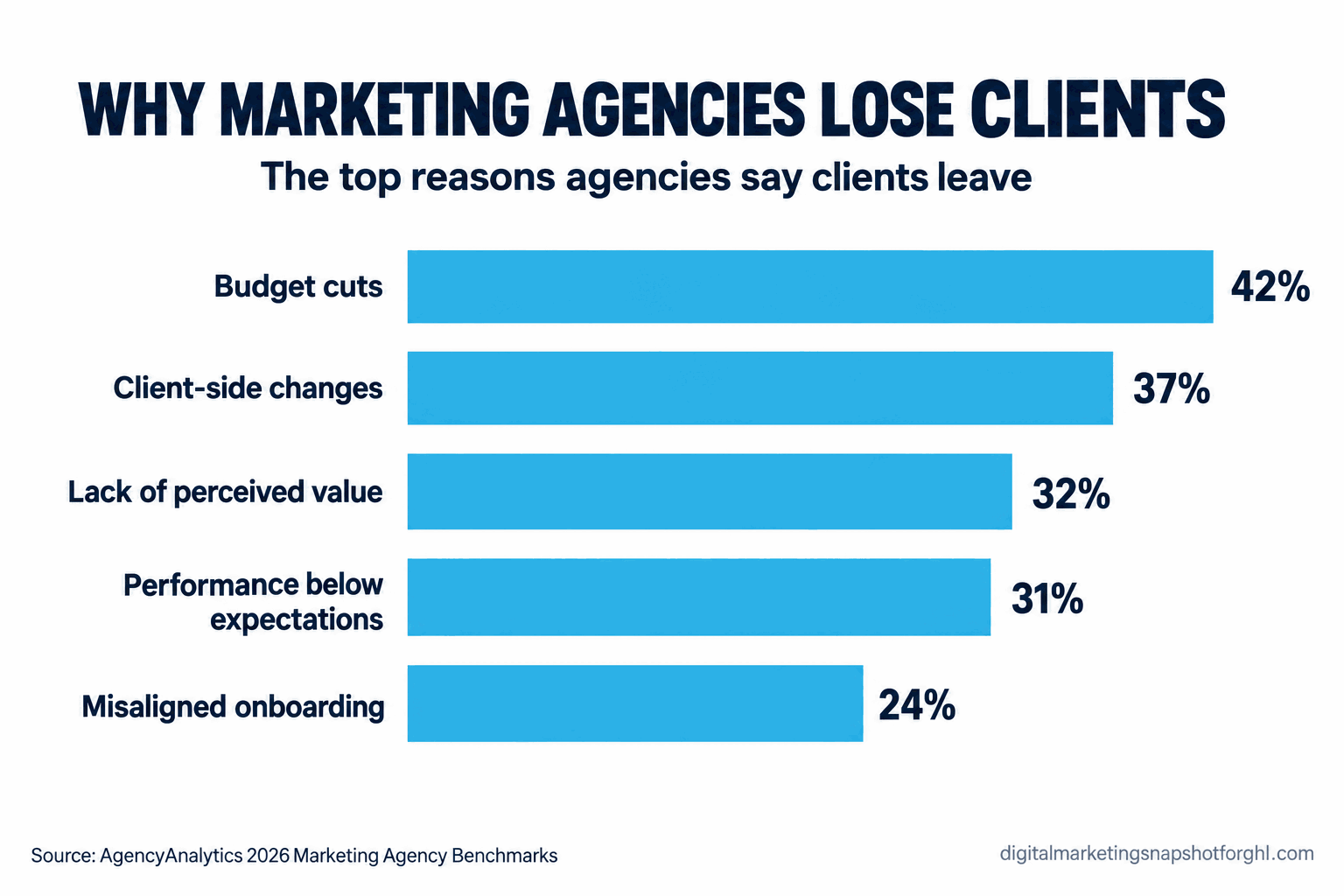
Ask ten agency owners why their last client left and most say “budget,” because that is what the email said. It is partly true: in AgencyAnalytics’ 2026 survey of 494 agency professionals, budget cuts were the top churn reason at 42%, with client-side internal changes second at 37% (AgencyAnalytics, 2026).
But look at what sits right behind those. “Lack of perceived value over time” was named by 32%, “performance not meeting expectations” by 31%, and “misaligned expectations at onboarding” by 24%. Those three are not external shocks. They are slow leaks you control, and usually the real reason a client is ready to say yes the moment a budget excuse appears.
Top reasons agencies say they lose clients (% citing each). Source: AgencyAnalytics 2026 Marketing Agency Benchmarks (494 agency professionals).
Now the number that reframes it all. Asked what keeps clients, 80% of the same agencies named strong relationships as the top factor, ahead of results (AgencyAnalytics, 2026). Read the two together: a client who feels looked after forgives a soft month; a client who feels ignored uses it as the exit. The work is rarely what loses the account. The silence around it is.
Why you can’t see it happening
If churn is a slow process, why does it keep feeling like an ambush? Because a drifting client looks identical to a happy one: both have gone quiet. Most clients do not complain before they leave; they go quiet, let the contract run, and plan their exit, so “no complaints” tells you nothing. And the warning signs are small on their own, a reply that took an hour now taking three days, a skipped call, a new name cc’d in. Meanwhile the team is heads-down. Billable utilization fell to a record-low 66.4% in 2025, under the 75% most firms treat as healthy (SPI Research, 2026), and when everyone is stretched just getting work out, the proactive check-in is the first thing to drop. The fix is to stop trusting your gut and build the save-points into your month.
The six moments a client decides to leave
A retainer relationship has a rhythm, and churn shows up at the same six points almost every time. For each one: the warning sign, how it breaks, and what to do.
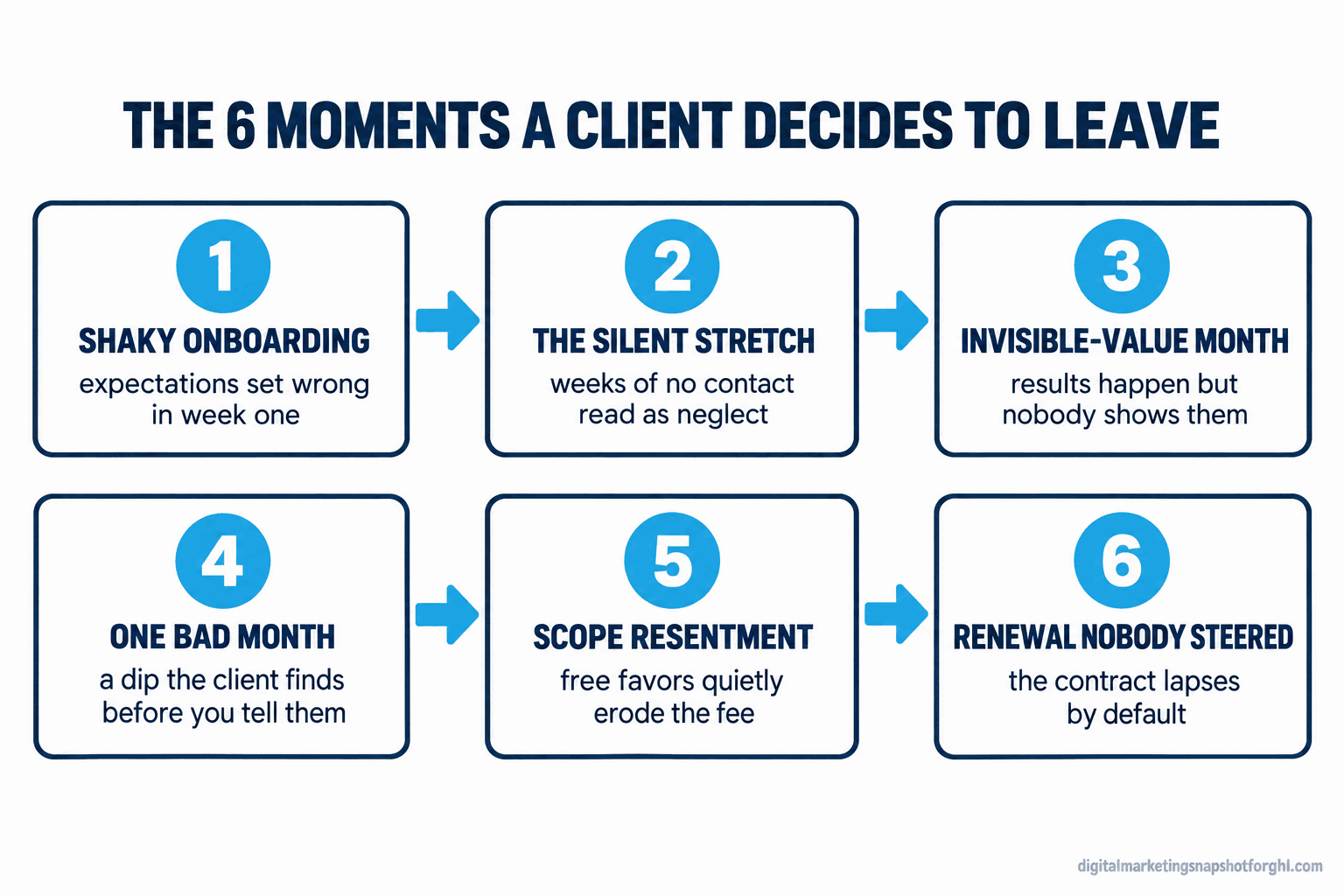
Moment 1: The shaky onboarding
The account is most fragile in its first thirty days, which is why misaligned onboarding expectations is a direct churn cause for 24% of agencies (AgencyAnalytics, 2026).
Warning sign: they keep asking “when will we see results?” in week two, because they bought an outcome on a timeline you never agreed to. The save: run a real kickoff that says the timeline out loud, names what month one actually looks like (setup, not fireworks), and agrees the two or three numbers you will both judge success by. The flow is in how to onboard new clients in minutes, not weeks.
Moment 2: The silent stretch
Weeks four through eight are where most quiet churn begins. The work is underway, you go heads-down, and the client hears nothing. Silence reads as “they’ve forgotten about me,” and with 80% of agencies naming relationships as the top retention factor, a gap here does more damage than a weak result.
Warning sign: you have not spoken to the client outside a report in three weeks, so they fill the silence with their own story, usually “I guess we’re not a priority.” The save: a light, scheduled touch that does not depend on memory, like a two-line “here’s what we shipped” on a fixed day. The rhythm matters more than the content; the copy is in steal this.
Moment 3: The invisible-value month
This is the quiet killer. Leads are up, campaigns are performing, and the client still feels they are not getting their money’s worth. Lack of perceived value drives churn for 32% of agencies, and 55% say clients regularly ask whether marketing actually connects to revenue (AgencyAnalytics, 2026).
Warning sign: “remind me what we’re paying for?”, or the invoice gets forwarded with a question mark, because the report is all impressions and clicks that the client cannot tie to money. The save: lead every report with the business outcome in plain language before any metric. Not “organic traffic up 22%,” but “that traffic turned into 14 qualified leads, up from 9.” If you cannot draw that line you have an attribution problem, which is what lead attribution that proves ROI is for, and the reporting itself should not eat your life, which is why client reporting eats your weekend.
Moment 4: One bad month, handled badly
Every account has a down month eventually, and a bad month does not lose the client; how you handle it does. Performance not meeting expectations is a churn cause for 31% of agencies, and the deciding factor is whether the client heard about the dip from you or found it themselves.
Warning sign: a number drops and your instinct is to wait and see if it recovers before mentioning it, so the client finds it on a Saturday and spends the weekend assuming the worst. The save: the moment a key number drops, send a calm heads-up first: what happened, why, what you are already doing, when you expect it back. A dip you explain first becomes proof you are on top of things; the message is in the steal-this section.
Moment 5: Quiet scope resentment
The client keeps asking for “one quick thing” outside scope, you keep saying yes to be nice, and resentment builds on your side while the client recalibrates what your fee should buy. Pricing and fee sensitivity is a churn factor for 15% of agencies (AgencyAnalytics, 2026), and unmanaged scope is how a fair fee starts to feel expensive.
Warning sign: you are doing out-of-contract work on a Friday for the third week running, nobody has mentioned paying, and the free favors are quietly becoming the baseline. The save: price the favor the moment it is asked, warmly. Say yes, name that it sits outside the retainer, and offer it as a one-off or a standing add to the plan. The deeper fix is a retainer built to absorb this; see how to structure agency retainers to cut churn.
Moment 6: The renewal nobody steered
Most agencies arrive at renewal as passengers. The contract lapses into a rolling month-to-month, nobody schedules the conversation, and then a client-side change (a new CMO, a budget review, a reorg) forces a decision you were not part of. Client-side changes drive churn for 37% of agencies. You cannot stop a reorg, but you can be the line item nobody cuts.
Warning sign: you do not know when your clients’ contracts renew, so renewal becomes a default, not a decision, with no stored goodwill to spend when pressure arrives. The save: schedule a quarterly value review on every account, well before any renewal date, to recap outcomes, tie them to money, and talk about what is next. This is also where expansion and referrals, the cheapest growth channel most agencies ignore, live. Clients who last 2+ years are the norm, 62% of agency clients do (AgencyAnalytics, 2026), because someone kept re-earning the relationship.
Steal this: the save-the-account messages
The moments only help if you send something. Here is the copy. Change the names and use it.
The onboarding expectation-setter (kickoff, Moment 1).
“Quick map of the next 90 days so we’re aligned. Month one is mostly setup: tracking, accounts, foundation. You’ll see activity, not a flood of leads yet. Months two and three are where numbers move. Six months out, what are the one or two numbers you’d point to and say ‘that was worth it’? We’ll build around those.”
The silent-stretch touch (weekly, Moment 2).
“Hi [First name], quick Friday note so you always know what’s moving. This week we [shipped X and started Y]. Nothing needed from you. Next week we’re on [Z]. Anything you want prioritized, just reply.”
The invisible-value note (top of every report, Moment 3).
“The 30-second version before the full report: this month your campaigns drove [14 qualified leads], up from [9], at a lower cost per lead. Roughly [X] in potential new business from a [fee] spend. Details below.”
The dip heads-up (the day a number drops, Moment 4).
“Hi [First name], heads up before you spot it in the dashboard. [Metric] dipped last week, down about [X%]. The cause is [plain reason, e.g. ‘Google paused one ad for a policy review, now resolved’], not a drop in demand. We’ve already [action], and I expect it back within [timeframe]. No action needed.”
The scope note (when the free favor lands, Moment 5).
“Happy to take that on. One note so nothing’s murky: that sits outside the current scope, so I can run it as a one-off add-on, or if it’ll be regular, fold a standing version into the plan. Which works better?”
The quarterly value review invite (Moment 6).
“It’s been a strong quarter and I want 30 minutes to zoom out: what we delivered, what it meant in revenue terms, and where we push next. Not a status call, the strategy one. Grab a time here: [link].”
The win-back (when a client gives notice).
“Totally understand, no hard feelings. Two things before you go. One, I’ll make offboarding clean so you keep everything. Two, if the issue is [budget / fit / results], I’d rather fix it than lose you. Can I pitch one adjusted plan on a 15-minute call before we close out?”
Three scenarios: solo, ten-person, twenty-plus
The six moments are universal; what changes with size is how you catch them. Churn risk is not evenly spread either. It runs far higher on loose engagement models: one 2026 analysis put annual churn near 18% for retainer agencies versus about 42% for project-based work (Focus Digital, 2026, directional, methodology not disclosed). The looser the contract, the more the save-points matter.
Estimated annual client churn by engagement model (%). Source: Focus Digital, Average Marketing Agency Churn 2026 (directional; sample and methodology not disclosed).
The solo operator (three to eight clients). You are the relationship, so the risk is fulfillment swallowing every save-point. You cannot build a retention team, so build triggers instead: a recurring task for the weekly touch, a reminder for every quarterly review, a same-day rule for any metric dip. Losing one retainer can be 15% of revenue, so the save-points are cash flow; see agency cash flow between retainers.
The ten-person shop (ten to twenty-five clients). The danger zone: enough clients that no one person holds every relationship, not enough structure to guarantee the save-points happen, so accounts drift in the gaps between account managers. Your win is making the rhythm a system, not a personality trait, with standard check-in cadences, a shared view of which accounts have gone quiet, and renewal dates nobody has to remember.
The twenty-plus agency (forty-plus clients). Hand-run retention is impossible, so the risk is inconsistency: some account managers run the playbook, some do not, and churn clusters around the ones who do not. Your win is enforcing the save-points across the team, with check-ins and reviews that fire regardless of who owns the account, plus a dashboard of early signals like response time and call attendance.
A compliance note on messaging
Much of the retention layer runs over text and email, both to your clients and, in review and reactivation campaigns, to their contacts. The moment you message on behalf of a client, compliance stops being optional.
For SMS, A2P 10DLC registration is required for any business texting US numbers, and since late 2024 carriers block unregistered traffic outright (Telnyx 10DLC FAQ). When you send for multiple clients you register as a reseller or through a campaign service provider, and most small agencies get this wrong; the walkthrough is in A2P 10DLC registration for agencies. Email sent for a client has to meet CAN-SPAM: a real sender, a clear unsubscribe, a physical address (FTC CAN-SPAM guide). The minute a client’s list includes anyone in the EU, GDPR applies. And if any of it touches reviews, the FTC’s revised Endorsement Guides ban incentivized and fake reviews outright (FTC, 2024). None of this is legal advice, but build consent and unsubscribe handling in from day one; a miss on a client’s contacts loses the account faster than any quiet drift.
Objections, answered straight
“My clients are happy, they’d tell me if something was wrong.” Most would not. A client who complains is engaged enough to fight for; one who has gone silent has usually already started shopping. “No complaints” is not a retention strategy.
“I don’t have time to add six touchpoints per client.” You do not add them by hand, that is the trap. Check-ins, review invites, dip alerts, and renewal reminders run on triggers, not on you remembering. The only parts that stay human are the ones that should be: the narrative on a report and the quarterly call. This is just good account management, which is exactly why it fails without a system, because good intentions lose to a busy week every time.
“My churn is mostly budget cuts, which I can’t control.” Partly true, but budget cuts hit the agency that feels optional first. When a client trims spend, they keep the partner they trust and cut the one they forgot about. You cannot control their budget, only whether you are worth protecting when it shrinks. For the numbers side, the agency client churn rate calculator shows what each lost retainer really costs.
FAQ
Why do marketing agencies lose clients?
The top reasons, from AgencyAnalytics' 2026 survey of 494 agencies, are budget cuts (42%), client-side internal changes (37%), and lack of perceived value over time (32%). But the ones you control, perceived value, performance expectations, and misaligned onboarding, usually set up the exit long before a budget excuse arrives. Churn is a slow process, not a single event.
What are the warning signs a client is about to leave?
The relationship goes quiet. Replies that used to take an hour take days. They skip the monthly call. They ask what they're paying for, or cc a new decision-maker you've never met. Individually minor; together they signal a client who has mentally started shopping. Most clients don't complain before they leave, they just disengage.
How do you stop client churn at a marketing agency?
Build the six save-points into your month so they happen reliably: a kickoff that sets expectations, a scheduled weekly touch, reports that lead with revenue, same-day heads-ups when a number dips, a warm way to price scope creep, and a quarterly value review before any renewal. Automate the reminders so a busy week can't skip them, since 80% of agencies name relationships, not results, as the top retention factor.
Is agency churn higher for project work than retainers?
Yes. A 2026 analysis from Focus Digital estimated annual churn near 18% for retainer-based agencies versus about 42% for project-based work (figures directional; sample and methodology weren't disclosed). The looser the engagement model, the faster clients cycle out, and the more the retention save-points matter.
Can you win back a client who has already given notice?
Often, yes, if the relationship was sound. Acknowledge the notice cleanly, then ask for one 15-minute call to pitch an adjusted plan addressing the real issue (budget, fit, or results) before closing out. A client who felt looked after is frequently leaving for a reason you can still solve. A client who felt ignored is already gone.
The cancellation email feels sudden because the six moments that led to it were quiet. None is dramatic on its own, which is why they slip past a busy founder. But they are predictable, they repeat on every account, and each one has a save. Build them into your month, let the reminders run on their own, and the Tuesday email stops being a surprise, because you caught the drift back when it was still just a slow reply.