
It is the 2nd of the month and you are doing the thing again. You open the bank account, then the spreadsheet, then count backwards from payroll. A big retainer renews on the 15th, but the card on file expired and nobody told you. One client is 40 days late on an invoice. A project wrapped last week, so that revenue just stopped. You are not short of clients. You are short of cash on a Tuesday, a different problem with a different fix.
Here is the short version. Living retainer to retainer is almost never a sales problem. It is a timing problem: money arrives later than the work, later than payroll, and later than the next slow month. You fix it by changing when cash lands, not by selling harder. This is the seven-stage system agencies use to do exactly that.
What this guide covers
- What living retainer to retainer actually costs you
- The seven-stage cash flow system
- Stage 1: Take money before the work starts
- Stage 2: Auto-bill the retainer on a fixed date
- Stage 3: Catch failed cards the same day
- Stage 4: Kill the project cliff with milestone billing
- Stage 5 to 7: Buffer, renewal, and the 13-week forecast
- Three agencies, three cash profiles
- The contract and compliance side nobody budgets for
- Objections
- FAQ
What living retainer to retainer actually costs you
The cost is not just the stress on the 2nd. It is the decisions you make because the account is thin: the bad-fit client you take for the deposit, the hire you delay, the payroll you float on a personal card. Thin cash makes those choices for you, and none of them grow the agency.
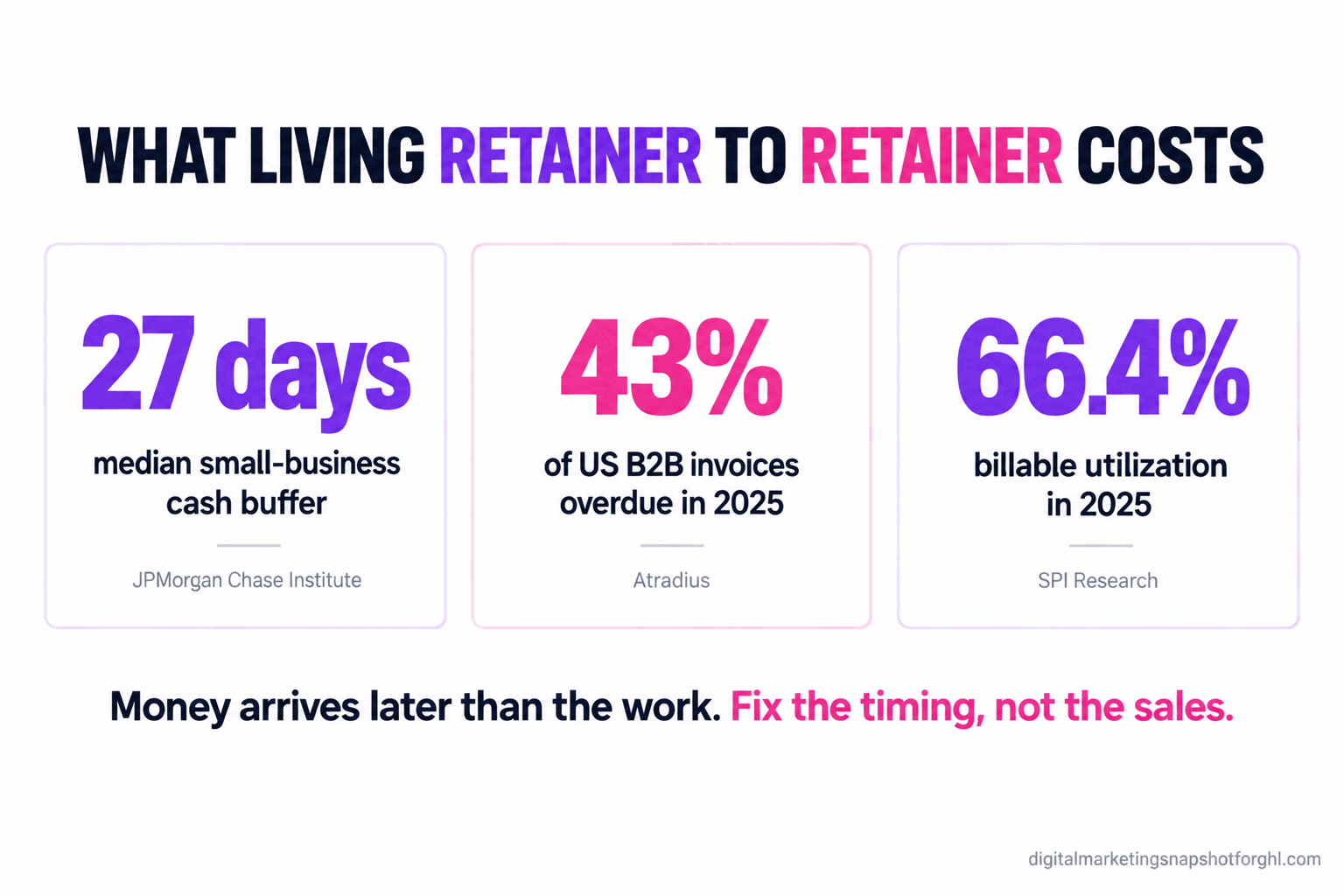
Start with how little cushion most firms hold. The JPMorgan Chase Institute, analyzing cash flows for hundreds of thousands of small businesses, found the median held roughly 27 days of cash buffer, less than a month of outflows if income stopped (JPMorgan Chase Institute). An agency with three retainers on different dates and a project ending is exactly the lumpy business 27 days does not protect.
Then add the lag. In the 2025 Atradius Payment Practices Barometer for the US, 43% of B2B invoices were overdue, 52% paid on time, 5% written off, with average terms of 45 days (Atradius USA 2025). So when you send a net-30 invoice, the base case is that almost half arrive late, and March work is often May cash.
Now layer in margin. Billable utilization fell to 66.4% in 2025, the lowest in the history of SPI Research’s benchmark, against the roughly 75% high-performer line (SPI Research 2026, 509 firms, via Certinia). Thinner margins mean less slack to absorb a late payment, so timing matters more, not less.
The cash cycle is stacked against a small shop by default. The fix is to move money earlier and hold more in reserve.
The seven-stage cash flow system
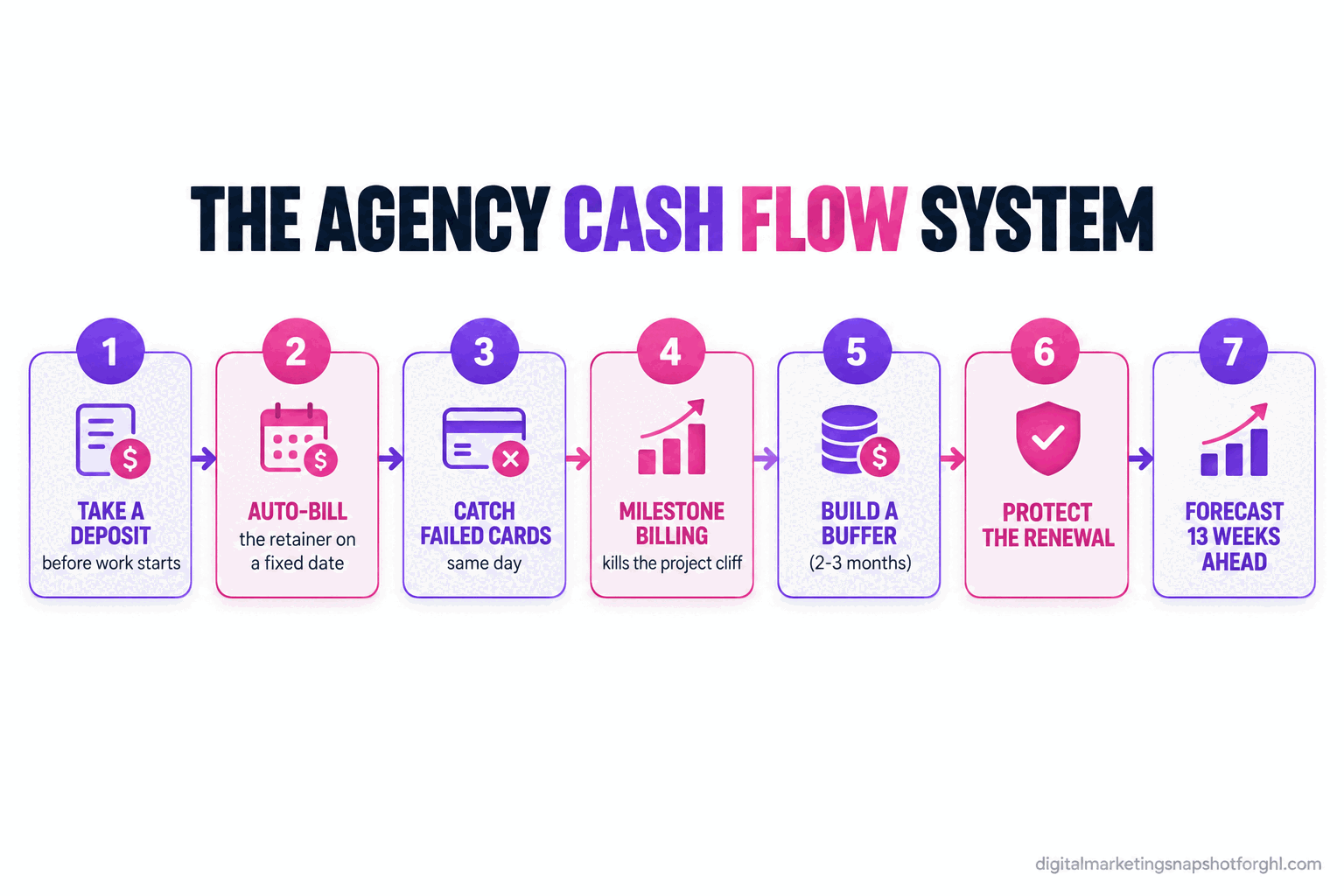
Think of every dollar as moving through a pipeline, the same way a lead does. Work happens, you invoice, the client pays, the money clears, then you can use it. Each handoff is a place cash gets stuck, and this system attacks the stuck points in order.
- Take a deposit before the work starts.
- Auto-bill the retainer on a fixed date, card on file.
- Catch failed cards the same day they decline.
- Bill projects in milestones, not one lump at the end.
- Build a buffer sized for your real volatility.
- Protect the renewal so retainers never lapse by accident.
- Forecast 13 weeks out so a slow month is never a surprise.
You do not need enterprise finance software, just something that holds a card on file, bills on a schedule, and tells you when a charge fails. GoHighLevel does this natively, which is why we build the billing side on it, but the stages matter more than the tool.
Stage 1: Take money before the work starts
This is the biggest single change in the guide. A deposit, setup fee, or first-month-in-advance charge moves revenue to the front of the job. Instead of doing four weeks of work and hoping a net-30 invoice lands, you have cash before the kickoff call.
For a retainer, bill the first month on the day they sign. For a project, take 50% up front and 50% on delivery, or a non-refundable setup fee covering onboarding that also filters out tire-kickers who were never going to pay.
Steal this deposit clause:
A non-refundable onboarding fee of $[X] is due on signing and covers account setup, strategy, and the first two weeks of work. Monthly retainer billing of $[Y] begins on the [1st] of the following month and recurs on the same date each month via the card on file.
How it breaks. The usual failure is caving on the deposit to close a nervous prospect. Waive it once and you are back to financing every engagement yourself. The second failure is a setup fee too small to cover the onboarding hours, which quietly reintroduces the gap you were closing. Price it against real hours, not a round number that feels polite.
Stage 2: Auto-bill the retainer on a fixed date, card on file
Manual invoicing is a cash-flow tax you pay every month. You send the invoice late because you were delivering, the client pays late because that is the base case, and your most predictable revenue arrives on a random day. Retainers are recurring, so bill them like a subscription: card on file, same date every month, automatically.
Pick one billing date and move every client toward it over a renewal cycle, so you know when the bulk of the month’s cash lands. Store the card at signing, not three weeks in.
Steal this card-on-file onboarding line:
To keep your account active and avoid service interruptions, we keep a card on file and bill your monthly retainer automatically on the [1st]. You will get a receipt each time, and we will always notify you before any change to your plan.
How it breaks. The two classic failures are no card on file and no fixed date. Without a card, you are chasing invoices again; without a fixed date, retainers scatter across the calendar and cash lands in dribs you cannot plan around. Make both non-negotiable parts of onboarding, and if a client truly cannot do card-on-file, put them on strict net-7 with auto-reminders, not net-30 on trust.
Typical days from work delivered to cash in the account, by billing method. Manual net-30 reflects the 45-day average US B2B term. Illustrative. Source: Atradius USA Payment Practices Barometer 2025.
Stage 3: Catch failed cards the same day they decline
Here is the leak almost nobody watches. Cards expire, hit limits, and get flagged for fraud all the time. When a retainer charge fails and nothing catches it, you lose that month silently, and often you do not notice until you reconcile weeks later, by which point the client has had a free month and the conversation is awkward.
This is involuntary churn, and it is bigger than most operators think. Across subscription businesses, failed and expired cards drive a large share of total churn, commonly cited between 20% and 40%, and recovering a failed payment quickly keeps that client on the books for many more months (Recurly). Most card failures are a dead card, not a decision to leave, so catch it the same day with a dunning sequence: retry the card automatically, then message the client on two channels.
Steal this failed-payment sequence:
Same day, text: “Hi [Name], heads up: the card on file for [Agency] just declined your monthly payment. Totally normal, usually an expired card. Update it in 30 seconds so nothing pauses: [link]”
Day 2, email: Subject “Quick fix: your [Agency] payment didn’t go through.” Restate the link, the amount, and that service continues once it clears.
Day 4: a call or personal text from the account manager if it is still open.
How it breaks. The failure is treating a declined card like a collections problem instead of an admin blip. Aggressive “pay now” language on day one scares a good client over a reissued card. Keep the first touch friendly, with a one-tap update link, and escalate only if it stays unpaid past a few days.
Stage 4: Kill the project cliff with milestone billing
Retainers smooth cash. Projects do the opposite. A one-off build pays once, often at the end, and revenue falls off a cliff until the next project lands. If project work is a meaningful part of your mix, that cliff is probably why the account swings so hard.
Bill projects in stages tied to milestones, not a single final invoice: a third on signing, a third at an agreed midpoint like design approval, a third on delivery. Pair it with a service like a productized website build where the stages are obvious and the client knows what triggers the next payment. Milestone billing turns one scary lump into three predictable landings and protects you if a client goes quiet halfway through.
How it breaks. The usual failure is a vague midpoint. “Halfway done” is an argument; “design approved in writing” is a trigger. Tie each milestone to a signed-off deliverable so the payment is automatic, not a negotiation. The second failure is letting scope creep eat the gap between milestones without re-billing, a margin leak we covered in why agency margin shrinks as you grow: a change in scope is a change order, and a change order is a new line of cash.
Disclosure: the GoHighLevel link above is an affiliate link. If you start a plan through it we may earn a commission, at no extra cost to you.
Stage 5 to 7: Buffer, renewal, and the 13-week forecast
Stage 5, build a buffer that survives a slow month. A buffer lets you ride out the month a big client pauses or a project slips. The 27-day median is thin for anyone, and dangerously thin for an agency whose income arrives in lumps. Target two to three months of fixed outflows (payroll, contractors, software, owner’s draw), funded by routing the Stage 1 deposits and a fixed slice of each retainer charge into a separate account you do not touch for operations. Automate the top-up so it rebuilds itself, and never confuse the buffer with profit.
Stage 6, protect the renewal. A retainer that lapses by accident is the most expensive churn, because the client did not even decide to leave. Automate a renewal runway: a reminder 30 days out, a recap of what you delivered, and a card-expiry check before the date. The retention playbook lives in structuring retainers to cut churn.
Stage 7, forecast 13 weeks out. Once billing is on fixed dates, a forecast is finally possible. A 13-week cash forecast is the operator’s standard: a simple sheet of each week’s expected inflows and outflows. It just needs to show you the week the line goes red early enough to act, while you still have options.
Three agencies, three cash profiles
The system is the same; where you focus changes with your size and engagement model, not your location. Your mix of retainer, project, and performance work is what changes your cash timing.
Solo or 1 to 3 person, mostly retainer
Your whole risk is concentration. Lose or pause one retainer and you can be down 30% of revenue overnight. Your priorities are Stage 1 (deposits, so new work funds itself) and Stage 5 (a buffer sized to survive losing your biggest client for a month). Never skip the buffer; at your size it is the difference between a bad month and a crisis.
The 10-person agency, retainer plus projects
You have enough clients that failed cards and scattered billing dates are a real leak, and enough project work that the Stage 4 cliff whipsaws your account. Your priorities are Stage 2 (everyone on one billing date), Stage 3 (automated dunning), and Stage 4 (milestones on every project). This is where the 66.4% utilization reality bites hardest. See billable utilization for agencies for the margin side.
The 20-plus agency, mixed retainer, project, and performance
Performance deals are the worst cash profile there is: you fund the work for weeks and get paid last. If performance work is in your mix, back it with fat deposits and a large buffer, never thin cash. Your priorities are Stage 6 (renewal protection across dozens of accounts, where a 2% accidental-lapse rate is real money) and Stage 7 (a disciplined forecast). The SaaS-mode recurring-revenue mechanics become worth the setup at this volume.
The contract and compliance side nobody budgets for
Cash-flow automation touches a few rules worth getting right, since a billing dispute is also a cash-flow event.
Stored-card authorization. Charging a card on file automatically needs the client’s clear, written consent to recurring charges, with the amount and cadence stated. Put it in the agreement, not a footer: a clean authorization is your best defense against a chargeback that claws back cash you already counted.
Late fees and surcharges in writing. A late fee you did not agree in the contract is usually unenforceable, and card surcharging is regulated and banned in some states. To charge for late payment, put it in the signed agreement as a stated rate.
Dunning emails are commercial messages. The failed-payment emails in Stage 3 are business correspondence, so keep them honest under the FTC’s CAN-SPAM rules: truthful subject lines, a real reply path, no “account suspended” claim unless it is true. None of this is legal advice, but an hour with a lawyer on your agreement pays for itself the first time it stops a chargeback.
Objections
“My clients will push back on deposits and card-on-file.” Some ask, few walk. Position it as standard practice, because it is: every tool they already pay for keeps a card on file and bills automatically. Frame it around them (“so your service never pauses over an expired card”), not around your cash flow. The ones who refuse any deposit or stored card are often the ones who pay late, useful to know before you sign.
“We are too small for a forecast and a separate buffer account.” Small is when a thin account does the most damage, because one late payment is a bigger share of your total. The forecast is one spreadsheet, the buffer one extra bank account with a standing transfer. Both take an afternoon.
“Isn’t this just squeezing clients harder?” No. You are not charging more; you are charging on a schedule that matches the work instead of lagging it by 45 days. Clients prefer predictable auto-billing with receipts to surprise invoices, and a deposit buys them a faster start.
“We already use an invoicing tool, so we are covered.” Invoicing is Stage 2 at best. It does not take deposits at signing, automate same-day dunning, or do anything for your buffer or forecast. The tool sends the bill; the system decides when the cash lands.
FAQ
Agency cash flow: quick answers
What causes cash flow problems for marketing agencies?
Timing, not sales. You do the work, invoice, wait on payment that is late in 43% of US B2B cases, then wait again for projects that pay at the end. That gap between delivering and collecting, plus a thin buffer, is the retainer-to-retainer feeling. Move cash earlier with deposits and auto-billing, and hold more in reserve.
How much cash buffer should an agency keep?
More than the roughly 27-day median small businesses hold, because agency income is lumpy. A practical target is two to three months of fixed outflows: payroll, contractors, software, and the owner's draw. Fund it automatically from deposits and a fixed slice of each retainer charge, in a separate account you do not touch.
Should agencies charge a deposit or setup fee?
Yes, for almost every engagement. A non-refundable onboarding fee or first-month-in-advance charge moves revenue to the front of the job and filters out clients who were never going to pay. For projects, 50% up front and 50% on delivery, or milestone thirds, is standard.
What is involuntary churn and why does it hurt cash flow?
It is revenue lost to failed payments, expired cards, and declined charges rather than clients choosing to leave, commonly 20% to 40% of subscription churn. It hurts because it is silent: a charge fails, nobody catches it, and you lose the month. Same-day dunning recovers most of it.
Do performance-based deals wreck agency cash flow?
They have the hardest cash profile: you fund the work for weeks and get paid last, on results. Performance work can be great business, but only backed by solid deposits and a large buffer. One delayed payout can take down an agency that is otherwise profitable.
The bottom line
Go back to the 2nd of the month. The retainers all billed on the 1st, on fixed dates with cards on file. The one card that expired got caught the same morning and the client updated it before lunch. The late invoice is annoying but not a crisis, because the buffer covers the gap and the forecast saw it coming. The wrapped project did not drop revenue to zero, because the next already took a deposit.
That is what cash-flow discipline buys you: decisions made because they are right for the agency, not because the account is thin on a Tuesday. Take money before the work, bill on a schedule, catch the failures, keep a buffer. The clients were never the problem. The timing was, and that you can control.
Related reading: how to price marketing agency retainers, structuring agency retainers to cut churn, and why agency margin shrinks as you grow.