
It is a Tuesday and you have three tabs open: a project tool nobody updates, a spreadsheet tracking which retainer is late, and a Productive.io pricing page that says “$10 per user” in big friendly numbers. Ten dollars times your five people is fifty bucks a month. You can afford that. So you start the trial, invite the team, and two weeks later a billing summary lands that is nothing like the number in your head.
That gap is the whole story. Productive.io is a genuinely good agency operations platform, but its sticker price and its real price are two different animals. The difference is what a small shop gets caught by: a seat minimum, a per-seat meter that climbs when you hire, a change fee buried in the docs, and a top tier with no public number.
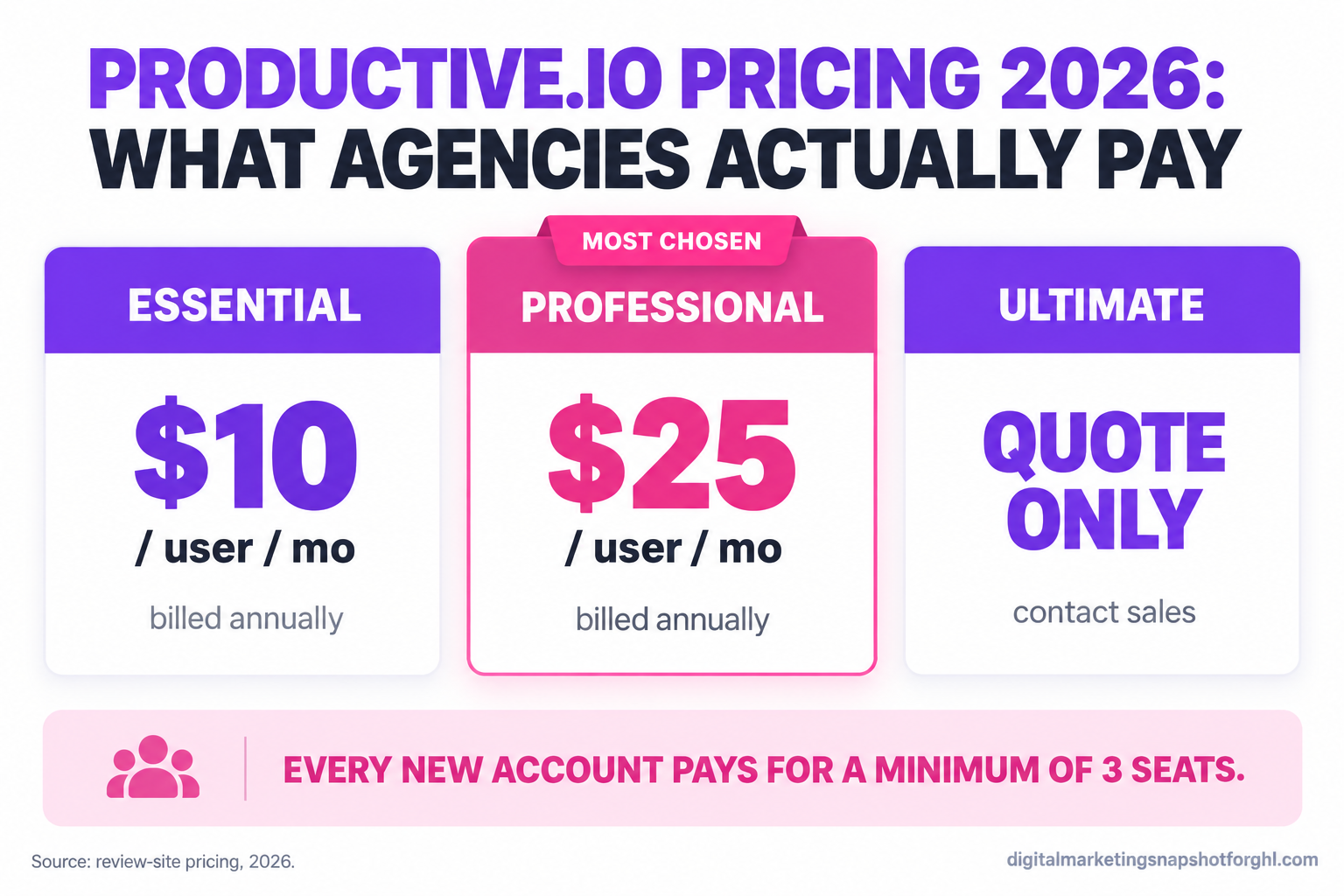
Here is the short answer. Productive.io lists Essential at about $10 per user per month and Professional at about $25 on annual billing, but every new account pays for at least three seats, the price scales with headcount rather than revenue, and the top “Ultimate” tier is quote-only. For a solo operator the real floor is roughly $360 a year on Essential, not $120. For a 10-person shop on Professional it is about $3,000 a year. For a 25-person shop it is about $7,500, which is where a flat-fee platform starts to win on cost alone.
What this article covers
- Why the price feels smaller than the bill
- What Productive.io actually costs in 2026
- The three tiers, side by side
- Three scenarios: solo, 10, 25 people
- Five ways the pricing bites a small agency
- Steal this: the demo script and true-cost formula
- What Productive does not do
- The compliance cost no ops tool quotes
- Objections
- FAQ
Why the price feels smaller than the bill
Per-user pricing is not dishonest, it is just framed to look smaller than it is. What your brain skips is the multiplier, the minimum underneath it, and the annual lock. And it matters more in 2026 because the money is tighter. Billable utilization across professional services firms fell to 66.4% in 2025, the lowest in the history of the benchmark, against the 75% the industry treats as the high-performer line (SPI Research 2026 Benchmark, 509 firms, via Certinia). When a third of your paid hours are not billable, a cost that climbs with headcount is the wrong line to grow. Fixing that is its own project, covered in how to lift billable utilization.
What Productive.io actually costs in 2026
Productive publishes two of its three prices and hides the third. Here are the reported 2026 numbers, with sources, because the exact figures move.
Essential: the entry tier
Essential runs about $10 per user per month billed annually, or $12 monthly (ERP Research, 2026). It covers the core: project and task management, time tracking, budgeting, resource planning, reporting, an AI assistant and API access (Project-Management.com, 2026). For a lot of small shops that is enough. The catch is the floor. New accounts pay for a minimum of three seats, and guests you invite do not count toward paid seats (Software Advice, 2026). So the real starting price is three times the sticker, around $30 a month, even solo.
Professional: where the agency features live
Professional is about $25 per user per month annually, or $29 monthly (Project-Management.com, 2026). It is the tier agencies get nudged toward, because it adds what separates a project tool from an ops platform: recurring budgets, rate cards, billable time approvals, advanced reports, and HR and invoicing integrations. That is a 2.5x jump per seat for features a two-person shop may never open.
Ultimate: the “let’s talk” tier
The top tier is quote-only. Some review sites peg it near $33 to $40 per user per month (Software Advice, 2026); others list it as custom. It carries revenue forecasting, a scenario builder, multiple subsidiaries, SSO and 2FA, and webhooks. For a small agency it is a non-answer: you cannot plan around a number you are not shown until a rep learns your budget.
The add-ons and the fine print
Syncing time-off data from an HR tool is reported at about $2 per seat on top (Project-Management.com, 2026). Adding seats mid-cycle can trigger a one-time adjustment fee rather than a clean prorate. Volume discounts only open up around 50-plus users. And the $10 and $25 numbers are annual-billing rates that lock you in for a year; the monthly rate is the honest comparison for a shop that might change its mind.
The three tiers, side by side
| Essential | Professional | Ultimate | |
|---|---|---|---|
| Per user / month (annual) | ~$10 | ~$25 | Quote only (~$33-40 reported) |
| Per user / month (monthly) | ~$12 | ~$29 | Quote only |
| Minimum paid seats | 3 | 3 | Sales-defined |
| Project, time tracking, budgeting, resourcing | Yes | Yes | Yes |
| Rate cards, billable approvals, advanced reports | No | Yes | Yes |
| Revenue forecasting, scenario builder | No | No | Yes |
| SSO / 2FA, multiple subsidiaries | No | No | Yes |
| Price you can plan around today | Yes | Yes | No |
Prices reported by review aggregators, 2026 (Project-Management.com, Software Advice). Confirm current figures before you sign.
Three scenarios: what a solo, a 10-person and a 25-person agency really pay
The per-seat model means there is no single “Productive price.” Here is the real annual math for three common shapes, using the Professional tier, the one most agencies land on.
The solo operator or two-person shop
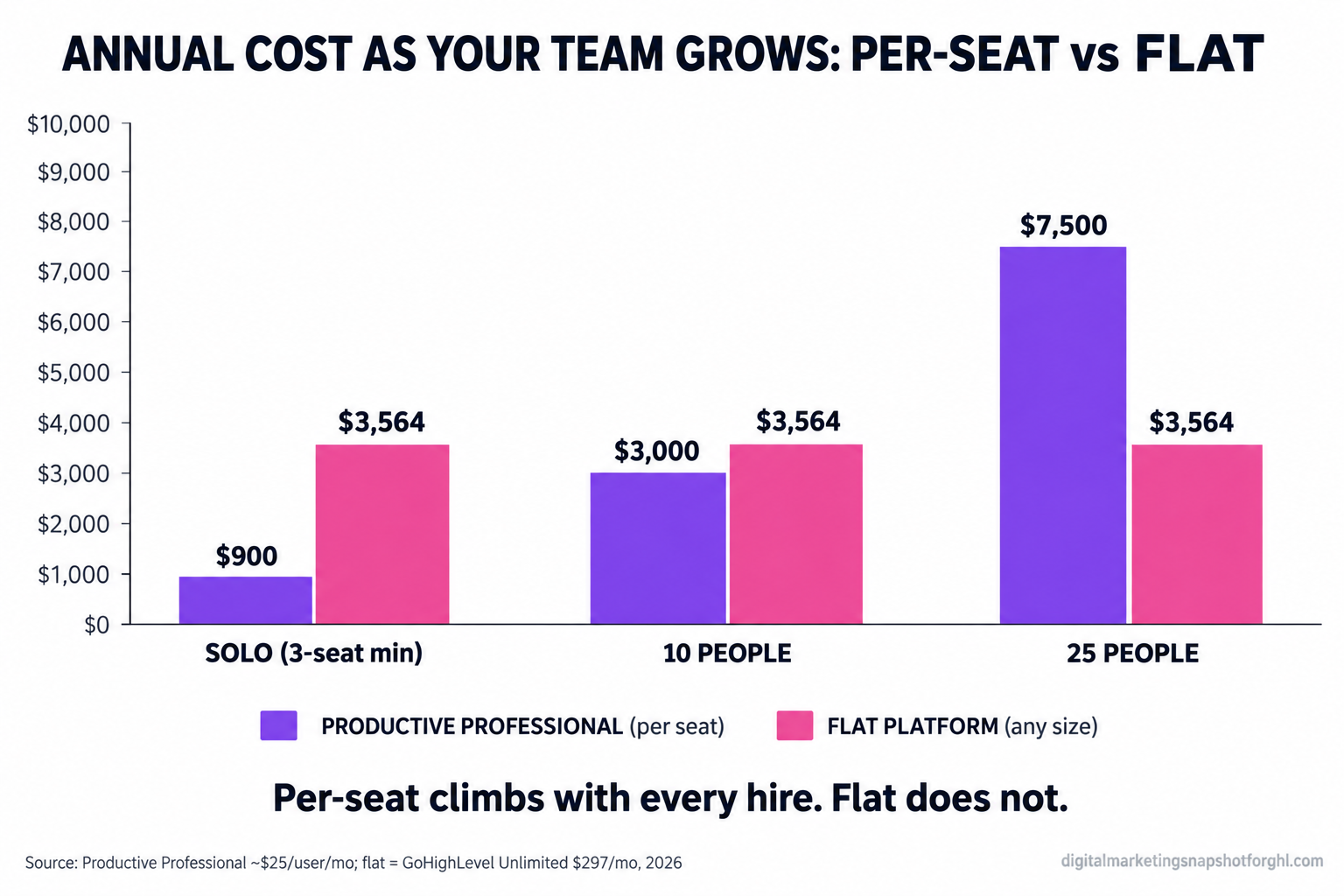
You expect to pay for one or two seats. The three-seat minimum means you pay for three regardless. On Professional that is 3 x $25 = $75 a month, about $900 a year, for software two people use. On Essential, about $360 a year. Productive is priced for a team you do not have yet; you are pre-paying for seats to grow into.
The 10-person agency
Ten seats on Professional is 10 x $25 = $250 a month, $3,000 a year. On Essential, $1,200 a year. This is the band where Productive’s depth earns its keep: you have utilization to track, budgets to protect, and approvals worth enforcing. The $3,000 is defensible if you actually run on rate cards.
It is also where a flat-fee platform draws level. GoHighLevel publishes $97, $297 and $497 a month with no per-seat charge (GoHighLevel pricing). Its Unlimited plan at $297 is about $3,564 a year flat, for any number of users, within a few hundred dollars of Productive Professional at ten people.
The 25-person agency
Twenty-five seats on Professional is 25 x $25 = $625 a month, $7,500 a year, climbing with every hire. On Essential, $3,000 a year. That same flat platform is still $3,564 a year at 25 people, because it does not meter seats. The 25-person shop pays roughly double for Productive Professional.
The same picture another way, holding the team at ten and comparing the two Productive tiers against a flat platform fee.
Annual cost (USD) for a 10-person agency. Flat platform = GoHighLevel Unlimited at $297/mo. Sources: Project-Management.com, 2026; GoHighLevel pricing.
Disclosure: the GoHighLevel links in this article are affiliate links; if you start a plan through one, we may earn a commission at no extra cost to you. The prices come from GoHighLevel’s public pricing page.
Five ways the pricing bites a small agency
The sticker is not where small shops lose money. These five are.
1. The three-seat minimum taxes the smallest shops hardest
A solo founder pays 300% of the per-seat sticker on day one, because the floor is three seats. The model is upside down for the people most likely to be price-sensitive. Do this: if you are under three people, price Productive as a three-seat purchase and ask whether you would buy three seats of anything right now.
2. Every hire raises your software bill before it raises your revenue
Hire a coordinator in January, your bill goes up in January, and the revenue that hire generates might not land until March. For a shop managing cash flow between retainers, that timing is backwards. Do this: model the fully loaded seat cost into your hiring math. A $25 seat is $300 a year.
3. The quote-only top tier anchors you to your budget, not the software
The moment a rep learns your team size and spend before quoting Ultimate, the number is anchored to what you can pay, not what the software costs. That is the whole reason it has no public price. Do this: make them put a per-seat number in writing before you share headcount. Script below.
4. The mid-cycle seat change fee
Adding seats partway through a cycle can trigger a one-time adjustment fee rather than a clean prorate (Software Advice, 2026). For a shop that adds people in ones and twos, those fees never show in the headline comparison. Do this: ask, in writing, what happens to your bill when you add a seat on day 40 of a cycle.
5. Paying Professional for features you will never open
The jump to Professional is 2.5x per seat, for rate cards, billable approvals and recurring budgets. If you bill flat retainers and not hourly, half of that may be dead weight on every seat. Do this: name three Professional-only features you will use this quarter. If you cannot, Essential plus a spreadsheet may beat it for a year.
Steal this: the demo-call script and the true-cost formula
Two things you can copy today: the script that forces a real number out of a sales call, and the formula that turns any per-seat sticker into the number that lands on your card.
And the math. Any per-seat tool costs this per year, not what the sticker says:
For the broader version across every major agency tool, not just Productive, see agency management software pricing in 2026, the pillar this post sits under.
Disclosure: the GoHighLevel link above is an affiliate link; if you start a plan through it we may earn a commission at no extra cost to you.
What Productive does not do (and what you still pay for)
This is the part the per-seat math leaves out. Productive is an internal operations platform: time, budgets, resourcing and profitability for your own team. It does not do the client-facing work. It is not a CRM for your clients’ leads, it does not send SMS or email for clients, and it does not build the white-label dashboard your client logs into. For that layer most agencies pay AgencyAnalytics, near $20 per client per month annually (Reporting Ninja, 2026), a meter that climbs every time you win a client. We mapped the ways off it in AgencyAnalytics alternatives that do not charge per client.
So the honest total for a small agency is often two per-unit meters at once: Productive per seat, a reporting tool per client. One climbs when you hire, the other when you win. That is why a flat, done-for-you agency platform bundling CRM, messaging and client reporting under one fee can beat a two-tool stack even when neither tool is overpriced alone. The project-side comparison is in HighLevel versus ClickUp for agencies.
The compliance cost no ops tool quotes
Whatever you spend on operations software, the client-facing sends carry a compliance cost that never appears on a pricing page, and getting it wrong costs far more than any seat.
If you send SMS on behalf of clients, US carriers require A2P 10DLC registration, and agencies registering campaigns for other brands need a reseller identifier most small shops get wrong the first time. Unregistered traffic gets blocked, so the texts you pay to send never land. The step-by-step is in setting up A2P 10DLC when you send SMS for clients, and the wording is in the TCPA-compliant opt-in script.
Email sends fall under CAN-SPAM: a real physical address and a working unsubscribe on every message. The moment one EU lead enters a client list, GDPR applies. And if you run review automation as a service, the FTC’s revised Endorsement Guides govern it directly: incentivized and fake reviews are banned, and “results not typical” is no longer a defense (FTC Endorsement Guides). Productive touches none of this. Budget for the setup separately, because the fine dwarfs the subscription.
Objections
“We already pay for AgencyAnalytics, so adding Productive is fine.”
Then you are about to run two per-unit meters at once. AgencyAnalytics bills per client, Productive per seat. Win a client and one climbs; hire a person and the other climbs, and neither is capped. Before you add the second meter, price the flat-platform alternative that covers both under one fee.
“Isn’t per-seat pricing fair, though? You pay for what you use.”
Fair in theory, punishing in practice for a service business, because your headcount is your product. Per-seat software gets most expensive exactly when you are scaling and cash is tightest. Fair is not the same as affordable at your stage.
“Do I even need profitability tracking at my size?”
Maybe not yet. Under five people you can usually see your margins without a scenario builder, and a spreadsheet will tell you your billable utilization before a $900-a-year three-seat minimum will. Past ten people, when you genuinely cannot see where hours leak, is when Productive’s depth starts paying for itself.
“Productive looks more professional than a flat all-in-one platform.”
It is a cleaner product for operations, no argument. But your clients never see it. What they log into and judge you by is the reporting dashboard and the communication, which Productive does not provide. Paying a premium per seat for a tool only your team notices is a lot of money for polish.
Frequently asked questions
How much does Productive.io cost per month in 2026?
Essential is about $10 per user per month on annual billing (about $12 monthly), and Professional about $25 annually (about $29 monthly), per 2026 review reporting. The top Ultimate tier is quote-only. Every new account pays for a minimum of three seats, so the real starting cost is three times the per-seat sticker. Confirm current figures on Productive's own pricing page before you sign.
Is there a seat minimum on Productive.io?
Yes. New accounts pay for a minimum of three seats, so a solo operator starts near $30 a month on Essential or $75 on Professional, regardless of seats used. Clients and collaborators invited as guests do not count toward paid seats.
Why doesn't Productive.io publish its Ultimate tier price?
Ultimate is quote-only, which lets a rep anchor the number to your budget after learning your team size. Some review sites report it around $33 to $40 per user per month, but there is no public figure. If you are pushed toward it with fewer than 50 people, ask for a written per-seat number before sharing headcount.
Does Productive.io replace AgencyAnalytics or a CRM?
No. Productive is an internal operations and profitability platform: time tracking, budgeting, resourcing and reporting for your own team. It is not a client CRM, it does not send SMS or email for clients, and it does not provide the white-label dashboard your clients log into. Most agencies run it alongside a per-client reporting tool, which means two meters.
What is the true annual cost of Productive.io for a 10-person agency?
About $1,200 a year on Essential (10 x $10 x 12) or about $3,000 on Professional (10 x $25 x 12), before add-ons like the $2-per-seat time-off sync and any mid-cycle change fees. At that size a flat-fee platform is within a few hundred dollars, and the gap widens as you hire.
When does a flat-fee platform beat Productive.io on cost?
Roughly past 12 to 15 seats on Professional, a flat platform fee (for example GoHighLevel's $297 Unlimited plan, about $3,564 a year for any number of users) costs less than Productive and stops climbing with headcount. A 25-person shop on Professional pays about $7,500 a year, roughly double, because per-seat billing never caps.