
You booked the demo because the website would not tell you the price. Forty minutes later you have seen a slick pipeline board, a rep has asked how many people are on your team, and you still cannot put a number in a spreadsheet. That is the pricing model, and it is why comparing agency management software in 2026 feels like buying a car where every sticker says “call us.”
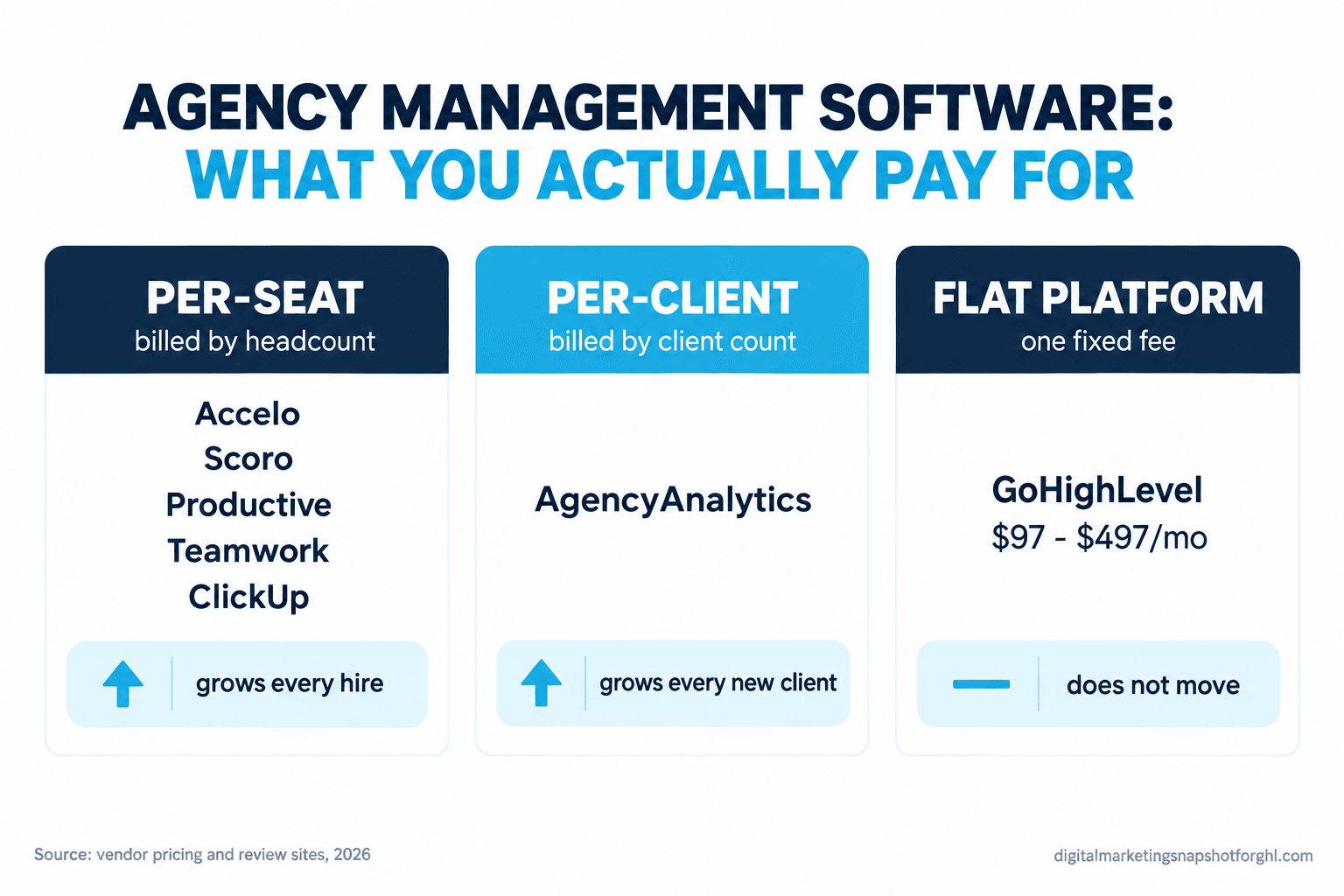
Here is the short version. Agency management software prices three ways, and each bills you for a different kind of growth. Per-seat tools (Accelo, Scoro, Productive, Teamwork, ClickUp) cost more every time you hire. Per-client tools (AgencyAnalytics) cost more every time you win business. Flat-platform tools like GoHighLevel charge one fee that does not move when you add either. The trap: the price you finally pry out of a rep is rarely the real one, because seat minimums, annual locks and setup fees sit underneath it.
What this article covers
- Why the price is behind a demo
- The three pricing models, and who each punishes
- What each tool actually costs in 2026
- The side-by-side table
- Three scenarios: solo, 10-person, 20-plus
- Five ways the pricing breaks you
- Steal this: the demo-call script and true-cost formula
- The compliance cost nobody quotes
- Objections
- FAQ
Why the price is behind a demo in the first place
Vendors hide pricing partly because cost genuinely varies by seat count and setup, and partly because a rep who learns your team size and spend before quoting can anchor the number to your budget, not the software. Walk in blind, negotiate blind.
This matters more in 2026 because margins are thinner. Billable utilization across professional services firms fell to 66.4% in 2025, the lowest in the history of SPI Research’s benchmark, against the 75% mark the firm treats as the high-performer target (SPI Research 2026 Professional Services Maturity Benchmark, 509 firms, via Certinia). A fixed cost that grows with headcount or client count is the wrong expense to sign blind.
The three pricing models, and who each punishes
Every tool fits one of three models, and the model, not the sticker, decides what you pay in two years.
Per-seat. You pay per user per month (Accelo, Scoro, Productive, Teamwork, ClickUp). Cost grows every time you hire, and seat minimums make it worse for small teams.
Per-client. You pay by clients served. AgencyAnalytics is the clearest case, near $20 per client per month annually (Reporting Ninja, 2026). The bill grows every time you close a retainer. We covered the ways off that meter in AgencyAnalytics alternatives that do not charge per client.
Flat platform. One fee that does not move with seats or clients. GoHighLevel publishes $97, $297 and $497 a month (GoHighLevel pricing), no per-user or per-contact charge. The catch is scope: it is a full CRM and automation system, so more to set up than a single-purpose app.
Disclosure: the GoHighLevel link above is an affiliate link; if you start a plan through it we may earn a commission, at no extra cost to you.
What each tool actually costs in 2026
Where a vendor hides its numbers, the figures come from review sites, and I say so.
Accelo: the full blackout
Accelo is the teardown target: it publishes nothing, and every tier says “contact sales.” Review sites consistently report four tiers, Core, Professional, Business and Advanced, at roughly $20, $50, $70 and $90 per user per month (Capterra, 2026), with about three seats wanted on entry and higher minimums on upper tiers (research.com, 2026). Onboarding packages cost extra and are also unpublished. Treat every Accelo number as reported, not quoted. A ten-person shop on the Business tier runs roughly $700 a month before any setup fee.
Scoro: the seat-minimum trap
Scoro publishes three tiers and hides the fourth: Essential $26, Standard $37, Pro $63 per user per month annually, Ultimate custom (Agiled, 2026). The headline omits the 5-seat minimum on every plan: entry is not $26 but 5 times $26, about $1,560 a year, even if two of you use it. Standard and Pro run higher, and monthly billing adds 8 to 13 percent.
Productive.io: honest headline, custom ceiling
Productive is more transparent: Essential about $10 per user per month annually ($12 monthly), Professional about $25 ($29 monthly), Ultimate custom (ERP Research, 2026), with a small seat minimum (around three) and a custom ceiling.
Teamwork.com: two prices shown, two hidden
Teamwork.com offers a free tier for up to five users, then per-seat plans: Deliver around $13.99, Grow around $25.99, Scale around $69.99 per user per month, Enterprise custom (costbench, 2026). Tier naming has shifted, so confirm on the live page, but the shape holds: two public prices, a sales call for the top.
ClickUp: cheapest sticker, most bolt-ons
ClickUp is the price leader: Free, Unlimited about $7, Business about $12 per user per month annually, Enterprise custom (Vendr, 2026), with month-to-month about 40 percent higher. The catch is scope: ClickUp is project management, not agency software. It does no client reporting, sales CRM or client messaging, so agencies pair it with a reporting tool and a CRM, and the cheap line item quietly becomes three.
AgencyAnalytics and GoHighLevel: the other two models
For contrast, the per-client and flat models: AgencyAnalytics starts near $59 a month for five clients and scales about $20 per extra client, so roughly $179 at ten (Reporting Ninja, 2026), while GoHighLevel stays at $97, $297 or $497 at any size (pricing; our tier breakdown).
A ten-person agency pays this per month under each, using per-seat mid-tiers and the flat Unlimited plan:
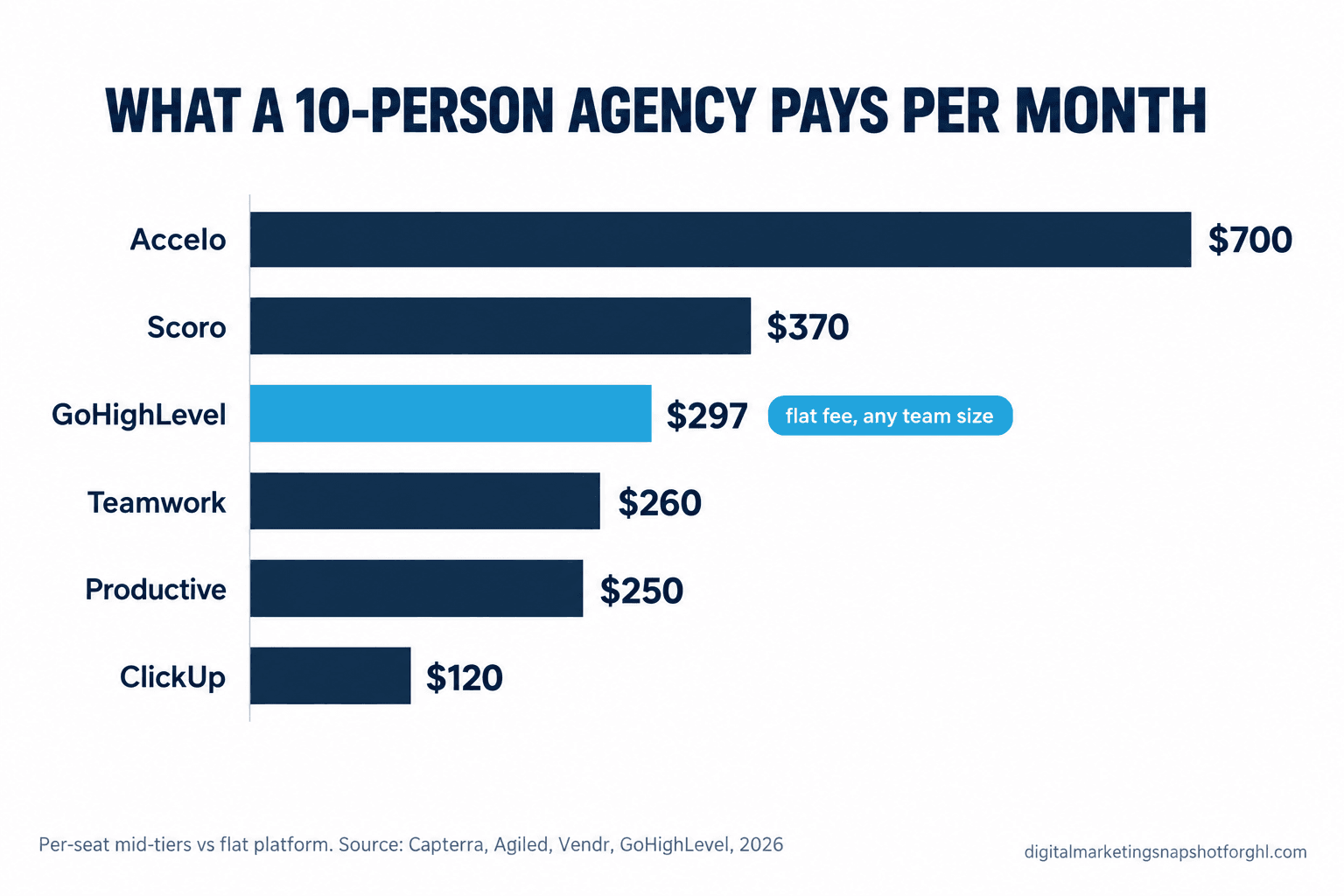
10-person costs use each per-seat tool’s mid-tier (Accelo Business ~$70/user reported, Scoro Standard $37, Teamwork Grow ~$25.99, Productive Professional $25, ClickUp Business $12) versus GoHighLevel Unlimited (flat $297). Sources: Capterra, Agiled, costbench, Vendr, GoHighLevel, 2026.
ClickUp looks like the runaway winner there. Remember what it leaves out before you crown it, because that gap is the rest of this article.
Side-by-side: the models compared
Entry price tells you where a tool starts. The model tells you where it ends up.
| Tool | Billing model | Real entry cost | What grows the bill | Published? |
|---|---|---|---|---|
| Accelo | Per seat | ~$50-$90/user + seat min | Every hire | No, demo only |
| Scoro | Per seat | ~$1,560/yr (5-seat floor) | Every hire | 3 of 4 tiers |
| Productive | Per seat | ~$10-$25/user | Every hire | 2 of 3 tiers |
| Teamwork.com | Per seat | Free, then ~$14/user | Every hire | 2 of 4 tiers |
| ClickUp | Per seat | Free, then ~$7-$12/user | Every hire | 3 of 4 tiers |
| AgencyAnalytics | Per client | ~$59/mo (5 clients) | Every new client | Yes |
| GoHighLevel | Flat platform | $97-$497/mo | Nothing | Yes |
Only the flat model has “nothing” in the grow-the-bill column. And the tools that hide the most (Accelo, then Scoro’s fourth tier) are the ones whose real cost sits furthest from their sticker. Opacity and cost travel together.
Three scenarios: solo, 10-person, and 20-plus
The right answer changes with size. Same decision, three ways, at annual mid-tiers.
The solo operator or 2-person shop
At two people, per-seat looks cheap until the minimums bite. ClickUp Business is about $24 a month, Productive around $50 to $75 with the seat floor, Teamwork about $52. Scoro still charges for five seats, so its “cheap” Standard plan is $185 a month for two users: you pay for a team you do not have. If you mostly need task tracking, ClickUp’s free tier is fine, but the moment you need client reporting, a pipeline and messaging, a flat platform at $97 to $297 beats stacking three point tools and will not re-price when you hire.
The 10-person mid-size agency
This is where per-seat starts to hurt. Ten seats of Accelo Business is roughly $700 a month; Scoro Standard $370; Teamwork Grow $260; Productive $250; ClickUp $120. Layer on a reporting tool (AgencyAnalytics at ten clients is about $179) and the ClickUp stack is no longer the cheap option. A flat platform at $297 covers all ten people, every client, the CRM, reporting and messaging in one line, which is why the real question becomes “should software be a per-seat line item at all,” as we show in how to scale an agency without adding headcount.
The 20-plus-person agency
Above twenty seats, per-seat is openly expensive. Twenty-five seats of Scoro Standard is about $925 a month, and Accelo Advanced at that size clears $2,000. A flat platform at $297 to $497 does not care whether you have 20 people or 60, a four-figure monthly swing that compounds every month you stay.
Scoro Standard ($37/user/mo, 5-seat minimum) as a team grows: flat at the $185 floor to 5 seats, then climbing to $925 at 25. A flat platform stays at $297 across every point on this line. Source: Agiled Scoro pricing, 2026.
Five ways the pricing breaks you
The subscription is the number you can see. These five never appear on a pricing page. Price each before you sign.
1. The seat minimum you pay for empty chairs. Scoro’s 5-seat floor is the classic: a three-person shop on a “$26” plan pays for five seats, so its effective cost is $43 per user, not $26. Fix: divide the plan floor by your actual users, not the vendor’s minimum.
2. The annual lock hiding a 40 percent monthly penalty. Most per-seat tools quote the annual rate and charge far more month to month. Fix: get both numbers, and only commit annually to a tool you have already run for a full month.
3. The implementation fee that doubles year one. Accelo, Teamwork and other upper tiers sell onboarding packages, sometimes four or five figures, that never show on the pricing page. Fix: ask “what is the total first-year cost including setup, onboarding and required training,” in writing.
4. The bolt-on stack that eats the savings. ClickUp is cheap because it does one job. An agency also needs reporting, a CRM and messaging, so the cheap tool anchors a three-tool stack. Fix: price the whole job, not the one tool.
5. The growth tax you only feel at renewal. Per-seat and per-client both raise your bill for succeeding, and you do not feel it until renewal week. Fix: project twelve months out, price every option at today’s size and next year’s, and buy the flattest line.
Steal this: the demo-call script and true-cost formula
When a vendor makes you book a call to learn the price, walk in with a script and write down the answers. It turns a sales pitch into a data-gathering call.
Seven questions to ask on any hidden-pricing demo:
- “What is the per-user, per-month price on each tier, on annual and monthly billing?” Get both numbers for every tier, not just the one they push.
- “What is the minimum number of seats I have to pay for?” This is the Scoro trap. Ask it directly.
- “Is there an implementation, onboarding or setup fee, and how much?” Get the figure, not “it depends.”
- “Is required training extra, and is it mandatory to get support?”
- “What is the contract length, and what does it cost to cancel early or export my data?”
- “Which features I just saw in this demo are on the tier you quoted me?” Demos routinely show top-tier features against a mid-tier price.
- “Send me the total first-year cost for my exact team size in writing.” If they will not, that is your answer about the relationship.
The true-cost formula. Do not compare stickers. Compute the real annual cost:
True annual cost = (higher of your users or the seat minimum) x per-user price x 12, on the billing term you will actually use, plus implementation, plus required add-ons and training, plus every other tool you still need to buy to do the whole job.
Run that for each finalist and for a flat platform, at today’s size and your realistic size in twelve months. The tool that wins on sticker rarely wins on that formula, which is the entire reason the sticker is hidden. For the “whole job” side, our custom software versus off-the-shelf tools breakdown lists what a full agency stack has to cover.
The compliance cost nobody quotes
If your agency sends texts or emails on behalf of clients, the platform has to handle messaging compliance, and most per-seat project tools (Accelo, Scoro, ClickUp) do not send client SMS or email at all. So you bolt on another tool, another bill, another compliance surface.
Three rules decide whether that bolt-on is safe. A2P 10DLC: US carriers block unregistered application-to-person texting, and registering campaigns on behalf of clients generally needs a reseller identifier, which small agencies get wrong constantly (CTIA messaging principles); we laid out the process in A2P 10DLC registration for agencies. CAN-SPAM governs every marketing email your clients send, and GDPR applies the moment a client has one EU or UK lead (European Commission, GDPR overview). And if any fulfillment involves collecting reviews, the FTC’s revised Endorsement Guides (2023, at 16 CFR Part 255) ban fake and incentivized reviews and removed the old “results not typical” defense (FTC Endorsement Guides).
Every extra tool holding client data or sending client messages is another processor you are responsible for. One platform you already vet is one compliance surface, not four.
Objections
“Hidden pricing means it is enterprise-grade. Worth paying for?” Sometimes, but “we hide the price” is a sales tactic, not a quality signal. Judge the tool on whether it does your whole job, then run the true-cost formula. Per-seat is also cheapest at the exact moment you are trying to stop being small, so shop the slope, not today’s bill.
“ClickUp is only $12 a user. Why pay more?” Because $12 buys project management, not an agency. Add the reporting tool, CRM and messaging tool ClickUp does not include, and the real stack often costs more than a single flat platform.
“Why would a CRM like GoHighLevel replace agency software?” For most small agencies the jobs overlap: pipeline, client comms, reporting, onboarding and follow-up. A flat platform does those in one system at a price that does not move with headcount. If you run complex multi-stage professional-services retainers with deep resource planning, a dedicated PSA like Accelo may still fit better.
“We already pay for one. Is switching worth it?” Under about five people, usually not for cost alone. Above ten, a flat model repays the migration inside a quarter, and the switch is mostly rebuilding your templates once.
Frequently asked questions
Agency management software pricing: quick answers
How much does Accelo cost in 2026?
Accelo does not publish prices; every tier requires a sales call. Review sites report roughly $20 (Core), $50 (Professional), $70 (Business) and $90 (Advanced) per user per month, with seat minimums of about three on entry tiers and more above, plus unpublished setup fees. Treat these as reported estimates and get your number in writing.
Why is Scoro more expensive than its $26 price suggests?
Scoro enforces a 5-seat minimum on every plan, so the real entry cost of the $26 Essential tier is 5 times $26, about $1,560 a year, even if only two people use it. Standard lands near $2,220 and Pro near $3,780 at the floor, before the 8 to 13 percent monthly-billing surcharge.
What is the cheapest agency management software?
By sticker, ClickUp (free, then about $7 to $12 per user per month annually). But ClickUp is project management only. Once you add the reporting, CRM and messaging tools an agency needs, the stack often costs more than a single flat platform. Price the whole job, not the cheapest tool.
Is per-seat or flat-fee pricing better for an agency?
Per-seat is cheapest for very small teams that will not grow. Flat-fee wins as soon as you are hiring or adding clients, because it does not re-price when you do. Run the true-cost formula at today's size and your size in twelve months, and buy the flattest cost line, not the lowest sticker.
How do I get a real price out of a demo call?
Go in with a script. Ask for the per-user price on every tier (annual and monthly), the seat minimum, the setup and training fees, the contract length and data-export cost, which demoed features are on the quoted tier, and the total first-year cost for your exact team size in writing. If a vendor will not put that in writing, that is itself an answer.
The bottom line
Agency management software hides its price because the real number is usually higher than the sticker, and the model underneath grows your bill as you grow. Per-seat tools tax hiring. Per-client tools tax winning. Only a flat platform charges the same whether you have two people or sixty, five clients or fifty.
So do not shop on the sticker, and do not walk into a demo blind. Ask the seven questions, run the true-cost formula, and buy the flattest line. The renewal week you want is the one where you have hired two people and signed four clients, and your software bill has not noticed.
Related reading: GoHighLevel pricing for agencies, AgencyAnalytics alternatives that do not charge per client, and how to price agency retainers.