
A slow website costs a Raleigh marketing agency clients in three measurable ways: it loses prospects before the pitch (53% of mobile visitors abandon a page that takes longer than three seconds to load), it suppresses conversions (a 0.1-second speed gain lifts conversions by up to 8.4%), and it drops the agency out of Google — Core Web Vitals are still a confirmed 2026 ranking signal. The cruel part is that the business selling speed, funnels, and SEO to everyone else is usually the one running the slowest, most neglected site on its own street. That gap isn’t cosmetic. It’s leaking real retainers.
I’ve spent years on the performance-marketing side, and the single most awkward audit I run is the one on an agency’s own domain. The funnels they build for clients are tight. Their own homepage takes six seconds to paint on a phone, ships a hero video nobody asked for, and hasn’t had its case studies updated since 2024. Below is exactly what that costs — with the sourced numbers — and the fix that takes it off your plate for good.
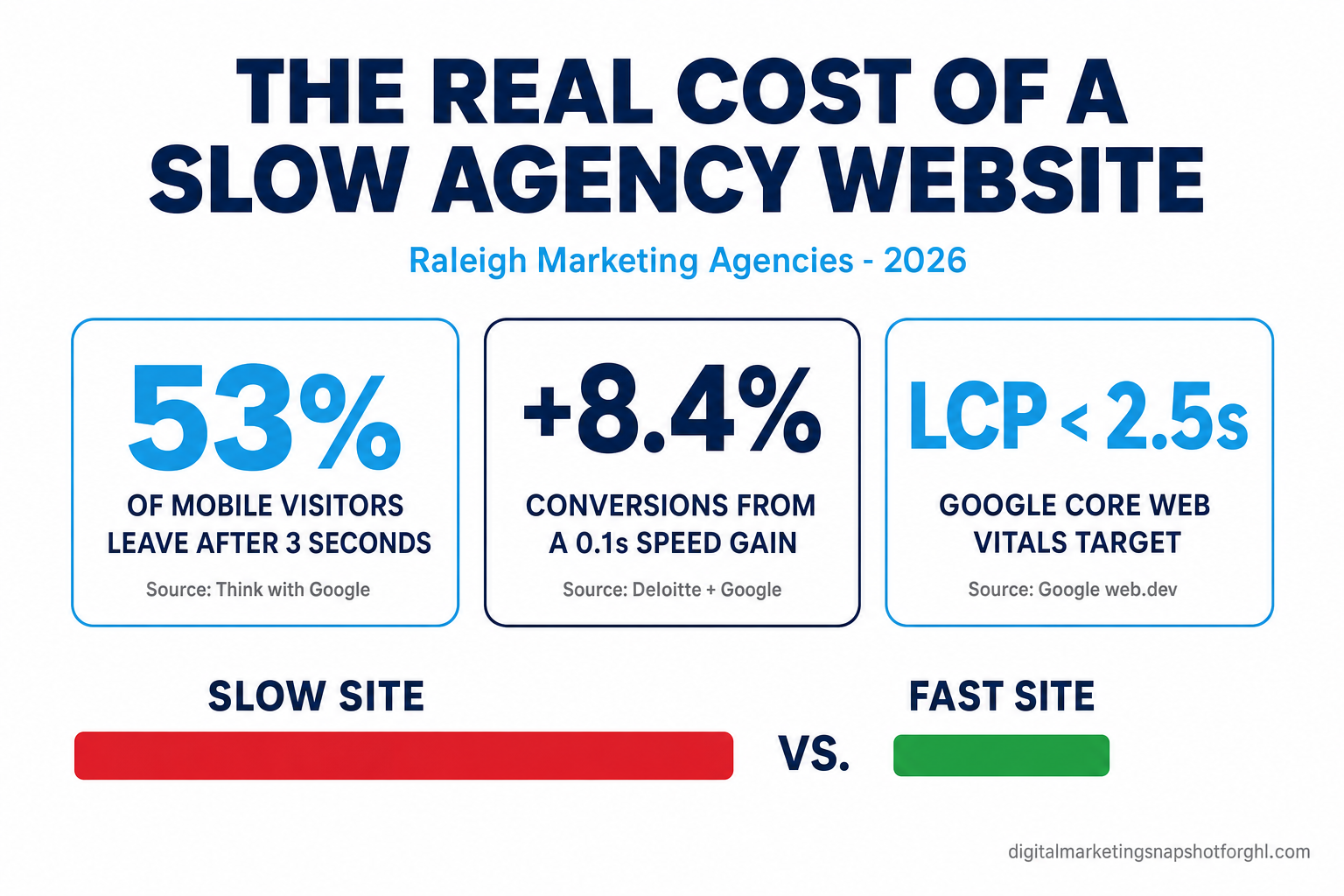
Table of contents
- The job nobody bills for: your own website
- What a slow site actually costs (the 2026 data)
- Cost #1 — You lose the lead before the pitch
- Cost #2 — You suppress your own conversion rate
- Cost #3 — You’re invisible to Google and AI answers
- Cost #4 — A slow, dated site undercuts your fee
- Why this hits Raleigh agencies specifically
- How fast is fast enough? The 2026 benchmarks
- Fix it yourself vs hand off the build
- FAQ
The job nobody bills for: your own website
Every agency I’ve audited has the same blind spot. The client work is sharp because it’s the thing that gets invoiced. The agency’s own website is the job that loses to a client deadline every single week — so it sits there, two years stale, quietly working against new business.
That neglect has a cost curve, and it’s steeper than most owners think. A prospect who found you at 11pm has your site and two competitors’ open in adjacent tabs. Every second yours spends loading is a second they spend reading someone else. And you, of all businesses, are the one who’s supposed to know better. When a marketing agency’s own site is slow, the prospect doesn’t just leave — they draw a conclusion about whether you can be trusted with theirs.
What a slow site actually costs (the 2026 data)
Speed isn’t a vanity metric; it’s a conversion input with a documented dose-response curve. Google’s machine-learning analysis of millions of mobile landing pages found that as page load time goes from one second to three seconds, the probability of a bounce increases 32%. Push it to five seconds and bounce probability climbs 90%; at six seconds it’s 106% (Think with Google). Every second isn’t a rounding error — it’s a compounding tax on every visitor you paid to acquire.
Increase in bounce probability as mobile page load time grows. Source: Think with Google (analysis of 11M+ mobile landing pages).
For an agency, this is doubly expensive. You’re often driving traffic to your own site with the same paid and organic effort you sell to clients — so a slow page burns both the click and the credibility. The lead you lose to a six-second load is a lead you’ll never even see in your CRM to follow up on.
Cost #1 — You lose the lead before the pitch
Most agency owners assume prospects who leave “weren’t serious.” Often, they just left. 53% of mobile visits are abandoned if a page takes longer than three seconds to load (Think with Google) — and with mobile now roughly 58% of all web traffic (Statista, 2025), that’s not an edge case. It’s the majority path to your contact form.
That abandonment happens before anyone reads your positioning, sees your case studies, or fills out an audit request. The decision is made in the loading spinner. And it’s reinforced by how fast humans judge: research published in Behaviour & Information Technology found people form a visual first impression of a website in about 50 milliseconds (Lindgaard et al., 2006). By the time your hero video is buffering, the verdict is already in.
Cost #2 — You suppress your own conversion rate
Speed doesn’t only decide whether someone stays — it moves how many of the people who stay convert. In the Deloitte and Google study Milliseconds Make Millions (30M+ sessions across 37 brands), a mere 0.1-second improvement in mobile site speed lifted retail conversions by 8.4% and average order value by 9.2%, with travel conversions up 10.1% (Deloitte + Google, 2020). A tenth of a second. That’s how sensitive buying behavior is to speed.
Portent’s analysis of 100M+ page views found the same gradient in the other direction: conversion rates drop about 4.4% for each additional second of load time in the crucial 0–5 second range, and the fastest sites convert several times better than the slowest (Portent). For an agency, your “conversion” is a booked audit call or a submitted contact form — the exact events a laggy page suppresses. You’re not just losing visitors; you’re losing a percentage of the ones who were ready to talk.
Cost #3 — You’re invisible to Google and AI answers
Here’s the compounding problem: a slow site doesn’t just convert worse, it gets seen less in the first place. Core Web Vitals remain a confirmed Google ranking signal in 2026, part of the page-experience system. The three metrics and their “good” thresholds — measured on real Chrome users at the 75th percentile — are Largest Contentful Paint (LCP) ≤ 2.5s, Interaction to Next Paint (INP) ≤ 200ms, and Cumulative Layout Shift (CLS) ≤ 0.1 (Google web.dev). (INP officially replaced First Input Delay as the responsiveness metric in March 2024, so an audit citing FID is already out of date.)
The opportunity is that most sites still fail. Only about 48% of mobile sites passed Core Web Vitals in 2025 — up from 44% in 2024 and 36% in 2023, but still barely half (HTTP Archive Web Almanac 2025). Speed is a live ranking advantage, not a solved problem.
Share of mobile websites passing Google Core Web Vitals. More than half still fail. Source: HTTP Archive Web Almanac 2025 (CrUX data).
And it’s no longer only about the blue links. AI answer engines — Google’s AI Overviews, ChatGPT, Perplexity — read fast, well-structured pages with clean schema and meta. If your agency site is slow and thin on structured data, you don’t just rank lower; you never get quoted when a Raleigh business owner asks an assistant “who runs paid social for home-services companies near me?” We break that side of it down in our guide to AI search optimization for marketing agencies — but it starts with a fast, crawlable foundation.
Cost #4 — A slow, dated site undercuts your fee
There’s a softer cost that closes fewer deals than all the others combined, and it’s about trust. You are asking a business to hand you their marketing budget and a monthly retainer. Your website is the entire proof of concept. A tired template with a slow load and 2024 case studies says something about your standards that no pitch deck can undo afterward.
Stanford’s long-running web credibility research found that design and presentation are among the top factors people use to judge whether a business is trustworthy (Stanford Web Credibility Research). Combine that with the 50-millisecond first-impression window, and the message is blunt: prospects decide whether you’re credible almost instantly, and a slow, dated site answers the question for them — in the wrong direction. If you sell web design, SEO, or CRO, the credibility hit is even sharper, because you’re visibly not doing for yourself what you charge others to do.
Why this hits Raleigh agencies specifically
Raleigh isn’t a soft market. The Research Triangle — anchored by NC State, Duke, UNC, and Research Triangle Park with employers like Apple, Google, Cisco, and SAS — has one of the most tech-literate business populations in the Southeast, and a deep base of small businesses that agencies serve. North Carolina is home to roughly 1.1 million small businesses, which make up 99.6% of all NC businesses (SBA Office of Advocacy, 2025). That’s a rich pool of prospective clients — and a crowded field of agencies competing to serve them.
Nationally, there are roughly 105,214 advertising agencies in the U.S., up 3.8% year over year (IBISWorld). In a metro as competitive and technically fluent as Raleigh–Durham, a business owner comparing three agencies will notice which sites load instantly and which stall. When your prospects are Triangle founders and operators who live inside performance metrics, a slow site isn’t a neutral — it’s a disqualifier. Speed is one of the few advantages you can win before you ever get on a call.
How fast is fast enough? The 2026 benchmarks
Aim for a Largest Contentful Paint at or under 2.5 seconds, an INP at or under 200 milliseconds, and CLS at or under 0.1 — the three Core Web Vitals “good” thresholds (Google web.dev). In practical terms, that means a homepage that paints its main content in well under three seconds on a mid-range phone on 4G, with no janky layout shifts as it loads.
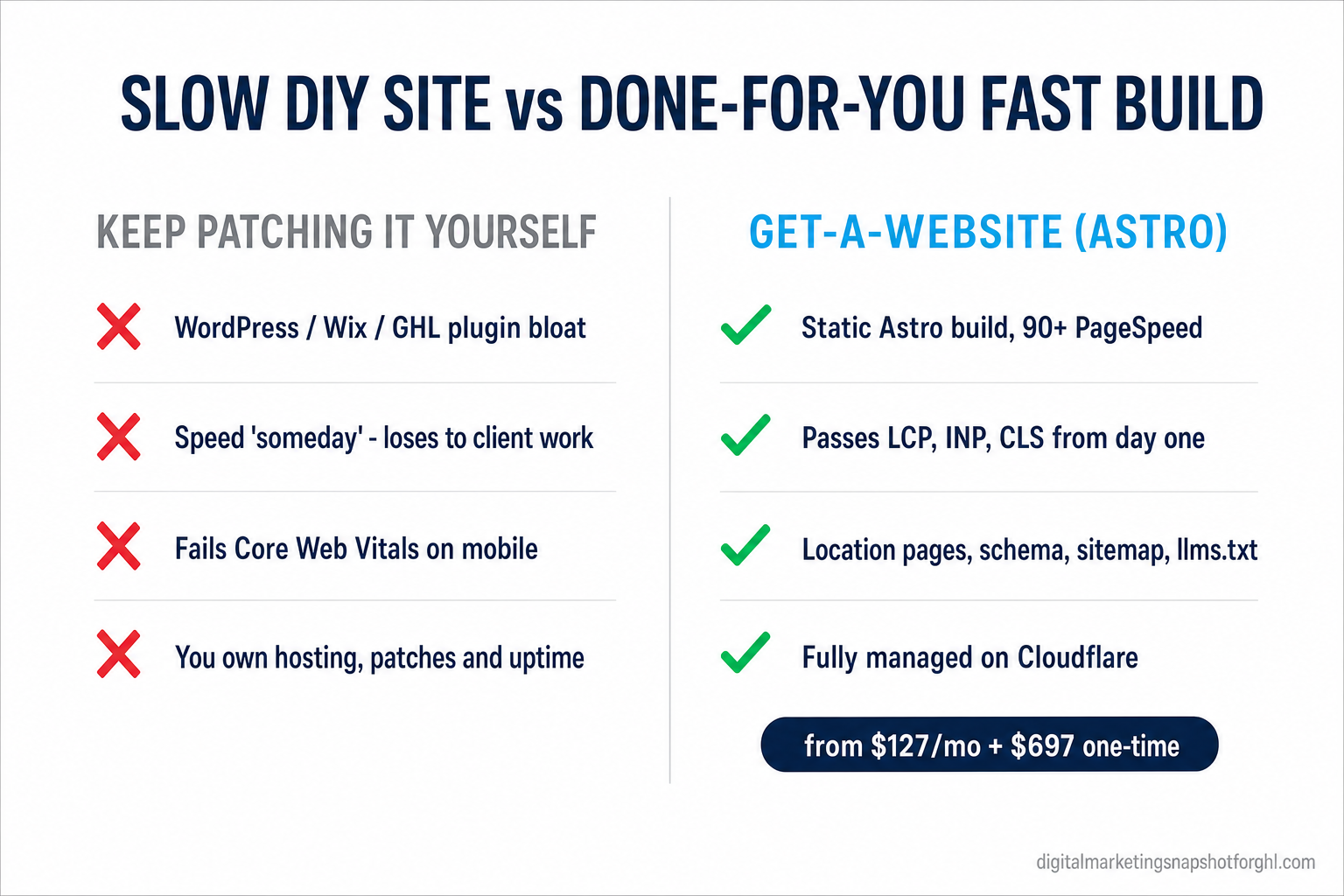
The problem is that the platforms most agencies default to make that genuinely hard. WordPress with a page builder, Wix, and heavy GoHighLevel site builds accumulate plugin bloat, render-blocking scripts, and oversized hero media that push LCP past the threshold on mobile. You can chase it with caching plugins and image compression — an endless internal project — or you can build on a static-first, edge-served stack designed to hit those numbers from day one. That’s the case we make in detail in Astro vs WordPress websites for agencies, and it’s the same reason speed-to-lead discipline matters once the visitor does convert.
Fix it yourself vs hand off the build
You have two honest options: keep the site as an internal project that loses to client work every week, or hand the whole thing to a team that builds it fast, ranks it, and maintains it — so nobody on your side ever logs in for a Saturday patch. Here’s the tradeoff laid out plainly.
Slow DIY site vs a done-for-you fast build
| Plan | Keep patching it yourself | Done-for-you Get-a-WebsiteRecommended |
|---|---|---|
| Price | Your time + hires | from $127/mo + $697 one-time |
| Feature 1 | WordPress/Wix/GHL bloat you fight with plugins | Astro static-first build, guaranteed 90+ PageSpeed |
| Feature 2 | Speed 'someday' — it loses to client deadlines | Faster than WordPress, Wix and GHL by design |
| Feature 3 | Core Web Vitals you check once and forget | LCP/INP/CLS built to pass from day one |
| Feature 4 | No location/service pages, thin schema | Location + service pages, schema, sitemap & llms.txt |
| Feature 5 | Case studies + rate card go stale for months | Retainers & case studies refreshed weekly |
| Feature 6 | You own hosting, SSL, patches and uptime | Fully managed on Cloudflare — nobody on your team logs in |
| See the $127/mo plan |
Whichever you choose, the principle is the same: your own website should be the fastest, cleanest asset in the pitch, not the slowest. If you’d rather it also plug into lead capture, booking, reviews, and reporting, that’s what the complete Digital Marketing Snapshot adds around the site. And if new-business generation is the deeper goal, a fast site is step one — how to get clients for a marketing agency covers the rest of the engine.
FAQ
Slow agency websites — quick answers
How fast should a marketing agency's website load in 2026?
Target Google's Core Web Vitals 'good' thresholds: Largest Contentful Paint (LCP) at or under 2.5 seconds, Interaction to Next Paint (INP) at or under 200 milliseconds, and Cumulative Layout Shift (CLS) at or under 0.1, measured on real mobile users. In practice, aim for your homepage's main content to paint in well under three seconds on a mid-range phone. Only about 48% of mobile sites passed Core Web Vitals in 2025, so hitting these numbers is a real competitive edge, not table stakes.
Does website speed actually affect Google rankings?
Yes. Core Web Vitals remain a confirmed Google ranking signal in 2026 as part of the page-experience system. Speed won't outrank strong, relevant content on its own, but between two comparable pages it's a tiebreaker — and a slow site also gets crawled and cited less by AI answer engines like Google AI Overviews and Perplexity, which favor fast, well-structured pages with clean schema.
Why is my agency's WordPress or Wix site so slow?
The usual culprits are page-builder overhead, too many plugins and third-party scripts, unoptimized hero images or video, and render-blocking CSS/JS. You can partially fix it with caching and image compression, but that becomes an ongoing internal project. A static-first, edge-served framework like Astro avoids most of that bloat by shipping mostly HTML and minimal JavaScript, which is why it hits Core Web Vitals thresholds more reliably.
How much does a fast done-for-you agency website cost?
Our Get-a-Website service starts at $127/mo plus a one-time $697 build fee, and includes an Astro build with a guaranteed 90+ Google PageSpeed score, individually written location and service pages, correct schema, sitemap, robots.txt and llms.txt, Cloudflare hosting, and weekly revisions so your retainers and case studies never go stale. The one-time fee is only charged after the site is live and you've signed it off.
How much revenue does a slow website really cost?
It compounds across the funnel. Deloitte and Google found a 0.1-second mobile speed improvement lifted conversions up to 8.4%, and Google found bounce probability rises 32% as load time goes from one to three seconds and 90% by five seconds. For an agency, every lost mobile visitor is a lost audit request you never get to follow up on — so the cost is the deal size of the leads that never reach your CRM, month after month.
Can I keep my current domain if you rebuild the site?
Yes. If you already own a domain, we point it at the new build so nothing changes for the clients and referral partners who already know where to find you. If you don't have one, a domain is included. The rebuild is designed to be invisible to your existing audience — same address, dramatically faster site.
Written by Callan Reeves, Performance Marketing & Attribution Lead based in Denver, CO. Callan came up on the media-buying side managing seven-figure ad budgets across paid social and search, then rebuilt the whole tracking and conversion stack inside GoHighLevel. He writes about site speed, lead attribution, speed-to-lead, and proving the ROI clients actually believe.
Related reading: Astro vs WordPress Websites for Los Angeles Agencies · AI Search Optimization for Marketing Agencies · Speed-to-Lead for Agencies · How to Get Clients for a Marketing Agency