
To turn one video into 30 days of content, a Charlotte marketing agency records a single 20–30 minute “pillar” video, cuts 8–10 short vertical clips from it, atomizes each idea into carousels, quote graphics, a blog post, an email, and text posts, then schedules the whole batch across every channel — so one focused film session feeds a month of daily posting. It’s not a growth hack; it’s an assembly line. The agencies that stay visible in a market as crowded as Charlotte aren’t the ones with more time — they’re the ones who stopped creating content one post at a time and started producing it in batches from a single source.
I’ve spent years helping boutique social and content agencies fix the exact problem this solves: the feed that goes quiet because “make content for ourselves” never beats a client deadline. The fix is almost never “try harder” — it’s a repeatable system that turns one input into thirty outputs. Below is that system, step by step, with the sourced numbers that explain why it works and why it matters most for agencies fighting for attention in Charlotte.
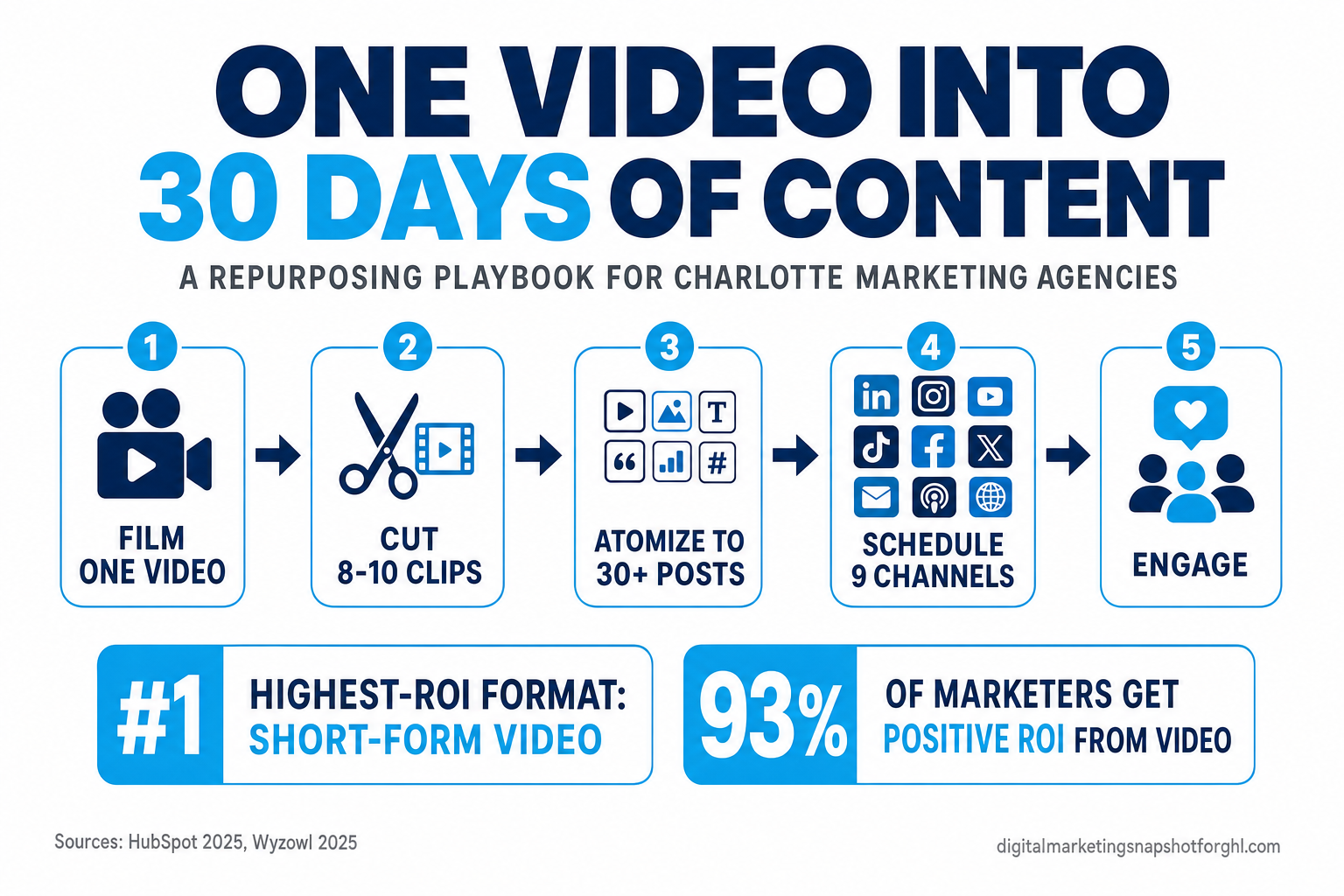
Table of contents
- Why one video is the highest-leverage asset your agency has
- The 5-step repurposing system, at a glance
- Step 1 — Film one 20–30 minute pillar video
- Step 2 — Cut 8–10 short-form clips
- Step 3 — Atomize each idea into every format
- Step 4 — Schedule the month across 9 channels
- Step 5 — Engage fast and double down on winners
- The math: one film day, 30+ assets
- Why this matters more for Charlotte agencies
- Do it yourself vs hand off the production line
- FAQ
Why one video is the highest-leverage asset your agency has
Most agencies don’t have a strategy problem with their own content. They have a volume problem. You already know what to say — you say versions of it to clients every week. What you don’t have is the bandwidth to turn that expertise into daily, multi-format, cross-platform posts on top of fulfilling client work.
The data backs up that this is the near-universal constraint. In Content Marketing Institute’s 2025 benchmarks, 42% of B2B marketers named “creating content consistently” a top challenge and 39% said creating enough content was a struggle (CMI, 2025). Notice the shape of the problem: not ideas, not quality — throughput. Consistency and quantity are operations problems, and operations problems are solved with systems, not willpower.
A single pillar video is the highest-leverage way to solve it because one recording contains dozens of publishable ideas. A 25-minute talk where you answer the ten questions clients ask most is, simultaneously, ten short-form scripts, ten carousel outlines, a blog post, a newsletter, and a week of text posts — you just haven’t cut it up yet. Recording once and slicing many times is how you convert a few hours of effort into a month of output, instead of grinding out one lonely post whenever a gap appears in the calendar.
And the format that comes out of a pillar video — short vertical clips — happens to be the one that performs best. Short-form video has been the #1 highest-ROI content format for four years running, and 56% of marketers say video is their most effective content type (HubSpot, 2025). On the demand side, 91% of consumers want to see more video from brands (Wyzowl, 2025). Repurposing isn’t just efficient; it front-loads the exact format the algorithms and your future clients reward.
The 5-step repurposing system, at a glance
The whole workflow is five steps: film once, cut clips, atomize to every format, schedule the month, then engage and double down on what works. Each step feeds the next, so the hard, creative part (having something worth saying) happens exactly once.
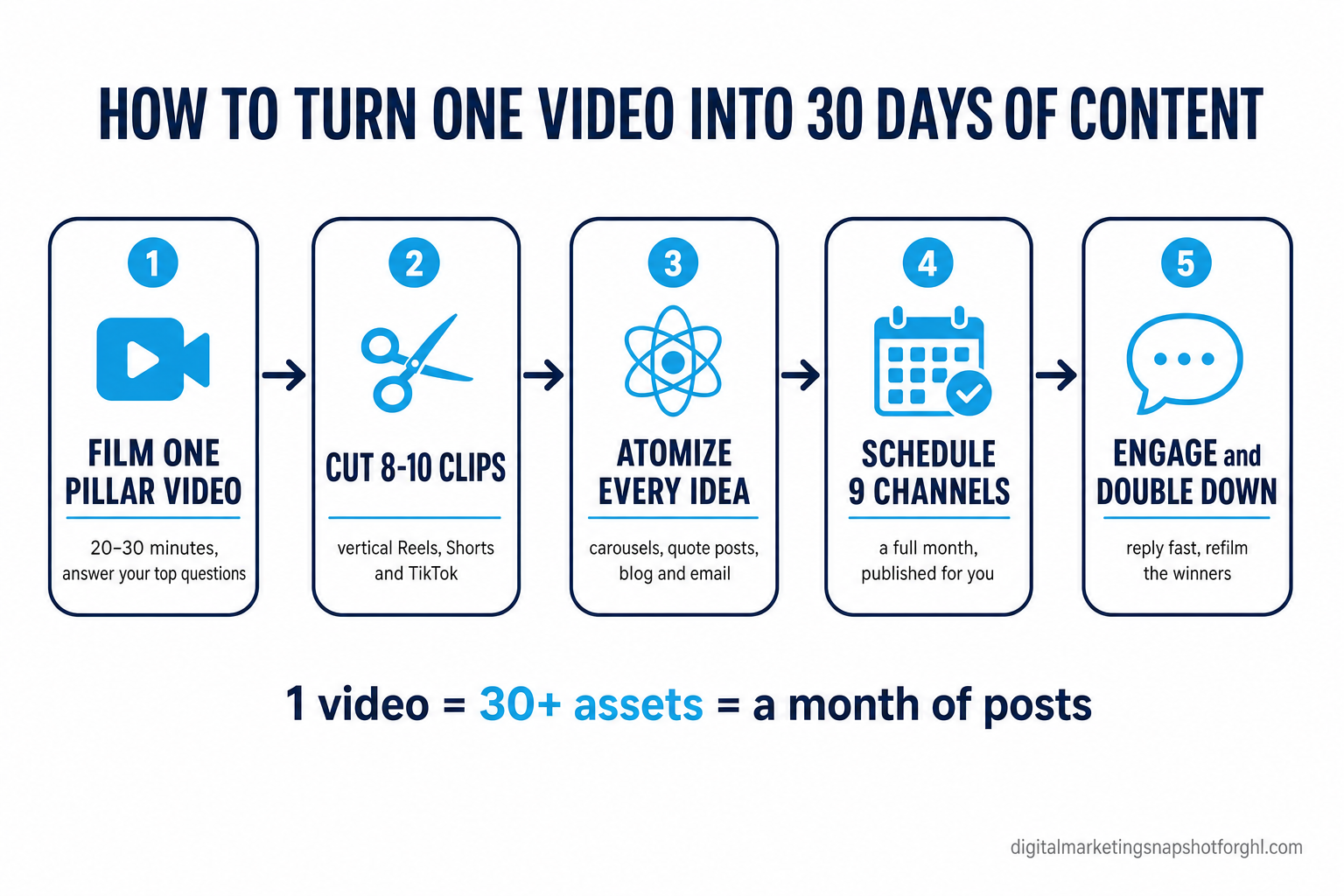
The sections below walk through each step the way I set it up for the agencies I work with — including where GoHighLevel’s social planner fits, so the “schedule and publish” half runs on autopilot.
Step 1 — Film one 20–30 minute pillar video
Pick one topic you could talk about without notes and block 30 minutes to record it. The highest-yield formats for an agency are:
- The “ten questions” video — answer the ten questions prospects and clients ask most. Each answer becomes its own clip.
- A teardown — screen-record yourself critiquing an anonymized ad, funnel, or landing page.
- A repurposed client call or webinar — you were going to be on the call anyway; record it (with consent) and mine it later.
You do not need a studio. A phone on a tripod in a quiet room, decent daylight, and a lav mic clears the bar — remember, 89% of businesses already use video and the ones winning aren’t the most cinematic, they’re the most consistent (Wyzowl, 2025). Talk in self-contained answers: state the question, answer it in 60–90 seconds, then move on. Those natural breakpoints are your future clips.
Step 2 — Cut 8–10 short-form clips
Watch the recording once and mark every moment that stands on its own — a sharp answer, a strong opinion, a surprising number. From a 25-minute video you should comfortably pull 8 to 10 vertical clips of 20–60 seconds each, formatted for Reels, TikTok, and YouTube Shorts.
This is the format that earns reach. Short-form video is where the discovery algorithms push content to people who don’t yet follow you — precisely the audience an agency needs to win new clients — and it’s the format marketers rate their most effective (HubSpot, 2025). Add captions (most feeds play muted), a one-line hook on the first frame, and a consistent look so the clips read as a series.
Ten clips from one video is already two weeks of daily short-form posts. Do it twice a month and short-form alone is handled.
Step 3 — Atomize each idea into every format
Each clip is really an idea, and an idea can live in more than one format. This is where one video quietly becomes thirty assets. For each of your 8–10 ideas, spin off the written and static formats:
- Carousel — turn a multi-part answer into a 5–8 slide carousel (these still earn saves and shares).
- Quote graphic / text post — pull the single sharpest line into a branded image or a plain LinkedIn/Threads/X post.
- Blog section — group the ideas into a blog post (like this one) for SEO and AI-answer visibility.
- Email — the same idea, written to your list, with a soft CTA.
You’re not writing anything new — you’re re-cutting one recording into the shape each platform rewards. Repurposing is standard practice for exactly this reason; it’s how lean teams keep up with demand for content without a proportional increase in hours. Weave in internal links while you’re at it: a blog built this way is a natural place to point readers toward your money pages and related playbooks, like our guide to Instagram DM automation for agencies.
Sources: HubSpot State of Marketing, 2025; Wyzowl State of Video Marketing, 2025.
Step 4 — Schedule the month across 9 channels
Now you have a pile of assets: ~10 clips, ~10 carousels, a batch of text/quote posts, a blog, and an email. The final production move is to load them into a calendar and let them publish on a schedule — not manually, one platform at a time.
Cadence is what turns a content pile into growth. Buffer’s analysis of more than two million posts found posting 3–5 times a week more than doubles follower-growth rate versus 1–2 times, and accounts posting 10+ times a week grow roughly 5.5x faster (Buffer). Frequency isn’t spam on today’s algorithms — it’s how you earn distribution.
Relative follower-growth multiplier by weekly posting frequency (1–2x/week = 1.0 baseline). Source: Buffer.
This is where a system beats hustle. Inside GoHighLevel’s social planner you can schedule the entire month across your channels in one sitting, cropping and captioning per platform, so the feed keeps posting whether or not you remember. A done-for-you setup takes it further — publishing 5 days a week across 9 channels (Facebook, Instagram, Google Business Profile, LinkedIn, TikTok, YouTube, Pinterest, Threads, and Bluesky) automatically. The point is the same: decide the month once, then never touch the “what do I post today” question again.
Step 5 — Engage fast and double down on winners
Publishing is only half of organic reach; the other half is responding. Buyers treat social as a real-time channel, and a comment or DM left overnight usually misses the window they expect. This is the same speed-to-lead principle we cover for client campaigns in Speed-to-Lead for Agencies — it applies just as ruthlessly to your own front door.
Then let the data pick your next pillar video. Whichever clip outperforms is a signal: that topic resonates, so film a deeper version of it next month. Over a quarter, your feed compounds toward the subjects your market actually cares about — informed by real engagement, not guesses. Reply fast, pin the winners, and feed the results back into Step 1.
The math: one film day, 30+ assets
Put the five steps together and the arithmetic is the whole argument. One 25-minute pillar video yields roughly:
- ~10 short-form clips (Reels / Shorts / TikTok)
- ~10 carousels or quote graphics
- ~8–10 text posts (LinkedIn / Threads / X)
- 1 blog post and 1 email
That’s 30+ publishable assets from a single recording — comfortably a month of daily, multi-format posting. Compare that to the one-post-at-a-time approach that dies every busy week, and you can see why repurposing is how agencies sustain the cadence the growth data rewards. It’s also why video keeps earning its keep: 88% of marketers say video helped them generate leads (Wyzowl, 2025), and a repurposing system means you get that lead-gen format and everything else from the same afternoon of work.
Why this matters more for Charlotte agencies
Every point above is true nationally. In Charlotte, the competitive math makes it sharper.
Charlotte is North Carolina’s largest city — 874,579 residents at the 2020 Census — and sits inside Mecklenburg County’s 1,115,482 people, the state’s second-most-populous county (U.S. Census Bureau). It’s one of the fastest-growing metros in the Southeast, which means a steady stream of new businesses shopping for marketing help — and a steady stream of agencies competing to serve them.
That competition is national and growing: the US is home to 105,214 advertising agencies, up 3.8% year over year (IBISWorld). When a Charlotte business searches “marketing agency near me” or scrolls Instagram for one, they open several tabs. The agency posting daily, showing real expertise in short-form video and answering fast reads as the safer, more capable choice — and gets the call. In a market this dense, content velocity isn’t vanity; it’s the tiebreaker that decides who looks like the obvious pick.
Do it yourself vs hand off the production line
You have three honest options, and only two of them hold up over time.
- Run the system in-house. Block a monthly film day, own the editing, atomizing, scheduling, and replies, and defend that time like a client deadline. This genuinely works — if you can protect the hours. Most agencies can’t, which is how the feed died the first time.
- Hire for it. Bring on an editor and a social manager. Effective, but you’re now paying salaries and owning hiring, training, and turnover on top of client work.
- Hand off the production line. Keep the expertise and the pillar-video ideas in-house; outsource the relentless output — clip editing, carousels, scheduling across every channel, and replies — to a done-for-you team.
For most lean agencies, option three is the sweet spot: you stay the face and the strategist, someone else runs the assembly line. That’s the same logic behind every automation we build — don’t add headcount to do repeatable work, systematize it (we made the broader case in How to Scale a Marketing Agency Without Adding Headcount).
Run repurposing in-house vs. done-for-you social
| Plan | Do it in-house | Done-for-you social (ours)Recommended |
|---|---|---|
| Price | Your time + hires | $397/mo |
| Feature 1 | You film, edit, atomize, schedule & reply | You share ideas; we produce & publish |
| Feature 2 | Consistency depends on your team's bandwidth | 1 text, 1 image, 2 carousels & 1 reel weekly |
| Feature 3 | Clip editing only when someone has time | Editing & design included — no hires |
| Feature 4 | Manual posting, platform by platform | Published 5 days/week across 9 channels |
| Feature 5 | Comments & DMs answered when remembered | 3 AI agents reply to comments, DMs & web chat |
| Feature 6 | You own hiring, training & turnover | Monthly performance report on every channel |
| See the $397/mo plan |
Whichever path you choose, the model is the same: create once, publish everywhere, and never let your own feed go quiet again. If you’d rather skip straight to a full content engine — plus lead capture, booking, reviews, and reporting — that’s what the complete Digital Marketing Snapshot delivers, and our done-for-you social service handles the posting half on its own.
FAQ
Turning one video into a month of content — quick answers
How many pieces of content can you really get from one video?
From a single 20–30 minute pillar video you can realistically produce 30+ assets: roughly 10 short-form vertical clips (Reels, Shorts, TikTok), 10 carousels or quote graphics, 8–10 text posts, plus a blog post and an email. That's about a month of daily, multi-format posting from one recording — which is why repurposing is the standard way lean agencies keep up with content demand.
What kind of video should a marketing agency film first?
The highest-yield format is a 'ten questions' video — answer the ten questions prospects and clients ask most, in self-contained 60–90 second answers. Each answer becomes its own clip and idea. Teardowns (critiquing an anonymized ad or funnel) and recorded client calls or webinars also work well. You don't need a studio; a phone, good daylight, and a mic clear the bar.
How often should a Charlotte agency post to grow?
Consistency drives distribution. Buffer's analysis of 2M+ posts found posting 3–5 times a week more than doubles follower-growth rate versus 1–2 times, and 10+ times a week grows roughly 5.5x faster. A repurposing system is what makes that cadence sustainable — you schedule a month at once instead of scrambling daily.
Does short-form video really outperform other content?
Yes. HubSpot reports short-form video has been the #1 highest-ROI content format for four years running, and 56% of marketers call video their most effective content type. On the demand side, Wyzowl found 93% of marketers get a positive ROI from video and 91% of consumers want to see more video from brands. Short-form is also what discovery algorithms push to non-followers — the new audience an agency needs.
Can I schedule all of this inside GoHighLevel?
Yes. GoHighLevel's social planner lets you schedule a full month of posts across your channels in one sitting, cropped and captioned per platform, so the feed keeps publishing automatically. If you'd rather not run it yourself, our done-for-you service publishes 5 days a week across 9 channels and includes AI agents that reply to comments, DMs, and web chat.
Should I run repurposing in-house or outsource it?
Keep the expertise and the pillar-video ideas in-house — you're the strategist. Outsource the repeatable output: clip editing, carousels, scheduling across platforms, and replies. Our done-for-you social service does exactly that for $397/mo for one brand (or $997/mo for up to four brands, white-label), which is far cheaper than hiring an editor and a social manager to run the same assembly line.
Written by Priya Naidoo, Client Retention & Growth Consultant based in Raleigh, NC. Priya helps boutique social and content agencies cut churn and turn their best clients into a referral pipeline, with a focus on the right touchpoint at the right moment — automated so nothing slips. She writes about client portals, review collection, referral engines, and the systems that keep an agency growing without constant new-business hustle.
Related reading: Social Media Management for Marketing Agencies in Dallas · Instagram DM Automation for Agencies · Speed-to-Lead for Agencies · How to Scale a Marketing Agency Without Adding Headcount