
To hire a GoHighLevel developer for your Pittsburgh marketing agency, work through seven steps in order: define exactly what needs building, write a scope with success criteria, pick a pricing model and budget, decide where to hire (freelancer, specialist partner, or in-house), vet for real GoHighLevel experience, lock down account access and data ownership, then run the engagement with milestones, testing, and a support window. Done right, you get an integration, custom app, migration, or AI agent that ships on time and holds up in production. Done wrong, you join the majority of software projects that run over budget or fail outright. This guide walks each step, with the sourced numbers behind why the vetting matters.
I spent eight years running fulfillment for a 40-client SEO and PPC shop before going independent, and every time we tried to bend GoHighLevel to do something it doesn’t do out of the box, the same question came up: do we hire someone to build this, and how do we not get burned? Below is the operator’s version of that answer — the checklist I wish I’d had the first time we scoped a custom GHL build.

Table of contents
- What a GoHighLevel developer actually builds
- Why hiring the right one matters for a Pittsburgh agency
- The 7-step process to hire a GoHighLevel developer
- Freelancer vs. in-house vs. done-for-you partner
- What it costs and how fast it ships
- Hiring mistakes to avoid
- FAQ
What a GoHighLevel developer actually builds
GoHighLevel does an enormous amount out of the box — CRM, pipelines, calendars, email and SMS, funnels, and reputation tools. A GoHighLevel developer is who you call for the things it can’t do natively, or can’t do the way your agency works. In practice that’s five kinds of work:
- Integrations. Connecting GHL to the platforms you and your clients already run — ad platforms, accounting, e-commerce, proprietary tools — via the GHL API, webhooks, and custom middleware. This is the most common ask; see our field notes on GoHighLevel integrations for agencies.
- Custom software. Client portals, application forms, niche dashboards, and internal tools that sit on top of GHL data. When off-the-shelf features stop fitting, agencies weigh custom software vs. off-the-shelf tools — a developer builds the custom path.
- Migrations. Moving contacts, pipelines, history, and automations into GoHighLevel from a legacy CRM without dropping data. Our team documented a clean agency migration to GoHighLevel step by step.
- AI agents. Voice and chat agents trained on your agency’s process, living inside GHL and handing leads to your pipelines.
- Marketplace apps. Packaging a build as a GHL Marketplace app you can install across every sub-account — the foundation of a real SaaS-mode recurring-revenue play.
The common thread: a GHL developer knows the platform’s API, webhooks, sub-account model, and limits well enough to extend it safely — not a generalist who’ll learn GoHighLevel on your budget.
Why hiring the right one matters for a Pittsburgh agency
Pittsburgh has quietly become a real technology market — the Pittsburgh Technology Council counts roughly 37,580 core technology workers in the region, with about 18% of regional employment in science and technology occupations (Pittsburgh Technology Council). That’s good news and a trap: there’s local talent, but “can write code” is not the same as “can extend GoHighLevel without breaking your client accounts.”
The stakes are set by how software projects actually go. The Standish Group’s CHAOS research, drawn from tens of thousands of projects, found only 31% succeed, while 50% are challenged — late, over budget, or missing features — and 19% fail outright (The Standish Group, CHAOS 2020). The single biggest predictor of which bucket you land in is clear scope and the right person — not the framework.
Software project outcomes, % of projects. Source: The Standish Group, CHAOS 2020.
The cost of getting it wrong is concrete. A U.S. software developer earns a median $133,080 a year (U.S. Bureau of Labor Statistics, May 2024), and the U.S. Department of Labor’s often-cited estimate puts the cost of a bad hire at at least 30% of that person’s first-year earnings (via Apollo Technical). For a small agency, one wrong hire — or one runaway freelance project — can wipe out a quarter’s margin. The good news: GoHighLevel is clearly worth building on. It now powers more than 2 million businesses worldwide (HighLevel, LevelUp 2025), so the skills you’re hiring for are a durable investment, not a one-off.
The 7-step process to hire a GoHighLevel developer
Follow these in order. Each step de-risks the next, and the early steps are the ones that actually decide whether you land in that 31%.
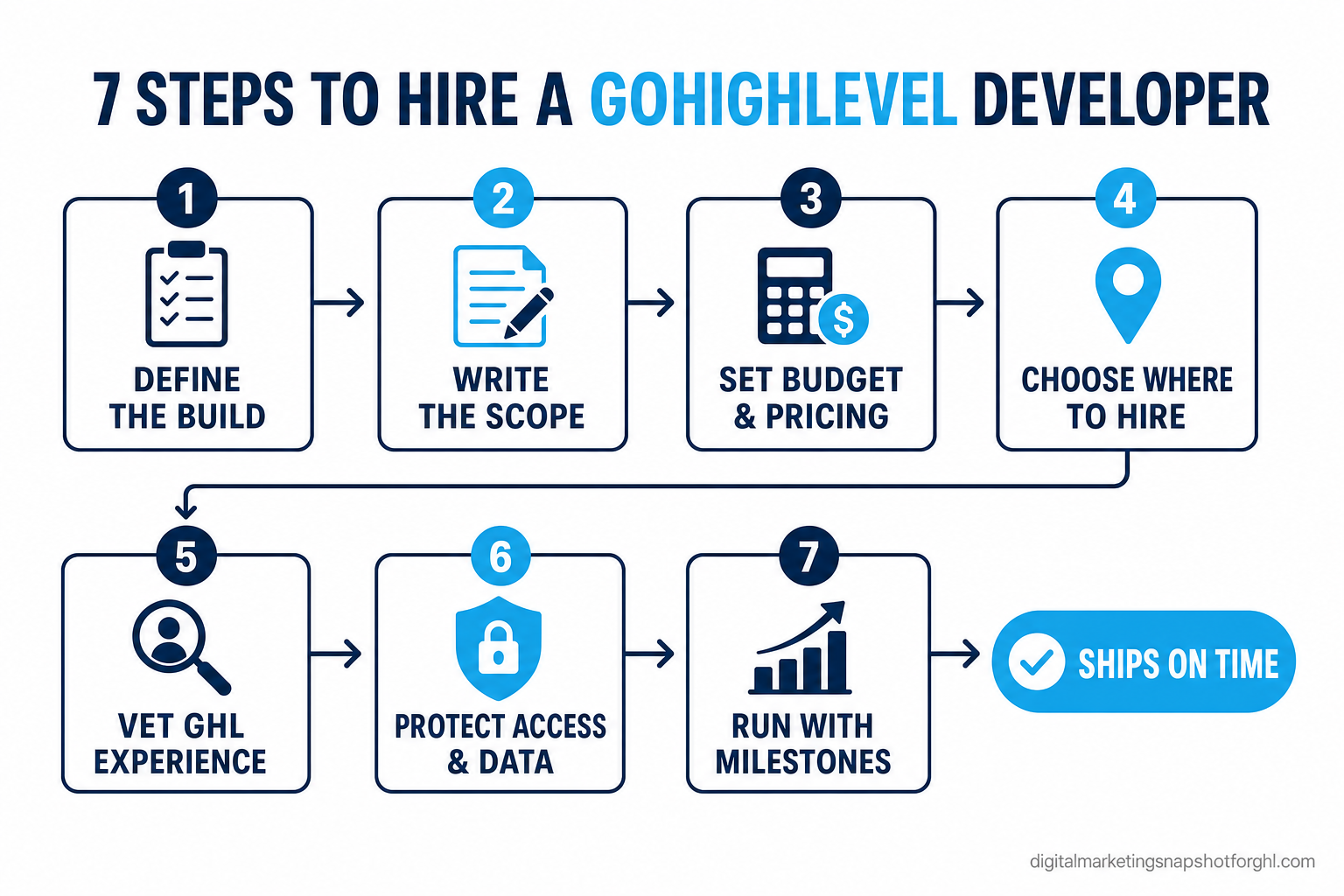
Step 1 — Define what you actually need built
Before you talk to anyone, name the outcome in one sentence: “Push every closed deal from GHL into QuickBooks automatically,” or “Give each client a branded portal to see their leads and reports.” Then classify it — integration, custom software, migration, AI agent, or marketplace app. This determines the skill set you’re hiring for and stops you from paying developer rates for something a snapshot or configuration already covers. If you can’t state the outcome in a sentence, you’re not ready to hire yet.
Step 2 — Write a scope with success criteria
A written scope is the difference between a fixed price and an open-ended bill. List the exact deliverables, the platforms and data involved, the edge cases, and — critically — how you’ll know it’s done (“a test deal in GHL appears in QuickBooks within 60 seconds, with tax mapped correctly”). Reputable GHL dev shops insist on this: our own GHL development engagements start with a written scope, milestones, timeline, and a fixed price so there are no moving targets. Vague scope is the number-one reason projects join the 69% that are challenged or fail.
Step 3 — Set a budget and pricing model
Decide how you want to pay before you get quotes, because it filters candidates. There are three models:
- Project-based / fixed price — best for a clearly defined build (an integration, a portal). You know the number up front.
- Hourly — best for open-ended iteration or ongoing tweaks, but requires trust and tight check-ins.
- Monthly retainer — best if you’ll have a steady stream of builds and want a developer on call.
Anchor the budget against the alternative: a full-time in-house developer at a $133,080 median salary (BLS) plus benefits and taxes. Most agencies don’t have enough continuous work to justify that — which is exactly why project or retainer work with a specialist usually wins on cost.
Step 4 — Decide where to hire
Your three real options are a freelance marketplace, a specialist done-for-you GHL partner, or an in-house hire. The freelance pool is deep and growing — Upwork found 1 in 4 (about 28%) of U.S. skilled knowledge workers now freelance, over 20 million people generating $1.5 trillion in 2024 (Upwork Research Institute). The catch is that a marketplace optimizes for any developer, not a GoHighLevel developer. A specialist partner narrows the field to people who already know the platform. The full trade-off is in the comparison below.
Step 5 — Vet for real GoHighLevel experience
This is where most agencies rush and pay for it. Ask for GHL-specific proof, not a generic portfolio:
- Show me a GHL build you shipped — an integration, an app, a migration. Get specifics on the API and webhook work.
- Two client references you can actually call.
- How do you handle the GHL API rate limits and sub-account permissions? A real GHL developer answers instantly; a generalist stalls.
And be clear-eyed about AI. 84% of developers now use or plan to use AI coding tools, but only 33% trust their accuracy — in fact more distrust it (46%) than trust it (Stack Overflow 2025 Developer Survey). AI accelerates a skilled developer; it does not replace the judgment you’re vetting for. If a candidate is leaning on AI without being able to explain the code, that’s a red flag, not a discount.
Developer AI adoption vs. trust, % of respondents. Source: Stack Overflow 2025 Developer Survey (49,000+ developers).
Step 6 — Lock down access, data, and ownership
Before any code is written, protect three things. Access: grant the minimum GHL permissions the work needs — a dedicated sub-account or scoped user, never your master admin login — and revoke it at handoff. Data: if the build touches client contacts, put a data-processing agreement in place; you’re responsible for your clients’ data. Ownership: the contract must say the code and IP are yours on final payment, with credentials and documentation delivered. Skipping this is how agencies end up locked out of a build they paid for.
Step 7 — Run the engagement with milestones and testing
Break the project into milestones with a payment tied to each accepted deliverable — never pay 100% up front. Insist the developer tests against your real GHL sub-account, not a sandbox, so edge cases surface before launch. Require a short support window (30 days is standard) to fix bugs after go-live. This is exactly the cadence a mature GHL shop runs: our GHL development process moves from scope to production in defined steps with a fixed timeline and a free bug-fix window, so there’s no scope creep and no surprise invoice.
Freelancer vs. in-house vs. done-for-you partner
Most Pittsburgh agencies choose between three routes. Here’s the honest side-by-side.
Three ways to get GoHighLevel development done
| Plan | Freelance marketplace | In-house developer | Done-for-you GHL partnerRecommended |
|---|---|---|---|
| Price | Lowest hourly — highest variance | $133,080/yr median + benefits | Fixed-price or retainer |
| Feature 1 | Huge pool, but few true GHL specialists | Always on call for your builds | GoHighLevel specialists from day one |
| Feature 2 | You manage scope, testing & risk | Full-time cost even between projects | Written scope, milestones & fixed price |
| Feature 3 | Quality and reliability vary widely | You own recruiting & the bad-hire risk | Tests on your real sub-account |
| Feature 4 | No guaranteed support after handoff | Weeks to hire, months to ramp on GHL | 30-day post-launch bug fixes included |
| Feature 5 | Best for small, well-defined tasks | Best only at high, steady build volume | Live faster than a new hire ramps |
| See GHL Development → |
The math usually favors a specialist partner for small and mid-size agencies. You skip the full-time salary, the recruiting, and the bad-hire risk, and you get someone who already knows the platform instead of paying anyone to learn it. For deeper or ongoing builds — Laravel, DevOps, HIPAA-ready work — a full-stack GHL developer or dedicated custom-software engagement covers the heavier lifts.
What it costs and how fast it ships
There’s no single sticker price for GHL development — a webhook integration and a multi-tenant marketplace app are different universes. But two anchors set your expectations.
First, the build-vs-buy anchor. Custom development pays off when it removes recurring manual work or unlocks revenue. The ROI on the systems a GHL developer builds is well established: CRM returns $8.71 for every $1 spent and marketing automation $5.44 per $1 (Nucleus Research), and McKinsey estimates about 60% of occupations have at least 30% of activities that could be automated with current technology (McKinsey Global Institute). The build that eliminates hours of weekly data entry pays for itself.
Return per $1 spent. Source: Nucleus Research.
Second, the speed anchor. A new in-house hire is weeks to recruit and months to become productive on GoHighLevel specifically. A specialist partner starts from a written scope and ships in defined milestones. And for the standard agency automations, you may not need a from-scratch build at all — the snapshot route is live in about a day. Full pricing is on the pricing page, and you can book a 20-minute call to get a real quote on a custom build instead of a form-letter estimate.
Hiring mistakes to avoid
A few things that quietly sink otherwise-promising GHL projects:
- Hiring before scoping. Vague scope is the top reason projects run over. Write Step 2 first — always.
- Paying 100% up front. Tie payment to accepted milestones. A developer confident in the work will agree.
- Hiring a generalist for GHL work. “Can code” isn’t “knows GoHighLevel’s API and sub-account model.” Vet for the platform (Step 5).
- Ignoring ownership and access. Get the IP-transfer clause and use scoped credentials before day one, not after a dispute.
- Building what already exists. Check the snapshot and your existing GHL setup before commissioning custom code.
- Skipping the reference calls. Two calls take twenty minutes and catch most bad hires before they cost you a quarter’s margin.
For the broader decision of when a homegrown GoHighLevel setup has outgrown DIY and needs real development help, see our companion piece on agencies that have outgrown DIY GoHighLevel, and the manual-reports vs. custom-dashboard breakdown for one of the most common first builds.
FAQ
Hiring a GoHighLevel developer — quick answers
How much does it cost to hire a GoHighLevel developer?
There is no single price — it depends on the build. A small webhook integration is far cheaper than a multi-tenant marketplace app. Your three pricing models are fixed-price (best for a defined build), hourly (best for open-ended iteration), and monthly retainer (best for steady, ongoing work). Anchor any quote against the alternative: a full-time in-house developer earns a median 133,080 dollars a year before benefits and taxes (U.S. BLS, May 2024), which most agencies can't keep busy. For a real number on a custom build, book a call rather than relying on a form estimate.
Where do I find a GoHighLevel developer?
Three routes: a freelance marketplace (deep pool, but few true GHL specialists and you carry the scope and testing risk), an in-house hire (always on call but a full-time cost and a weeks-to-months ramp), or a done-for-you GHL development partner (specialists from day one, with a written scope, fixed price, and a post-launch support window). For small and mid-size agencies, a specialist partner usually wins on cost, speed, and risk.
What should a GoHighLevel developer be able to build?
Five things: integrations that connect GHL to your other platforms via the API and webhooks; custom software like client portals and dashboards on top of GHL data; clean migrations of contacts, pipelines, and history into GoHighLevel; AI voice and chat agents trained on your process; and marketplace apps you can install across sub-accounts. A real GHL developer can speak fluently about the API, rate limits, and the sub-account permission model.
How do I protect my GoHighLevel account and client data when hiring a developer?
Grant the minimum permissions the work needs — a scoped user or a dedicated sub-account, never your master admin login — and revoke access at handoff. Put a data-processing agreement in place if the build touches client contacts, since you are responsible for that data. And make sure the contract assigns the code and IP to you on final payment, with credentials and documentation delivered.
Do I even need a developer, or can a GoHighLevel snapshot do it?
Often a snapshot is enough. Standard agency automations — lead capture, review harvesting, appointment and reminder flows, CRM workflows — already ship inside the Digital Marketing Snapshot and install in about 24 hours, no development required. Reserve a developer's budget for genuinely custom work: an unusual integration, a bespoke client portal, or an AI agent. If you just want GoHighLevel run for you day to day, a GHL VA is cheaper than a developer.
Why does vetting matter so much when AI can write code now?
Because AI accelerates a skilled developer but doesn't replace judgment. In the Stack Overflow 2025 Developer Survey, 84% of developers use or plan to use AI tools, yet only 33% trust their accuracy and more distrust it than trust it. Combined with the CHAOS finding that only 31% of software projects succeed, the takeaway is clear: scope tightly and vet for real GoHighLevel experience — that is what moves a project into the successful minority.
Written by Marisa Quintero, Agency Operations Strategist. Marisa spent eight years running fulfillment for a 40-client SEO and PPC shop before going independent, and writes about the boring, margin-saving half of agency life — onboarding, reporting cadences, and the systems (and the people who build them) that hold up at scale.
Related reading: What is a GoHighLevel snapshot? · GoHighLevel integrations for agencies · Custom software vs. off-the-shelf tools · Migrating an agency to GoHighLevel · Outgrown DIY GoHighLevel?