
For an Austin marketing agency, a silent YouTube channel isn’t a missing marketing tactic — it’s an inbound lead leak. Sixty percent of B2B buyers now go to YouTube to research vendors before they book a call, more than Instagram (28%) and TikTok (20%) combined, and short-form video has been the highest-ROI content format four years running. Yet most Austin agencies still treat YouTube like a nice-to-have: a channel with two founder videos from 2023, zero Shorts, and no owner. That silence is being read by prospects — and by Google’s SGE — as an answer, and the answer isn’t in your favor.
I spent eight years running fulfillment for a mid-sized Austin SEO and PPC shop before I went independent, and the single biggest miss I still see on my calls is agencies pouring budget into cold outbound while the free inbound engine — a working YouTube channel — sits idle. Below are the six specific pain-points behind the silence, what the silence costs you in real numbers, and what a done-for-you YouTube system actually looks like when it’s built into your fulfillment.
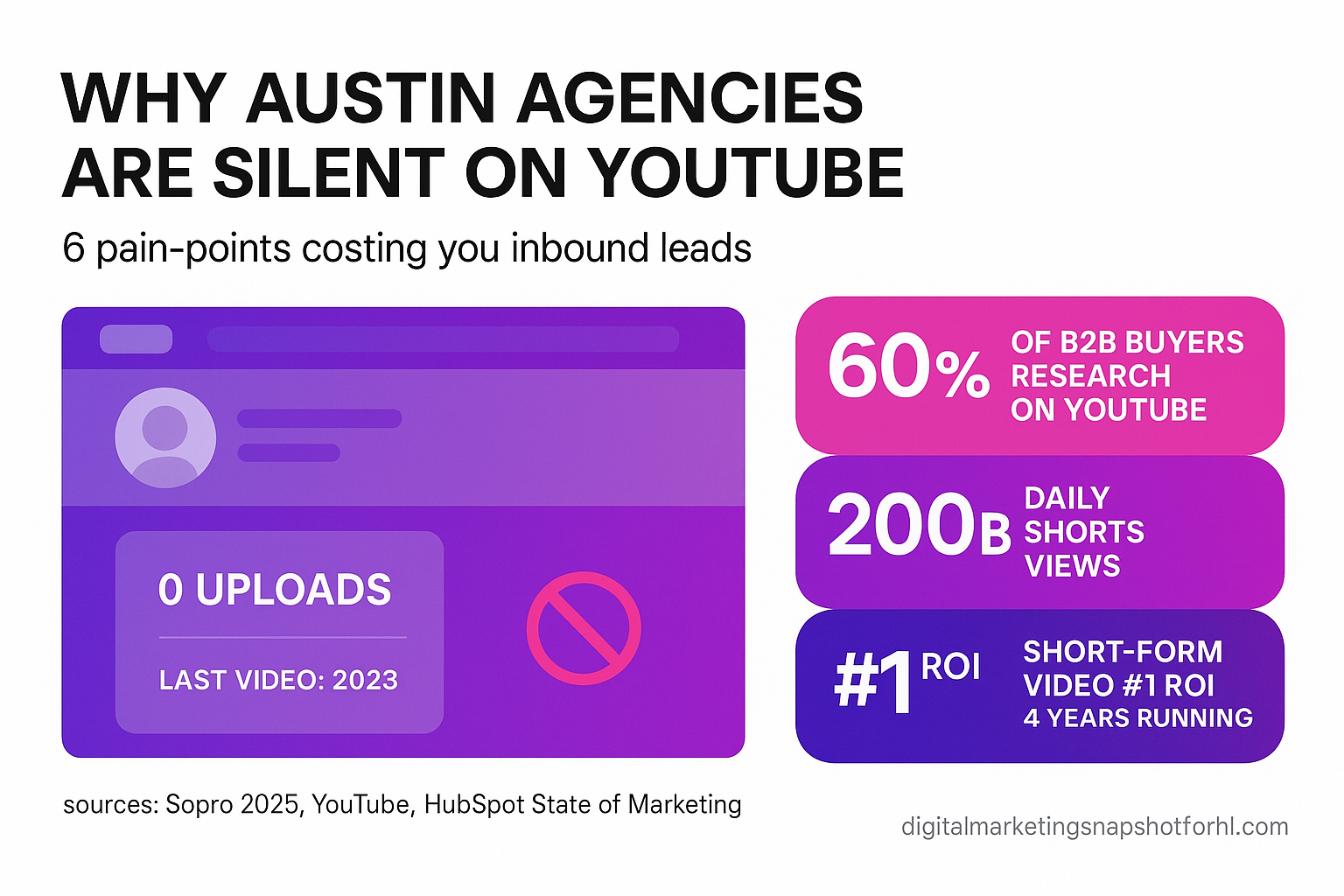
Table of contents
- Why YouTube is now the default vendor-research surface
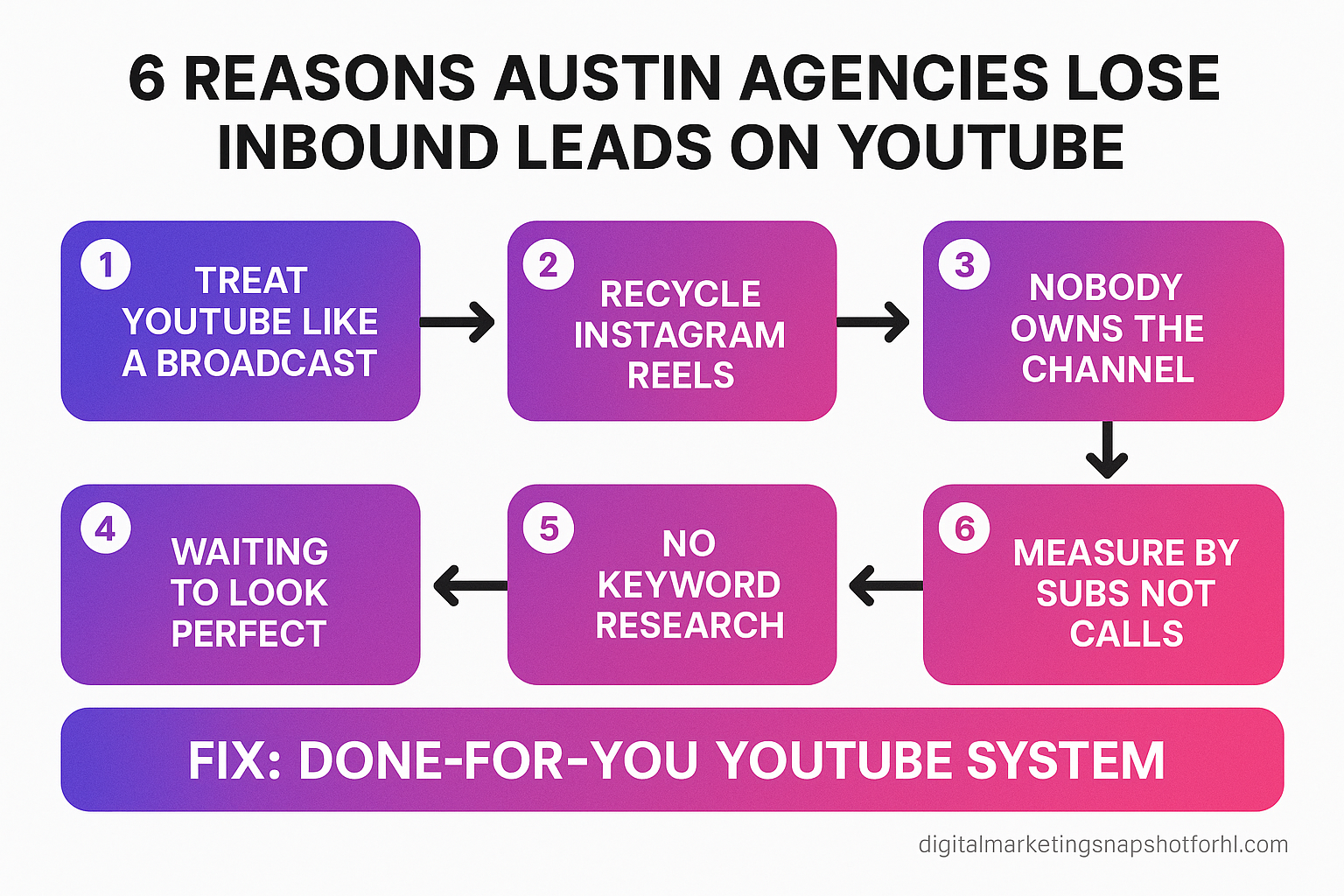
- Pain-point 1: You treat YouTube like a broadcast channel, not a search engine
- Pain-point 2: You confuse “posting Reels” with a YouTube strategy
- Pain-point 3: Nobody actually owns the channel
- Pain-point 4: You’re waiting to look perfect on camera
- Pain-point 5: You publish without keyword and title research
- Pain-point 6: You measure it by subscribers, not by discovery calls
- What the silence actually costs an Austin agency
- What a done-for-you YouTube system looks like
- FAQ
Why YouTube is now the default vendor-research surface
For years, “YouTube for agencies” was the thing you’d get around to after you’d nailed Instagram. That order is now backwards. When Sopro surveyed B2B buyers about how they research vendors in 2025, 60% named YouTube — more than Instagram (28%) and TikTok (20%) combined (Sopro). A separate Foundation Inc. cut of Google’s B2B data put it at 51% of B2B buyers watching YouTube videos to research purchases before deciding (Foundation Inc.). That is your Austin prospect at their desk, three days before they DM you, watching someone else explain how PPC-for-med-spas or local SEO-for-HVAC actually works.
Meanwhile, the raw distribution surface has changed shape. YouTube Shorts crossed 200 billion daily views in mid-2025 — up from 70 billion in early 2024 — and now has more than 2 billion monthly logged-in viewers, ahead of TikTok’s 1.59B and Instagram Reels’ 1.8B on the same measure (Hootsuite / YouTube data, Google announcement). And HubSpot’s State of Marketing has named short-form video the highest-ROI content format for the fourth year in a row, with 56% of marketers saying video is their most effective content type overall (HubSpot).
So the market’s most-used research surface is YouTube, the highest-ROI format is short-form video, and the number of businesses using video is 91%. If your Austin agency shows up in that search with nothing — no channel, one dusty webinar, or five random Reels reposted with the TikTok watermark still on — the prospect fills in the blank themselves. And they don’t fill it in kindly.
Pain-point 1: You treat YouTube like a broadcast channel, not a search engine
The single most expensive mental model I see agency owners bring to YouTube is treating it like Facebook — a feed you post to — instead of like Google, a place people search. That framing makes you optimize for the wrong thing (likes and reach on your existing followers) and skip the thing that actually compounds: intent-driven titles and thumbnails that match what your prospects type into the search bar at 11:30 p.m.
YouTube is the world’s second-largest search engine, and short queries like “how much does a PPC agency cost”, “local SEO for Austin dentist”, or “HVAC Google Ads example” all return video results. When your channel has no video for those queries, a competitor’s — or worse, some faceless “Top 10 Agencies” listicle channel’s — does. Sixty percent of B2B buyers are running that exact behavior on YouTube (Sopro), and each unanswered query is a warm lead you handed to whoever showed up.
The fix is to plan every video from a real search query first, script second, film third — the same way you’d plan a blog post. And to put the query in the title, the thumbnail, and the first line of the description, without cleverness. Boring, searched-for titles beat clever ones every time.
Pain-point 2: You confuse “posting Reels” with a YouTube strategy
The second failure mode is treating YouTube as an Instagram Reels dumping ground. Your team shoots a Reel for the client account, someone reposts the vertical file to your agency’s YouTube Shorts with the same caption, and everyone calls it a YouTube strategy. It isn’t.
Reels and Shorts look the same, but the audience and intent are different. Instagram users are scrolling to socialize; YouTube users are more often watching to learn — that’s why the platform indexes into Google search, generates chapters and transcripts, and rewards search-intent titles. A Reel that closes with “follow for more!” hits a dead end on YouTube — a Shorts viewer wants to click through to a long-form breakdown that answers the question in more depth. Channels that pair Shorts with long-form grow 41% faster than Shorts-only or long-only channels (AutoFaceless growth data), because the Shorts do discovery and the long-form videos do the closing.
Relative subscriber growth rate by channel format mix. Source: AutoFaceless YouTube Channel Growth Statistics 2026.
Reels-recycling also skips the parts that make YouTube unique: end screens that push viewers to a second video, cards that route to your lead magnet, chapters that keep watch-time up, and a pinned comment that sends buyers to your calendar. Skip those and the Short is a fireworks display — bright, gone, and untracked.
Pain-point 3: Nobody actually owns the channel
Here’s the Austin agency version of “nobody owns it”: the founder was going to run YouTube, then delegated it to the head of social, who delegated it to the intern, who left in April. There is a Google account whose password only one contractor knows. Nothing is planned, nothing is measured, and the last upload was seven months ago.
You’d never let a paying client’s channel drift like that, and every prospect who lands on yours can tell. Consistency is the single strongest correlate with growth on YouTube: creators who upload 12+ times per month gain 66% more subscribers than infrequent uploaders (AutoFaceless), and the average time-to-first-1,000-subscribers is roughly 15.5 months for a channel posting consistently (VidIQ, via Red11 Media). If cadence is what pays out, ambiguity of ownership is what kills you.
The organizational fix is to name one person accountable for the channel — either an internal media lead with real hours ring-fenced, or a done-for-you team that treats your channel like a client account with a shot list, a monthly plan, and a KPI they own.
Pain-point 4: You’re waiting to look perfect on camera
The most human pain-point on this list, and the most expensive. Agency owners defer YouTube because they don’t like their voice, they need to lose fifteen pounds first, the office isn’t finished, or they want the lighting kit before they start. The channel stays silent for another quarter. Meanwhile the prospect running the search finds three peers who did hit publish — and they didn’t look perfect either.
The audience-side data is unambiguous: short-form video’s advantage isn’t polish, it’s algorithm-friendly shareability and lower production barriers (HubSpot), and the top-performing agency Shorts on YouTube in 2025 are phone-shot vertical talking-heads with captions burned in and a hook in the first two seconds. Wyzowl’s 2026 report found that even as adoption hit 91%, the ROI number dipped from 93% to 82% — the most credible reason being that more teams are producing video, which pulls the average down when they overproduce (Wyzowl 2026). Translation: minimally-produced, high-frequency content wins over polished-and-rare.
Pain-point 5: You publish without keyword and title research
Even the agencies that do start publishing usually skip the fundamentals of YouTube SEO: the title, the first line of description, and the thumbnail are what decide whether the algorithm even offers your video to a real viewer. Most agency Shorts I audit have a founder-first title (“My take on Meta ads in 2026”) instead of a query-first one (“Meta Ads for local businesses — what changed in 2026”). The founder-first title reads as a personal opinion. The query-first title reads as a search result.
Same principle for the long-form: the video that answers “how to fire a client without hurting your reputation” will out-earn the one titled “reflections on client fit” every single week, because the first is a query real Austin agency owners actually type. YouTube’s own studies of high-performing channels find that click-through rate on the first day is one of the strongest predictors of algorithmic distribution — and CTR is a function of the title/thumbnail pair matching intent, not of channel size (HubSpot on YouTube CTR).
The workflow inside a done-for-you system: pick 3–5 real search queries per week from tools like YouTube’s own search suggest, TubeBuddy, and Google Trends; write the title from the query; produce the video to that title; and only then worry about the intro. Reversed order is why most channels never take off.
Pain-point 6: You measure it by subscribers, not by discovery calls
The last one is a measurement trap. Agency owners look at YouTube dashboards, see a subscriber count that isn’t moving fast enough, and quietly kill the effort at month four — right before the compounding usually starts. Subscribers are a lagging vanity metric; discovery calls booked, qualified leads, and pipeline generated are the metrics that decide whether the channel is paying its rent.
For our own clients we push three real KPIs on YouTube: (1) inbound discovery calls tagged with a “YouTube” lead source in GoHighLevel, (2) watch-time on the three top query videos (a proxy for whether the funnel is warming leads), and (3) direct traffic to the calendar link in the pinned comment or channel description. All three can be wired into a GHL pipeline in an afternoon — we cover the how in Lead Attribution That Proves Your ROI.
If your monthly YouTube “review” is a screenshot of the subs number, you’ll pull the plug too early. If it’s a line in your GHL dashboard tracking calls-from-YouTube, you’ll keep pushing publish because you’ll see the pipeline forming even before subs move.
What the silence actually costs an Austin agency
Let’s put a rough number on the silence for a mid-size Austin agency running a $12k/month retainer product with a 25% close rate on discovery calls. If YouTube is contributing zero inbound calls today and a working channel adds even 4 qualified calls a month at that close rate — a modest number for a channel with 20–30 Shorts and 6–8 long-form videos on-brand — that’s 1 new retainer a month, or $12,000 in new MRR added in a quarter without any paid spend. Multiply out a year and it’s a six-figure inbound line item you chose not to build.
Two more silent costs worth naming:
- You’re paying agency-priced ad budgets to buy attention YouTube would have given you free. Cold-outbound and cold-paid channels have gotten more expensive every year while YouTube’s organic reach for Shorts has gotten cheaper — 200B daily views is a distribution surface you can tap for the price of a phone and a plan (Hootsuite).
- You’re absent from Google’s AI Overviews and SGE. Google is increasingly pulling YouTube transcripts into its AI-generated answers for how-to and vendor-research queries. A channel with 30+ transcript-rich videos targeting your service queries is now a direct path into AI search results; a silent channel is invisible there too. (We cover this in depth in AI Search Optimization for Marketing Agencies.)
Austin agency YouTube: silent vs. staffed
Two founder videos from 2023, no Shorts, no keyword research, no consistent uploader. Prospects who search 'PPC agency Austin' find a competitor's channel and book a call there. Zero attributed calls from YouTube per month. Ad budget carries all lead gen.
3–4 Shorts/week and 1 long-form/week, each written to a real search query, uploaded and cross-posted across all 9 social channels, calls-from-YouTube tagged in GHL. 3–6 qualified discovery calls per month sourced from the channel by month 6, compounding after month 9.
What a done-for-you YouTube system looks like
Every pain-point above is fixable — but not with another tool or another course. The unlock is a system with clear ownership, a weekly production floor, and measurement tied to the same GHL pipeline you already use for client work.
That’s what we run for our Austin (and USA-wide) agency clients as part of our Done-For-You Social Media service. Concretely, per week: a keyword-first plan of 3–4 Shorts + 1 long-form from your agency principal’s calendar and Slack takes, a shoot list produced in a single 60-minute session, edited verticals with burned-in captions, thumbnails designed to a template, uploads scheduled with query-first titles, and cross-posts to the other 8 channels (Facebook, Instagram, GBP, LinkedIn, TikTok, Pinterest, Threads, Bluesky). All wired into GoHighLevel so every inbound call carries a YouTube tag and shows up in your pipeline attribution.
For agencies that also need the analytics and lead-attribution side wired up correctly — a real “leads from YouTube” line in your GHL dashboard instead of a guess — pair that with our Custom GHL Development work, or start with the fundamentals in Lead Attribution That Proves Your ROI and the operations playbook in How to Scale a Marketing Agency Without Adding Headcount.
FAQ
YouTube for Austin marketing agencies — quick answers
Do we really need a YouTube channel if our agency is already booked?
'Booked today' is not the same as 'booked in 9 months when your best client cuts spend.' A working YouTube channel builds an inbound pipeline that compounds — 60% of B2B buyers already research vendors on YouTube (Sopro, 2025), and short-form video has been HubSpot's #1 ROI format four years running. Skipping YouTube means depending 100% on outbound and paid, both of which are getting more expensive every year in the Austin market.
How long before a new YouTube channel produces leads?
For a channel publishing 3–4 Shorts and 1 long-form per week to real search queries, we typically see the first attributed discovery calls in months 2–3 and meaningful compounding by month 6–9. The average time to 1,000 subscribers with consistent posting is about 15.5 months (VidIQ), but subscribers aren't the KPI — attributed calls are, and those show up much earlier when titles are keyword-driven from day one.
We're camera-shy. Can this work without our founder on camera?
Yes — three formats work well: (1) faceless screen-recording breakdowns of ad accounts, GA4 dashboards, or funnels (with your voice-over); (2) 'day in the life' vertical b-roll of your team with captions; (3) client-win case studies filmed in one long session and cut into 6–8 Shorts. Any of these clear the phone-plus-tripod floor without the founder ever being on camera.
Isn't Austin YouTube saturated already?
The opposite. Austin's agency scene is heavy on Instagram and LinkedIn but noticeably thin on YouTube — very few local shops publish consistent Shorts, and even fewer target service-specific search queries like 'PPC for Austin restaurants' or 'local SEO for Austin med spa.' That gap is the opportunity: query-first titles are still winning distribution here in a way they no longer do on Meta.
How does this connect to our GoHighLevel setup?
Every YouTube-sourced inbound is tagged with a 'YouTube' lead source in GHL via a UTM'd calendar link (in the pinned comment and channel description) or a query-specific landing page. From there the contact flows into the same GHL pipeline as your paid leads, so cost-per-lead, close rate, and lifetime value from YouTube become directly comparable to your ad channels. See our post on lead attribution for the exact setup.
What does a done-for-you YouTube system cost vs. hiring in-house?
In-house typically means one part-time editor (~$2.5–4k/mo) plus a strategist (~$3–5k/mo) plus tools — call it $6–9k/mo before you've filmed a thing. Our Done-For-You Social Media service covers YouTube plus 8 other channels for a fraction of that, with the shoot compressed to a single 60-minute session per month. Book the scoping call and we'll price it against your specific channel goals.
Marisa Quintero is an Austin-based Agency Operations Strategist who spent eight years running fulfillment for a 40-client SEO and PPC shop before going independent. She writes about the boring half of agency life — onboarding, reporting cadences, retainer renewals — because that’s where margin quietly leaks out. On this blog she translates messy agency workflows into GoHighLevel systems that hold up at scale.
Related posts
- YouTube Shorts vs Instagram Reels for San Francisco Marketing Agencies — where each short-form platform actually pays out.
- Turn One Video Into 30 Days of Content: The Charlotte Agency Playbook — one 60-minute shoot, a full month of cross-posted content.
- Social Media Management for Marketing Agencies in Dallas — the 9-channel done-for-you system, end to end.
- Lead Attribution That Proves Your ROI — wiring every YouTube-sourced call back into GoHighLevel.
- How to Scale a Marketing Agency Without Adding Headcount — the operating model that makes a content engine work.