For a Tampa marketing agency, the fastest way to buy back hours and finally prove ROI isn’t another tool — it’s connecting the ones you already run to GoHighLevel. Most agencies bolt on a new app every time a gap appears: Google Ads and Meta for spend, GA4 for conversions, a spreadsheet for reporting, Stripe for billing, GoHighLevel for the CRM and follow-up. Each one is fine on its own. The problem is that they don’t talk to each other, so your team spends its day copy-pasting between tabs and your monthly report is a manual reconstruction that’s already out of date when you send it. A handful of GoHighLevel integrations — two-way syncs that push spend, conversions, and pipeline value where they belong — closes those gaps and turns a pile of disconnected tools into one system.
I rebuilt tracking stacks for agencies for years before I did anything else, and the single most expensive habit I see is treating “we use a lot of tools” as normal. It isn’t a badge of sophistication; it’s a tax you pay every day in wasted hours and unprovable results. Below is what the disconnected stack actually costs, which GoHighLevel integrations matter most, and how a Tampa agency wires it all together without hiring a full-time developer.
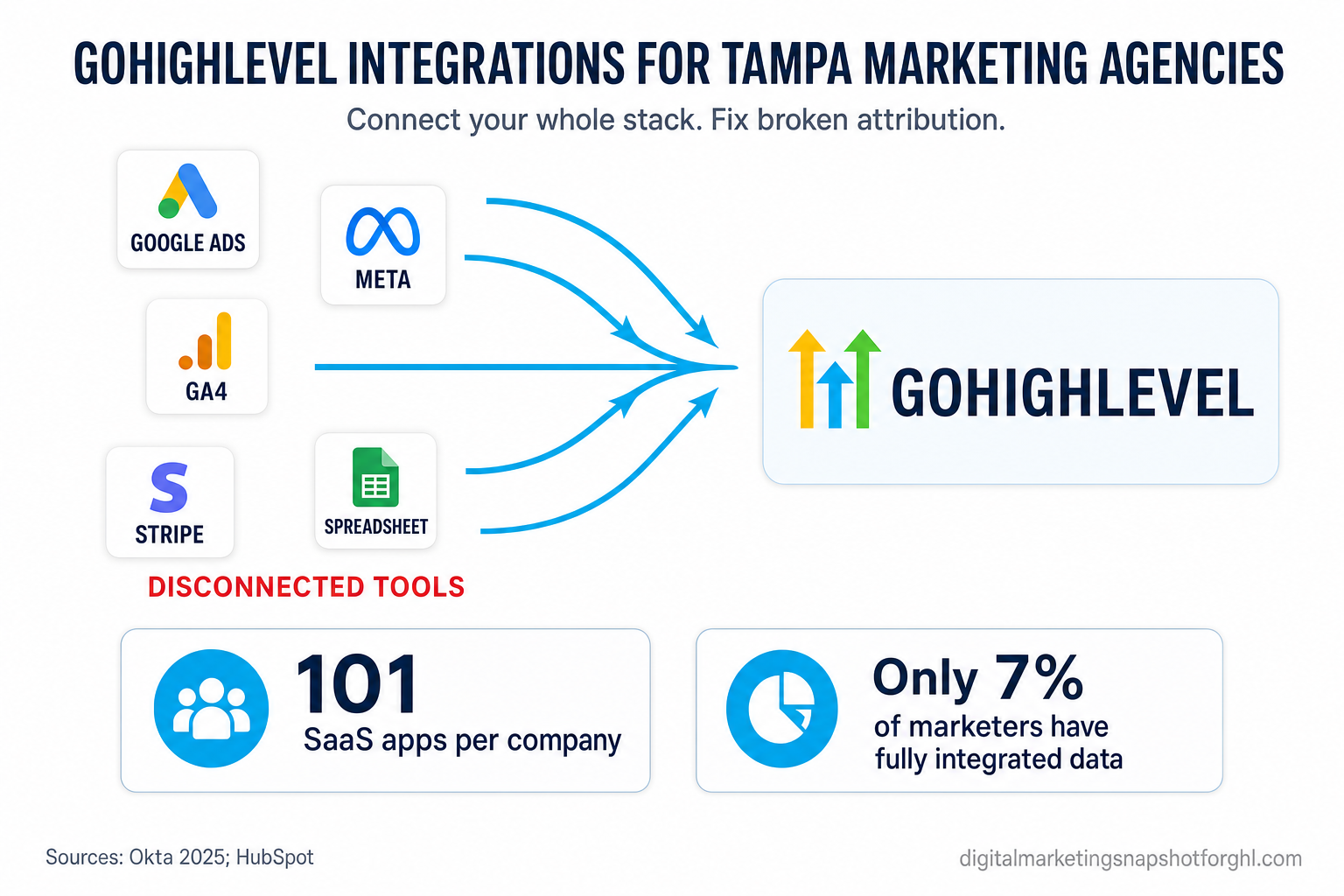
Table of contents
- Why disconnected tools are an agency problem, not an IT one
- The real cost of a stack that doesn’t talk
- Broken attribution: the silent margin killer
- The GoHighLevel integrations that matter most
- How a GoHighLevel integration actually works
- Why this hits Tampa agencies especially hard
- Build it, buy it, or duct-tape it: the honest options
- FAQ
Why disconnected tools are an agency problem, not an IT one
Agencies rarely choose tool sprawl on purpose. It accumulates. You add a form builder, then a scheduler, then a call tracker, then a reporting dashboard, then a second ad platform. Each decision is sensible in the moment. The result is not.
The data on how normal this has become is blunt. According to Okta’s Businesses at Work 2025 report, the average company now deploys 101 apps — the first time that number has crossed 100, up from 93 the year before (Okta). And that’s just what’s officially deployed; it doesn’t count the spreadsheet a strategist quietly maintains on the side. For marketing teams specifically, the raw supply is staggering: Scott Brinker’s 2024 martech landscape catalogued 14,106 solutions, a 27.8% jump in a single year (MarTech). There is a tool for everything, so agencies end up owning a little of everything.
Here’s why this is an operations problem and not something to shrug off as “just how software works”: every tool that doesn’t connect to the next one becomes a manual handoff, and manual handoffs are where your margin leaks. A lead fills out a Meta form → someone exports it → someone imports it into GoHighLevel → someone tags it by campaign → someone updates the spreadsheet the client report is built from. Five steps, five chances to drop the ball, and none of them are the strategic work you’re actually paid for.
The real cost of a stack that doesn’t talk
Put a number on the tab-switching and it stops looking harmless. Harvard Business Review’s study of nearly 140 users across three enterprises found people toggled between applications about 1,200 times a day and spent just under four hours a week — around 9% of their working time — simply reorienting themselves after each switch (Harvard Business Review). A separate Qatalog and Cornell study put it at 36 minutes a day lost to switching between tools, with 9.5 minutes to fully refocus each time (Qatalog / Cornell, via Construction Dive).
Zoom out and it’s worse. Salesforce’s State of Sales research found reps spend only about 30% of their time actually selling — the remaining 70% is swallowed by administrative work, manual data entry, and meetings (Salesforce). Swap “selling” for “fulfillment” and that’s your agency: the specialists you hired for SEO, paid media, or creative are spending most of their week pushing data between tools instead of moving client results.
How a rep’s working time splits. Source: Salesforce, State of Sales.
That lost time is expensive twice over. First, you’re paying skilled salaries to do copy-paste work. Second — and this is the part agencies underprice — the manual handoffs create errors and gaps that quietly undermine the results you show clients. A lead that never got its campaign tag is a lead your attribution can’t credit. Multiply that across a month and your reporting is fiction built on a spreadsheet.
Broken attribution: the silent margin killer
This is the part that keeps agency owners up at night, and it’s a direct symptom of a disconnected stack. If your ad spend lives in Google and Meta, your conversions live in GA4, your leads and pipeline live in GoHighLevel, and your invoices live in Stripe — and none of them sync — then nobody can answer the one question every client eventually asks: which campaign actually made me money?
The numbers say almost nobody can answer it well. Only 7% of marketers report that their marketing data is fully integrated with their tools, and tracking ROI is consistently rated one of the hardest tasks in marketing (HubSpot, State of Marketing). Ruler Analytics found that 28% of marketers can’t view channel performance holistically because of data silos, and only 39% run attribution across all or most of their activity (Ruler Analytics).
When the data is split across silos, agencies fall back on guesswork or on whatever single platform is loudest — usually the ad account that over-reports its own conversions. You end up optimizing to a number you can’t trust and defending renewals with a report the client half-believes. An integrated stack fixes this at the root: when spend, conversions, and pipeline value all land on the same GoHighLevel contact record, attribution stops being a monthly forensic exercise and becomes a live dashboard. (We go deep on this in Lead Attribution That Proves Your ROI and on replacing hand-built reports in Custom Reporting Dashboard vs Manual Reports.)
The GoHighLevel integrations that matter most
You don’t need to connect all 101 apps. For a marketing agency, a short list of integrations covers the overwhelming majority of the value. GoHighLevel exposes an API (v2) and webhooks, so anything with its own API or webhook support can sync two-way. These are the ones worth wiring first:
- Ad platforms → GHL (Google Ads, Meta, TikTok). Push lead-form submissions into GoHighLevel in real time with the campaign, ad set, and ad already attached, and push spend back so cost-per-lead is calculated automatically. This is the backbone of trustworthy reporting. (If you’re only connecting Meta today, start with our step-by-step on connecting Facebook Lead Ads to GoHighLevel.)
- GA4 and call tracking → GHL. Sync GA4 conversions and call outcomes (from CallRail or similar) onto the contact record, so a lead’s true source and the disposition of every call are attributed to the right opportunity — not lost between platforms.
- Stripe / billing → GHL. Keep payment status, MRR, and invoices on the contact and pipeline, so retainer value and lifetime value show up next to the leads that drove them.
- Analytics dashboards / client portals. Merge ad spend and GHL pipeline into a single branded portal each client logs into, replacing the monthly manual report entirely.
- Ops tools (Slack, project management, Airtable). Trigger internal alerts and tasks from GHL events so fulfillment kicks off the moment a deal closes, no manual kickoff required.
For tools that genuinely don’t expose an API, a bridge like Zapier, Make, or Pabbly covers most cases — but native API integrations are faster, cheaper to run at volume, and far less likely to break silently. The goal is the same either way: every important event ends up on the GoHighLevel record, so one system holds the truth.
How a GoHighLevel integration actually works
Under the hood, a well-built integration is unglamorous and reliable — which is exactly what you want. Here’s the shape of a typical ad-platform-to-GHL sync:
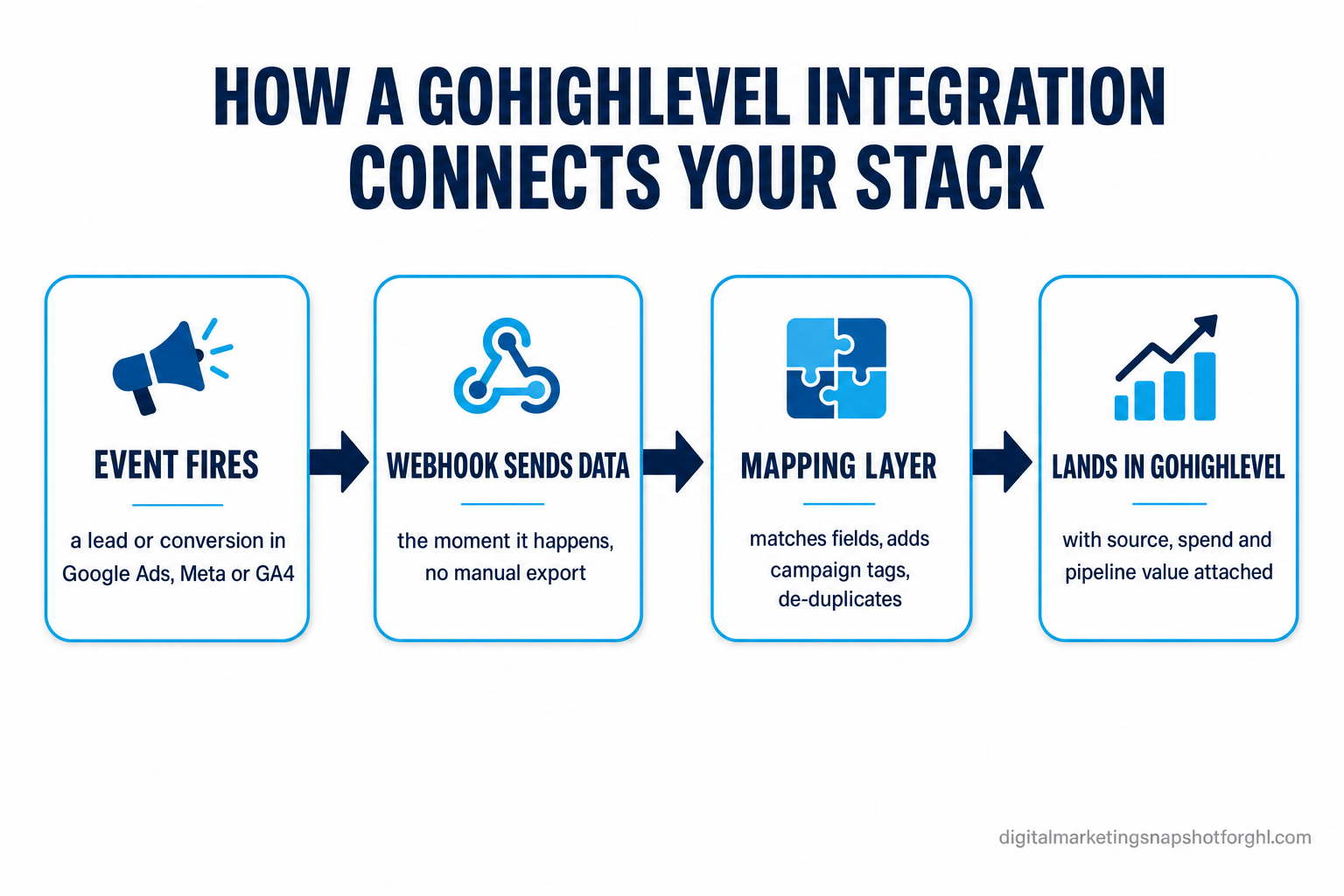
- An event fires in the source tool — a Meta lead form submission, a GA4 conversion, a Stripe payment.
- A webhook or API call carries the data out of that tool the instant it happens (no nightly export, no human).
- A mapping layer translates the fields — matching the source’s field names to your GoHighLevel custom fields, attaching the campaign/UTM tags, and de-duplicating against existing contacts so you don’t create a second record for the same person.
- The record lands in GoHighLevel with source, spend, and pipeline stage attached — ready to trigger your follow-up workflows and feed your reporting dashboard.
A new lead's journey
Lead submits a Meta form → sits in Meta until someone exports a CSV → gets imported to GHL hours later → maybe tagged by campaign → manually copied into the client's reporting sheet. Slow follow-up, missing attribution, stale report.
Lead submits a Meta form → webhook fires in seconds → mapped, de-duped, and tagged automatically → lands in GHL with campaign + cost attached → follow-up workflow starts instantly and the dashboard updates live.
The build itself is scoped work, not an open-ended science project. A single platform connector is typically a one-to-three-week job; a full client reporting portal that merges ad spend with GHL pipeline is more involved. Because it runs on GoHighLevel’s API v2 and webhooks, it keeps working as you add sub-accounts — you’re extending the platform, not fighting it. If you’ve felt your no-code setup start to strain as you scale, that’s the same wall we cover in 7 Signs Your Agency Has Outgrown DIY GoHighLevel.
Why this hits Tampa agencies especially hard
The disconnected-stack tax is national, but competition decides how much it hurts, and Tampa Bay is a fast-growing, crowded market. There are roughly 87,197 digital advertising agencies in the US as of 2025 — up 16.3% year over year (IBISWorld) — and Tampa’s tech and marketing scene has been one of the faster-growing in the Southeast. When a prospective client compares three Tampa agencies, the one that can show live, believable, campaign-level ROI in a branded portal wins the retainer over the two still emailing a screenshot from a spreadsheet.
There’s a retention angle too. A dead-simple truth of this business: clients churn when they can’t see the value. An integrated stack makes value visible on demand, which is why the same agencies that fix attribution tend to hold retainers longer. GoHighLevel is already the hub a huge number of agencies build on — HighLevel reports more than 1.4 million businesses and over 20,000 agencies on the platform (per HighLevel) — so for most Tampa agencies the question isn’t whether to centralize on GHL, it’s whether the rest of the stack is actually feeding it.
Build it, buy it, or duct-tape it: the honest options
I promised straight talk, so here are the three real paths and when each makes sense.
Duct-tape it with Zapier/Make. Best when you have one or two simple, low-volume connections and someone in-house who enjoys maintaining them. It’s the cheapest to start and the most likely to break silently at scale — a changed field or a rate limit can drop leads without an obvious error. Fine as a bridge; risky as a foundation.
Buy a point solution. Some tools offer a native GHL connector. When one exists and fits exactly, use it. The catch is that agencies rarely fit “exactly” — you want your field mapping, your campaign taxonomy, and a portal branded to you, which off-the-shelf connectors don’t bend to.
Build custom integrations on the GHL API. Best when the connections are core to how you report and get paid, when volume is real, or when you want a branded client portal that merges spend and pipeline. It’s a fixed-scope project with a defined timeline, and it runs reliably in production because it’s built for your exact stack. This is what our GHL Development team does day in and day out — and if the gap is a standalone tool that doesn’t need to live inside GHL at all (a custom CRM, a client portal, an internal dashboard), that’s the Custom Software lane instead.
The wrong choice is the fourth, unspoken one: leaving it disconnected and paying the tax forever. You can compare the full picture — snapshot plus done-for-you services — on the pricing page, or if you want the complete agency automation system in one move, get the snapshot.
FAQ
GoHighLevel integrations for agencies — quick answers
What can you actually connect to GoHighLevel?
Anything with an API or webhook support. In practice that covers Google Ads, Meta Ads, TikTok Ads, GA4, Search Console, CallRail, HubSpot, Salesforce, Pipedrive, Airtable, Stripe, Slack, ActiveCampaign, and Klaviyo, among others. For tools without an API, a bridge like Zapier, Make, or Pabbly can connect them, though native API integrations are faster and more reliable at volume.
How does connecting my stack to GoHighLevel fix broken attribution?
When ad spend, GA4 conversions, and call outcomes all sync onto the same GoHighLevel contact and opportunity — with the campaign and UTM tags attached automatically — every lead carries its true source and cost. That means cost-per-lead and pipeline value are calculated on one record instead of guessed at across disconnected tools, so your reporting becomes a live dashboard rather than a monthly manual reconstruction.
Is a GoHighLevel integration a one-time build or an ongoing cost?
The build is a fixed-scope, one-time project — a single platform connector is typically one to three weeks. After that it runs on GoHighLevel's API v2 and webhooks with minimal maintenance. That's the advantage of a native integration over a chain of no-code Zaps, which can break silently and need constant babysitting as volume grows.
We're a small Tampa agency. Is this overkill for us?
No — smaller agencies often benefit most, because you don't have staff to spare on manual data entry. Start with one or two high-value connections (usually your main ad platform and your analytics into GHL), prove the time savings, and add billing sync or a client portal as you grow. The point is to stop paying skilled salaries to copy-paste between tabs.
What does a custom GoHighLevel integration cost?
It's scoped per project. A single platform connector runs one to three weeks; a client reporting portal that merges ad spend with GHL pipeline is four to eight weeks. You get a free 30-minute discovery call, then a written scope with milestones, a timeline, and a fixed price before any work starts — no open-ended hourly billing.
How is this different from just migrating to GoHighLevel?
Migration moves your data and workflows off another CRM into GoHighLevel; integration keeps your other tools where they are and syncs them with GHL two-way. Many agencies do both — migrate the CRM, then integrate the ad platforms, analytics, and billing. If you're weighing a move, see our step-by-step migration playbook for the full process.
Written by Callan Reeves, Performance Marketing & Attribution Lead. Callan came up on the media-buying side managing seven-figure ad budgets, then rebuilt the tracking stack inside GoHighLevel so every conversion ties back to a campaign. He writes about lead attribution, speed-to-lead, and proving the ROI clients actually believe.
Related reading: Lead Attribution That Proves Your ROI · Connect Facebook Lead Ads to GoHighLevel · Custom Reporting Dashboard vs Manual Reports · 7 Signs Your Agency Has Outgrown DIY GoHighLevel · How to Migrate Your Agency to GoHighLevel