
HighLevel and ClickUp both get pitched as the tool that runs your whole agency, but they replace opposite halves of your stack. HighLevel replaces the client-facing engine: CRM, pipelines, email and SMS, calendars, reporting, and invoicing. ClickUp replaces the internal work engine: tasks, docs, dependencies, and time tracking. If your pain is slow lead follow-up and reports nobody reads, HighLevel is the answer. If it is missed deadlines and no one knowing who owns what, ClickUp is. Most 1-to-20-person shops run both; the real question is which you buy first.
I have rebuilt the ops stack inside both platforms, for my own shop and for clients. This is the honest version: what each does, what it quietly cannot do, real 2026 prices, and a straight call for a solo operator, an 8-person team, and a 20-plus agency.
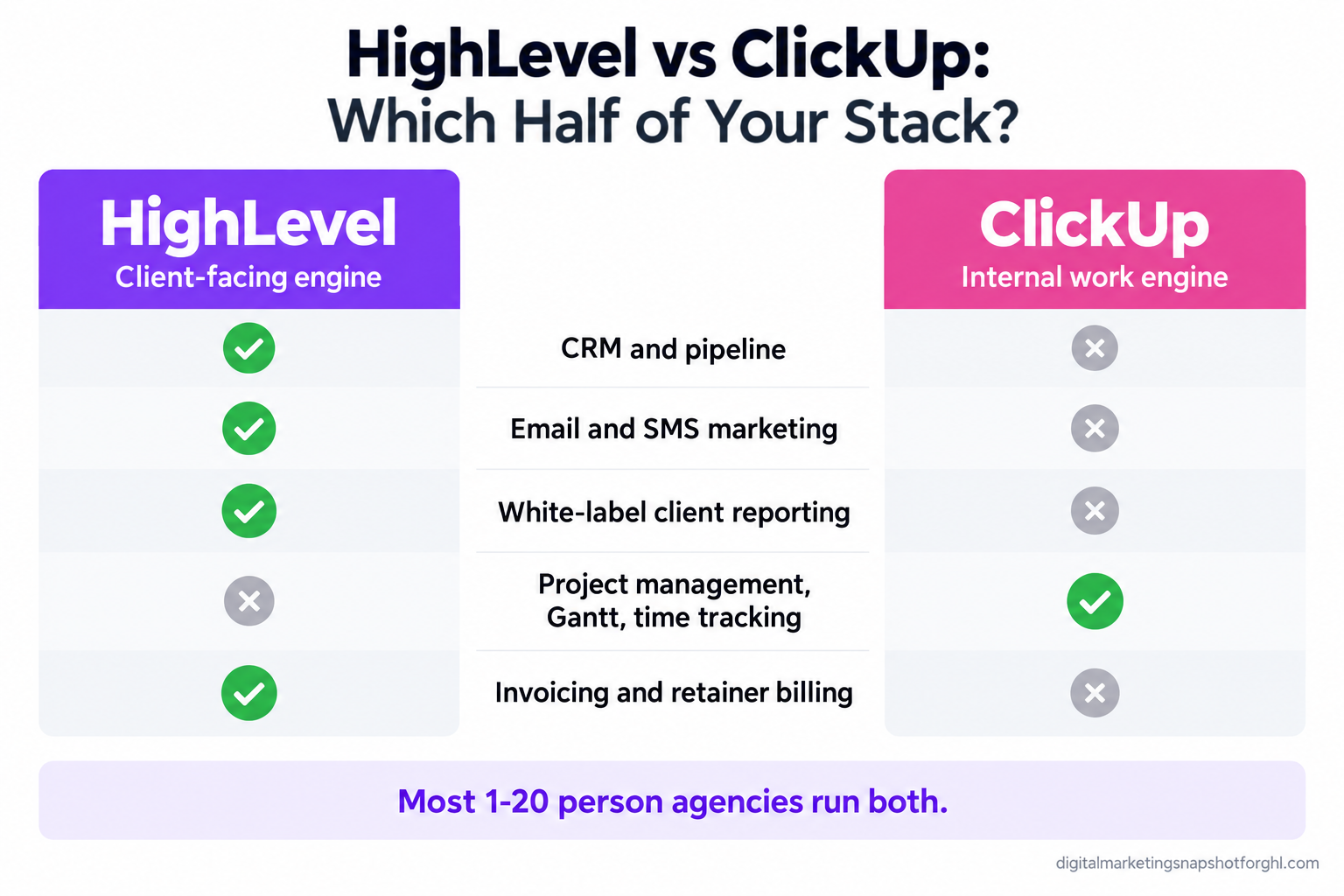
Table of contents
- Why agencies compare HighLevel and ClickUp at all
- What each tool actually is (and what it is not)
- HighLevel vs ClickUp across 8 criteria
- What the two pricing shapes do as you grow
- The three-scenario call: solo, 8-person, 20-plus
- Where each one breaks
- The stack most agencies actually land on
- The compliance the CRM half forces on you
- Objections, answered
- The bottom line
- FAQ
Why agencies compare HighLevel and ClickUp at all
It usually starts the same way. You pay for a CRM, an email tool, a scheduler, a reporting dashboard, a proposal app, and a project board, each with its own invoice. The average agency runs about 7.2 separate SaaS tools to deliver client work (Agiled, 2026), so you hunt for the one platform that swallows the rest, and the two names that keep coming up are HighLevel and ClickUp.
Both market themselves as the everything-tool, so it is easy to assume they compete for the same slot. They do not, and picking on the marketing means buying the wrong half. The wrong half is expensive: margins are already tight, with billable utilization at just 66.4% in 2025 against the 75% high-performer mark (SPI Research 2026, 509 firms), and a tool bought for the wrong problem wastes both its fee and the weeks spent migrating into it.
What each tool actually is (and what it is not)
HighLevel is a CRM and marketing operations platform built for agencies. One login gives you contact records and sales pipelines, two-way SMS and email, calendars and booking, funnel and site building, review requests, a client reporting dashboard, and invoicing, with a separate sub-account per client on the $297 Unlimited plan (HighLevel pricing). What it is not: a serious project manager. No Gantt timeline, no subtask hierarchy, no native time tracking, gaps open in its own community for years (HighLevel ideas board).
ClickUp is a work-management platform: tasks, subtasks, dependencies, docs, whiteboards, dashboards, time tracking, and hundreds of views. It is excellent at internal delivery. What it is not: a marketing engine. No native two-way SMS, no email or SMS sending, no client billing. Its “CRM” is a set of list templates, a place to store deals, not a system that texts a lead back in 60 seconds or sends a white-label report on autopilot (Breakcold, 2026).
HighLevel vs ClickUp across 8 criteria
The head-to-head on the eight things agency owners actually ask about. Read it as “who owns this job,” not “who wins,” because on most rows only one is even trying.
| Criterion | HighLevel | ClickUp |
|---|---|---|
| Client CRM and sales pipeline | Purpose-built: records, pipelines, lead source tracking | Template-based lists; storage, not automation |
| Email and SMS marketing | Native two-way SMS and email sends, workflows | None native; needs a third-party tool |
| Client reporting dashboards | Built-in, white-label, schedulable | Internal dashboards only, not client-facing reports |
| Internal project management | Basic tasks; no Gantt, no subtasks, no time tracking | Best in class: dependencies, time tracking, 15+ views |
| Scheduling and lead intake | Native calendars, booking, and forms | Forms exist; no booking or lead routing |
| Invoicing and retainer billing | Native invoices, subscriptions, text-to-pay | None; needs QuickBooks, Stripe, or similar |
| White-label and client access | Full white-label, per-client sub-accounts | Guest access to boards; not white-label at low tiers |
| Pricing shape as you scale | Flat fee, any team or client count | Per seat, multiplies with headcount |
Client CRM and sales pipeline
HighLevel was built around this. Every contact has a record, a source, a pipeline stage, and an automation history, and you can trigger a text or email off any stage change. ClickUp holds a deal in a list with custom fields, fine for a founder tracking ten opportunities. The moment you want the CRM to do something itself, like text a new lead in under a minute, ClickUp needs an outside tool bolted on. It is the same reason we run lead attribution inside HighLevel, not a task board.
Email and SMS marketing
The cleanest split in the comparison. HighLevel sends; ClickUp does not. HighLevel has native two-way SMS, native email, and workflows that fire both, with usage-based message costs on top of your plan (HighLevel pricing). ClickUp has no native SMS and no campaign email. If you send anything for clients, this row alone decides it.
Client reporting dashboards
Reports are where retainers quietly die: clients cannot see the work, assume nothing happened, and churn. HighLevel builds white-label dashboards you can schedule and send automatically, the whole point of stopping churn with automated reporting. ClickUp dashboards are superb for your team, but they are not client reports.
Internal project management
Now ClickUp wins, and it is not close. Dependencies, subtask hierarchies, sprint points, workload views, and native time tracking are all first-class. HighLevel has a basic task list on contacts, with no Gantt, no subtasks, and no time tracking (Fuel Your Digital, 2026). If your fulfillment is complex and deadline-driven, forcing it into HighLevel tasks is misery.
Scheduling and lead intake
HighLevel has native calendars, round-robin booking, and forms that route straight into pipelines. ClickUp forms create tasks, useful for intake requests, but there is no native booking and no lead routing.
Invoicing and retainer billing
HighLevel has native invoices, recurring subscriptions, and text-to-pay, so retainer collection lives next to the client record. ClickUp has none of this and expects billing in QuickBooks or Stripe. If cash flow between retainers is a weekly worry, that gap matters, and our guide to pricing agency retainers assumes billing you can automate.
White-label and client access
HighLevel white-labels the whole platform and gives every client a sub-account on Unlimited, so they log into something that looks like your software. ClickUp offers guest access to boards, fine for collaboration but not branded as yours at a small agency’s price.
Pricing shape as you scale
HighLevel is flat no matter how many people or clients you add. ClickUp charges per seat every month. That single difference reshapes your bill as you grow.
What the two pricing shapes do as you grow
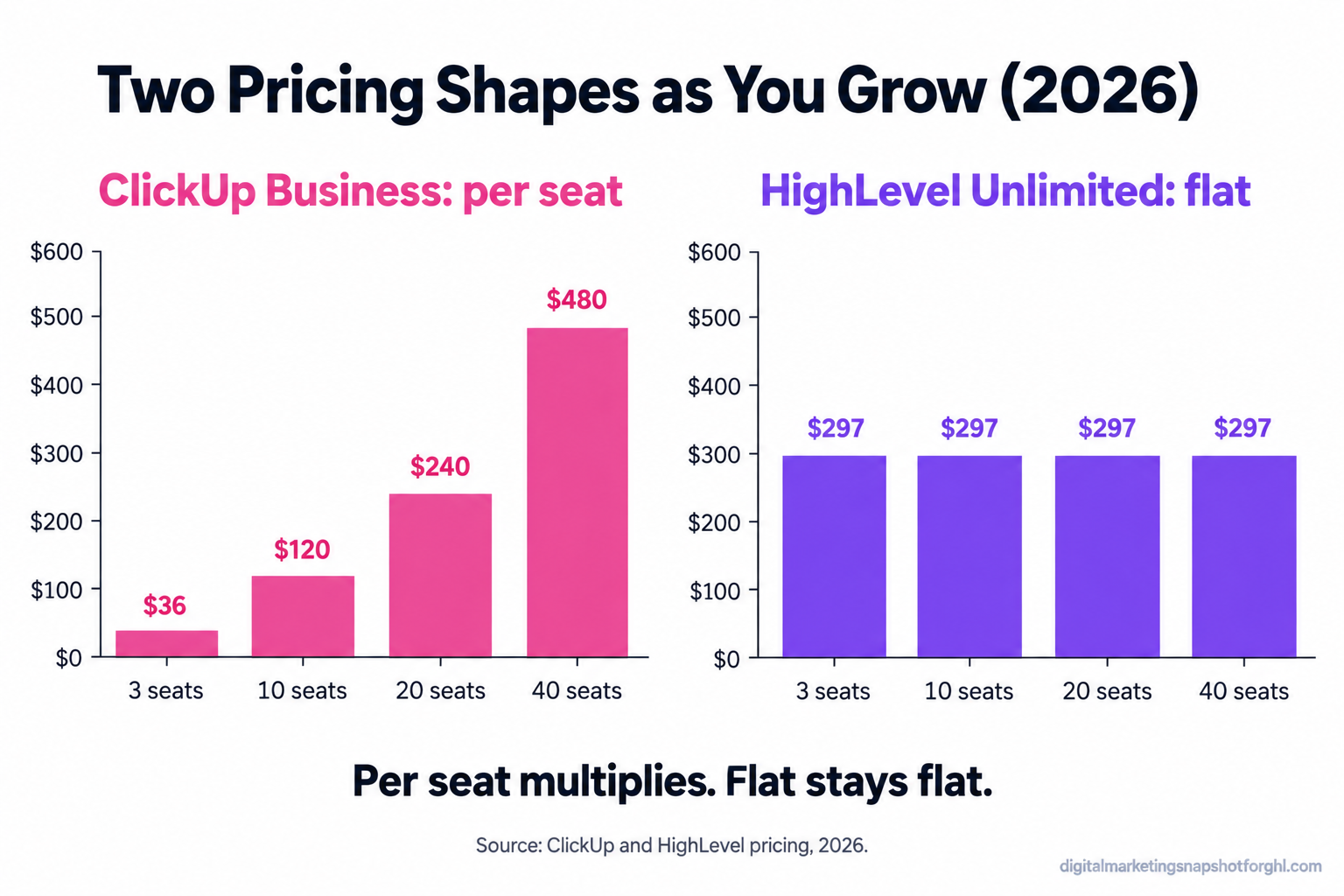
ClickUp’s 2026 paid plans are $7 per user per month for Unlimited and $12 for Business on annual billing, Enterprise by custom quote. The Free plan is real but capped at 60 MB of storage and 100 automation actions a month, which a working agency blows through fast (ClickUp pricing). Because it is per seat, the bill climbs every time you hire.
Monthly cost of ClickUp Business at $12 per user per month, annual billing. HighLevel Unlimited stays flat at $297 regardless of seat count. Source: ClickUp pricing, 2026.
HighLevel runs the opposite way: three flat tiers, each covering your whole team and, on Unlimited and above, every client you onboard.
HighLevel monthly price by plan, flat at any team or client count. Message and call usage is billed separately. Source: HighLevel pricing, 2026. Full breakdown in our GoHighLevel pricing guide.
Read together, the pattern is clear. At three seats ClickUp is cheap and HighLevel looks expensive; at forty seats ClickUp is $480 and HighLevel is still $297. But each buys a different thing: ClickUp’s $480 is one job, internal work; HighLevel’s $297 is six jobs, the whole client engine. You are choosing which job to consolidate first, not comparing two numbers.
The three-scenario call: solo, 8-person, 20-plus
Solo or two-person shop. Buy HighLevel first, on Starter or Unlimited. Delivery is simple enough for a task list and a shared doc, so you do not need ClickUp’s power yet. What you cannot fake is fast lead follow-up, booking, and a report that makes the client feel taken care of. If tracking outgrows a checklist, ClickUp Free covers you before you pay a cent.
Eight-person agency. Now you need both, and order matters: HighLevel is the revenue and retention system, ClickUp the delivery system. At eight seats ClickUp Business is about $96 and HighLevel is $297, roughly $393 for two engines that used to be six or seven subscriptions. This is where tool sprawl hurts most, and collapsing it into two platforms is a real margin win.
Twenty-plus agency. Both, and here HighLevel’s flat pricing pulls ahead hardest. Twenty seats of ClickUp Business is $240 and climbs with every hire, while HighLevel stays at $297 whether you have twenty clients or two hundred. You also weigh Agency Pro at $497 for SaaS mode and rebilling, which turns the platform into a product you can resell. The delivery engine scales with headcount; the client engine does not.
Where each one breaks
Every platform looks great in the demo. Here is where each cracks.
HighLevel breaks on complex fulfillment. The instant delivery has real dependencies, “design finishes before dev before QA,” the flat task list falls over: no Gantt, no subtask tree, no way to see who is overloaded. The fix is not to bend HighLevel into a project tool. Let it own the client relationship and hand delivery to ClickUp, connected so a won deal opens a ClickUp project.
HighLevel breaks on deliverability if you skip registration. Because it sends real SMS, you inherit real telecom rules. Carriers block unregistered A2P 10DLC traffic, so texts launched without registration silently fail to land. That is carrier law, not a bug, and the compliance section has the fix.
ClickUp breaks on client-facing anything. The moment you need a lead texted back, a campaign sent, or a branded report delivered, ClickUp has no native answer and you are shopping for add-ons, reopening the sprawl you were closing.
ClickUp breaks on complexity creep. Its strength, endless views, turns liability when everyone builds their own. Without a strict template, a workspace becomes a museum of half-used views in three months. The fix is one owner and one enforced structure.
The stack most agencies actually land on
The honest end state for most 1-to-20-person agencies is not “one tool.” It is two, split clean between money and delivery:
- HighLevel runs acquisition, follow-up, reporting, and billing. The system your clients feel.
- ClickUp runs the internal work. The system your team feels.
- One automation connects them, so a closed deal in HighLevel spawns the ClickUp project with no double entry.
Two platforms instead of seven. The case for a purpose-built system over a general one is in custom software versus off-the-shelf tools, and this split is how you scale without adding headcount.
Before buying, do not eyeball your stack. Total it. List every subscription in two columns and add up the monthly cost:
- Client-facing (HighLevel replaces this): CRM, email tool, SMS tool, booking app, funnel builder, review tool, reporting dashboard, invoicing tool.
- Internal delivery (ClickUp replaces this): project board, task app, docs/wiki, time tracker, workload tool.
Column one folds into HighLevel; column two into ClickUp. The column-one total minus $297 is roughly what HighLevel saves you monthly, and it is almost always positive by five clients.
The first automation you build in the HighLevel half is the follow-up sequence. Real copy to lift today. Instant missed-call text-back: “Hi {first name}, this is {your agency}. Sorry we missed you just now. What can we help you with? Reply here and we will jump right on it.” Same-day email subject line: “Quick recap + your next step with {your agency}.” Two-day nudge if they go quiet: “Still want us to look at {their goal}? Grab a time that suits you: {booking link}.” Three messages, all native to HighLevel, none possible in ClickUp without an add-on.
The compliance the CRM half forces on you
Pick the tool that sends messages and you inherit rules a task app never touches. This is the hidden cost of the HighLevel side, and getting it wrong costs more than a subscription.
A2P 10DLC registration. US carriers block unregistered application-to-person SMS. You register campaigns, and registering on a client’s behalf needs a reseller ID, which most small agencies get wrong the first time. Skip it and texts quietly fail to deliver. Full walkthrough in A2P 10DLC registration for agencies.
CAN-SPAM on every email. Every marketing email needs a real physical address and a working one-click unsubscribe, on your sends and your clients’ alike (FTC CAN-SPAM guide).
FTC Endorsement Guides on review automation. If your setup requests and publishes reviews, the FTC’s revised Endorsement Guides apply: they ban incentivized and fake reviews and removed “results not typical” as a defense (FTC.gov, 2023). Automate the request, never the review’s content.
Objections, answered
“Can’t I run my CRM inside ClickUp and skip HighLevel?” You can store contacts and deals, and a founder tracking a handful of opportunities gets by. What you cannot do natively is send a two-way text, run an email campaign, book an appointment, or deliver a white-label report. The second you need any of those you are buying another tool, back in the sprawl you were escaping (Breakcold, 2026).
“Can’t I run projects inside HighLevel and skip ClickUp?” For simple, repeatable delivery, yes. For anything with dependencies, subtasks, or time tracking, no, because those do not exist natively and have been unmet requests for years (HighLevel ideas board). If fulfillment is genuinely complex, do not fight it.
“I already pay for AgencyAnalytics and a scheduler. Is HighLevel cheaper?” Usually, once you count what HighLevel folds in. AgencyAnalytics bills per client, so its cost climbs as you win business, the treadmill we mapped in AgencyAnalytics alternatives that do not charge per client. HighLevel’s flat fee absorbs reporting, scheduling, CRM, and email into one line.
“Won’t clients find the automated texts annoying?” Not when they are fast and relevant. A lead who hears nothing for six hours is the annoyed one. A missed-call text-back in 60 seconds reads as attentive, as long as you honor opt-outs.
The bottom line
Stop asking which tool wins. Ask which half of your agency is bleeding. If leads slip, follow-up is slow, and retainers lapse, that is the client-facing engine, and HighLevel is the tool. If work is late and you cannot see who is overloaded, that is the delivery engine, and ClickUp is the tool. A solo shop starts with HighLevel; an eight-person team runs both and connects them; a twenty-plus agency leans on HighLevel’s flat pricing as headcount grows. The one path that never pays off is forcing either tool to do the other’s job.
If HighLevel is your pick and you would rather skip the month of building, that is what the Digital Marketing Snapshot is for: the entire client-facing half, pre-built and installed in 24 hours.
Frequently asked questions
Is HighLevel or ClickUp better for a marketing agency?
Neither is universally better; they do different jobs. HighLevel wins the client-facing side (CRM, email and SMS, reporting, billing), ClickUp wins internal project management. Most 1-to-20-staff agencies run both, buying HighLevel first if the pain is lead follow-up and retention, ClickUp first if it is delivery and deadlines.
Can ClickUp replace a CRM like HighLevel?
Only partially. ClickUp can store contacts and deals in lists, which works for a founder tracking a few opportunities. It cannot send two-way SMS, run email campaigns, book appointments, or deliver white-label reports natively, so it is not a substitute for a marketing CRM.
How much do HighLevel and ClickUp cost in 2026?
HighLevel is flat: $97 Starter, $297 Unlimited, or $497 Agency Pro, with message and call usage billed separately. ClickUp is per user per month annually: free, then $7 Unlimited, $12 Business, or custom Enterprise. HighLevel stays flat as you grow; ClickUp multiplies with headcount.
Does HighLevel have project management?
It has basic task management on contact records, but no Gantt timeline, no subtask hierarchy, and no native time tracking. For complex, dependency-heavy delivery, most agencies pair HighLevel with a dedicated tool like ClickUp.
What compliance rules apply when I send SMS through HighLevel for clients?
You must register A2P 10DLC campaigns, and registering on a client's behalf needs a reseller identifier. CAN-SPAM applies to all email sends, and the FTC Endorsement Guides govern review automation. The FCC one-to-one consent rule was vacated in January 2025 and does not apply.
About the author
Callan Reeves is a performance marketing and attribution lead in Denver, CO. He came up managing seven-figure ad budgets, got tired of dashboards that could not tie a conversion back to a campaign, and rebuilt the whole tracking and ops stack inside GoHighLevel. He writes about lead attribution, speed-to-lead, and proving ROI clients believe.