
For a Philadelphia marketing agency, comment-to-DM automation is the fastest way to turn organic Instagram and Facebook reach into booked calls — without hiring a social manager to sit on the inbox. When a viewer drops “info”, “guide”, or “price” under one of your reels, Meta’s official Instagram Graph API lets you send them one private DM automatically, within seconds, inside a 7-day reply window. Wire that DM into a GoHighLevel qualifier and calendar, and every “how much?” becomes a booked discovery call before the intent cools. Below is the operator’s playbook — exactly how to set it up, what Meta does and does not allow, and the sourced math for why it’s the highest-ROI social play a Philly agency can ship this quarter.
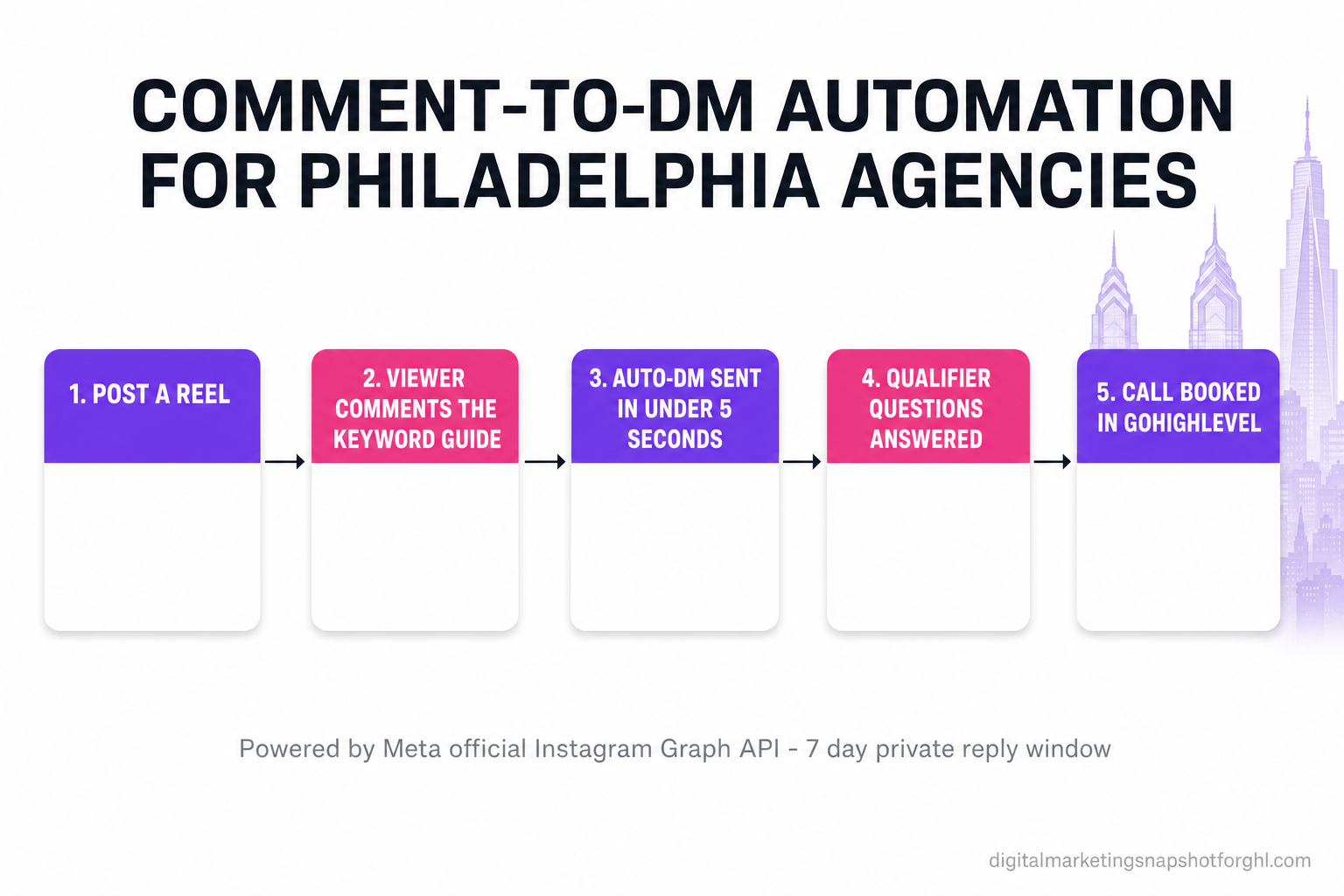
Table of contents
- Why comment-to-DM is the Philly agency play in 2026
- What Meta actually allows: the compliant path
- The 7-step comment-to-DM playbook
- Manual DM replies vs comment-to-DM automation
- Wiring it into GoHighLevel end-to-end
- Reel content that earns comments worth automating
- Measuring the retainer story it creates
- FAQ
- Related posts
Why comment-to-DM is the Philly agency play in 2026
Two facts collide for every Philadelphia marketing agency this year.
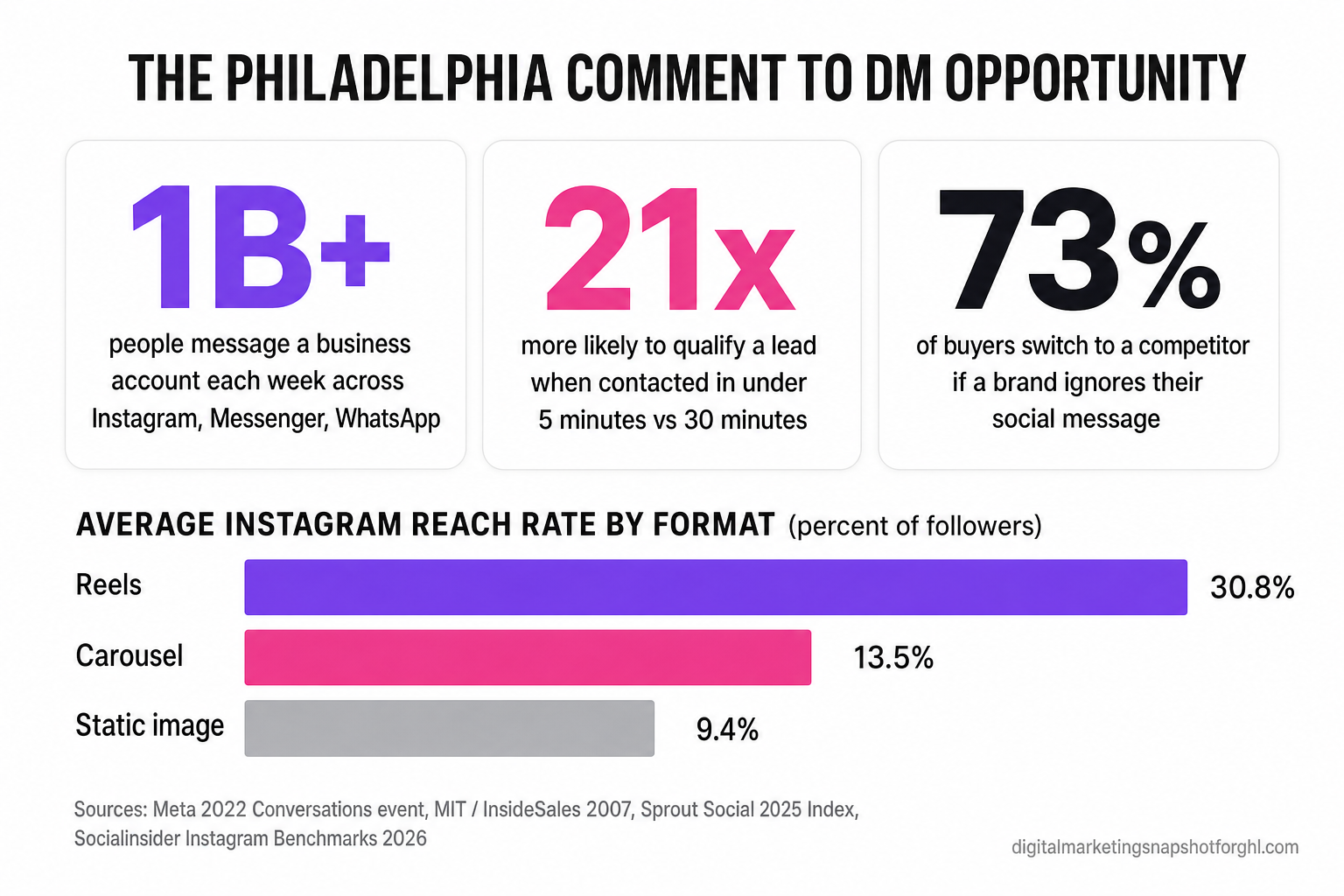
The first: conversational commerce is now where buyers actually raise their hand. Meta reports that more than 1 billion people message a business every week across Instagram, Messenger and WhatsApp (Meta, via Adweek), and “private messaging” is one of the three growth pillars Meta calls out in every earnings deck. Ads still drive the reach, but the conversion is happening one-to-one, in the inbox.
The second: your public comment section is the front door of that inbox. Every “info?”, “price?”, “link please” under a reel is a warm buying signal you can turn into a private conversation — but only if you answer while the intent is fresh. And you almost certainly aren’t. Independent research finds only about 7% of companies respond to a new lead within 5 minutes (Drift Lead Response Report), and once you slip past 30 minutes, your odds of qualifying that lead collapse by roughly 21x compared to a 5-minute response (MIT / InsideSales).
For a Philadelphia agency, the geography sharpens the math. Philly is home to 1,573,916 residents as of July 2024 (U.S. Census Bureau via Inquirer), sitting inside a metro of about 6 million buyers with high-value verticals — hospitals in University City, universities across the corridor, fintech in Center City, life-sciences in the Navy Yard. Those buyers are exactly the audience running Instagram business searches at 9pm, and every one of your competitors — 662 advertising agencies statewide in Pennsylvania (IBISWorld) — is one search result away. The agency whose feed talks back in seconds is the one that gets the call.
Comment-to-DM automation is what closes that gap without adding headcount. It’s the on-brand version of the same speed advantage you already sell your clients, pointed at your own agency first.
What Meta actually allows: the compliant path
This is the part most “growth hack” posts get wrong. Meta is explicit about which comment-to-DM behavior is sanctioned and which will get an account restricted, throttled or banned. If you’re going to run this for your Philly agency (and for the clients whose accounts you manage), you need to build on the official path only.
The sanctioned path is Meta’s Instagram Graph API “private replies” endpoint. It lets a business send one private DM in response to one public comment on a Post or Reel, within a 7-day window from the comment (Meta for Developers documentation summary via Postproxy). Meta caps that endpoint at roughly 750 private replies per hour per account — plenty for even a viral reel. Meta’s broader Instagram Messaging API also enforces a 24-hour standard messaging window: once a user has messaged you (or triggered you via a comment/story reply), you can converse freely for 24 hours (Meta Instagram Messaging API policy summary).
The three hard rules you cannot break:
- The user must initiate. A comment, story reply, DM or follow — those are the four “user actions” that unlock a compliant private reply (Instagram DM compliance guide). Cold DMs at scale are not.
- One private reply per comment, ever. Delete a comment and you lose the ability to send its private reply. Try to send two and Meta will silently drop the second (Meta private reply rules).
- Comment and story triggers are capped at 1 DM per user per 24 hours as of 2026 (Instagram automation compliance 2026) — which is fine for a real agency use case, and lethal for spam.
Facebook Pages get the same treatment through Messenger’s Send API: private replies to Page post comments are supported, with a 7-day window, and the same “user must trigger” rule applies. The tools change, the policy shape doesn’t.
The 7-step comment-to-DM playbook
Here’s the exact playbook we run for Philadelphia agencies inside our done-for-you social media service. Every step assumes you’re either using the Digital Marketing Snapshot for GoHighLevel or wiring the same logic yourself.
Step 1 — Convert both accounts to Instagram Professional + connect to a Facebook Page
Meta’s Messaging API only works on Instagram Business or Creator accounts linked to a Facebook Page. In the Instagram app: Settings → Account type and tools → Switch to Professional Account → Business. Then link that account to the Page you manage the Philly agency’s Facebook presence from. Without this pairing, you have no API access and everything below is impossible.
Step 2 — Get Meta app approval for instagram_manage_messages
You’ll need a Meta Developer app with the instagram_business_manage_messages, instagram_business_content_publish and pages_messaging permissions. If you build on top of an approved partner platform (GoHighLevel, ManyChat, Kommo, Spur, etc.), you inherit their app approval and skip the review queue — the trade-off is you’re bound by their pricing and rate limits, not your own. For most Philly agencies, inheriting approval is the right call for the first six months.
Step 3 — Pick the ONE keyword each Reel will listen for
The single biggest mistake we see: agencies listen for 12 keywords per post and the audience never knows what to type. Pick one keyword per Reel or Post, put it in the caption and the on-screen text, and repeat it in the call-to-action: “Comment GUIDE and I’ll DM you the 12-page Philadelphia agency playbook.”
Good keywords for agency lead-gen: GUIDE, PRICE, AUDIT, LOCAL, TEMPLATE, CHECKLIST. Bad keywords: anything more than one word, anything a bot could false-trigger on (YES, HI), or brand names Meta might flag.
Step 4 — Write the DM as a two-message sequence, not a one-shot brochure
The private reply endpoint sends one message per comment, so your first DM has to do two jobs: deliver the promised asset and invite the reply that opens the 24-hour messaging window. The second message — the qualifier — only fires after the user responds. Example:
- DM 1 (auto, ≤5 sec): “Hey — here’s the Philadelphia agency playbook you asked for:
{{link}}. Quick one, are you a solo operator or running a team?” - DM 2 (fires on user reply): “Got it — for a
{{team_size}}shop in Philly, our clients usually save 12–18 hours/week on reporting. Want a 20-min walkthrough this week?{{calendar_link}}”
That second reply is what closes the loop from comment → DM → booked call.
Step 5 — Qualify with 2–3 questions, no more
Every extra qualifier costs you drop-off. We run three tags on Philly agency accounts: stage (starting / scaling / stuck), stack (GHL / HubSpot / other), and timeline (this month / this quarter / researching). Everything else is a note field. Push those tags into GoHighLevel as contact fields the second the DM is answered — you’ll use them for routing in Step 7.
Step 6 — Book the call inside the DM, not on a landing page
The most-broken funnel we see is: agency DMs a link, link opens the browser, user gets distracted, call never books. Instead, use Instagram’s native “Book” action or drop the direct GoHighLevel calendar link with a specific time: “How’s Thursday at 3pm ET? — {{book_thursday_3pm}}”. If they tap once and it books, you’ve compressed a 4-touch funnel into a 4-second one.
Step 7 — Route the booked call to the right team + trigger the follow-up sequence
The moment the calendar event fires in GoHighLevel, kick off:
- SMS + email confirmation (with the Philadelphia office address / phone if you have one — good for local SEO trust)
- 24-hour and 1-hour SMS reminders (proven no-show reducers — see our appointment reminder automation guide)
- Pipeline stage update (contact → discovery booked)
- Slack/Teams ping to the account owner
That last step is the difference between a lead that quietly rots in a pipeline and one that gets called on time by a human who’s actually ready.
Manual DM replies vs comment-to-DM automation
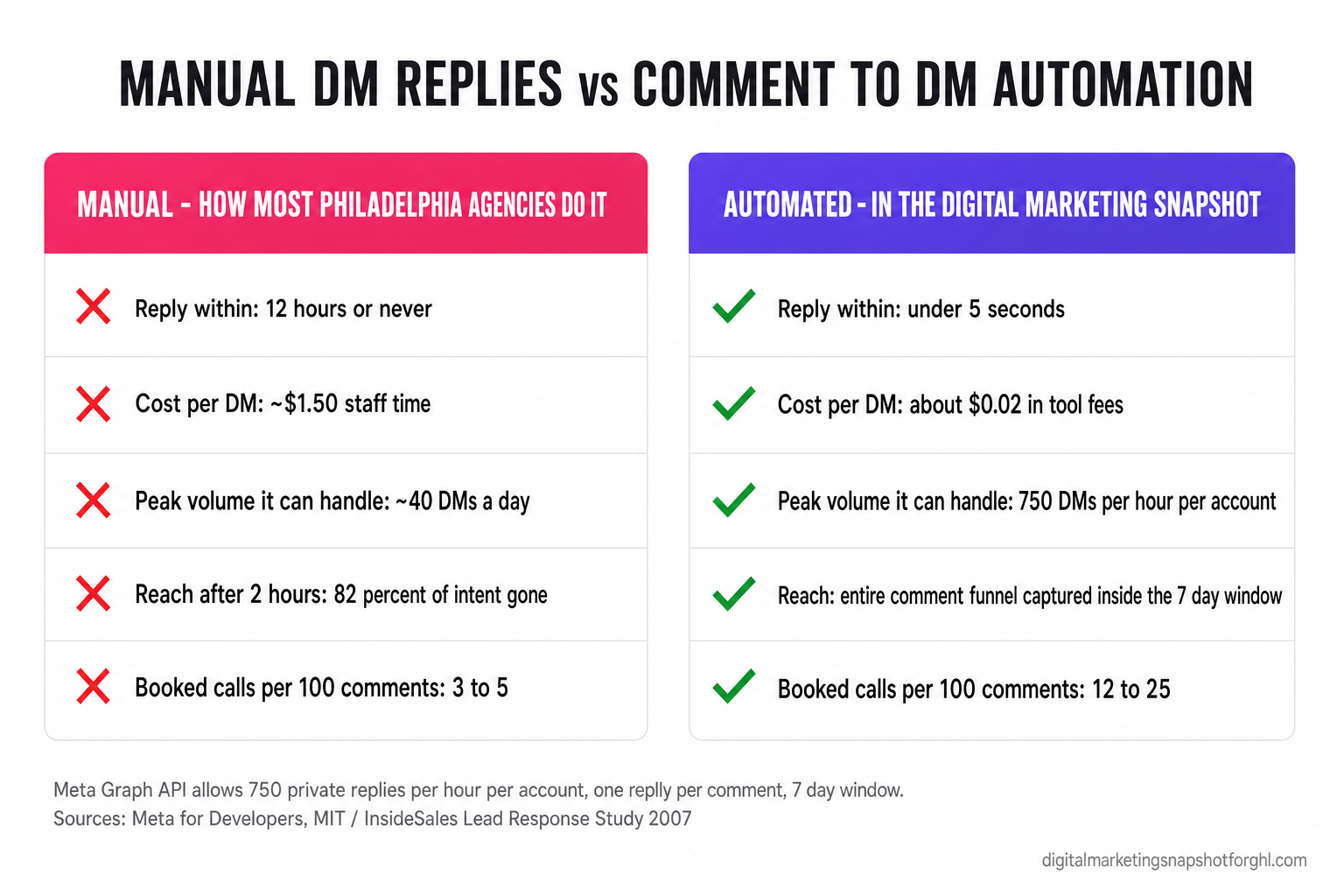
The reason to automate isn’t laziness — it’s math. A comment-to-DM engine runs the front-end of your sales conversation at a speed no human can hit, at a cost your P&L will actually notice.
Booked calls per 100 comments (illustrative agency benchmark). Assumes manual reply within ~12 hours vs auto-DM in ≤5 seconds. Underlying qualify rate curve from the MIT / InsideSales Lead Response Study.
Two clean wins to keep in mind:
- Speed. A ~5-second reply is up to 21x more likely to qualify than a 30-minute one (MIT / InsideSales).
- Coverage. 73% of buyers will pick a competitor if you ignore them on social (Sprout Social 2025 Index), and 73% expect a response within 24 hours — every unanswered comment is a % of them walking.
Wiring it into GoHighLevel end-to-end
GoHighLevel is where the DM stops being a “cool automation” and starts being a retainer story. Here is the wiring we deploy for Philadelphia agencies inside the Digital Marketing Snapshot:
- Instagram + Facebook connected as conversation channels — GHL treats DMs from both platforms as first-class inbound messages inside its unified inbox, so the reply happens without leaving the CRM.
- Workflow trigger: “Instagram/Facebook message received” — filters on the keyword the user commented (e.g.
GUIDE) and fires the DM 1 → wait → DM 2 sequence from Step 4 above. - Contact created + tagged in real time —
source: instagram-reel-guide,city: philadelphia,stage: <user reply>. This is what makes attribution actually work — see our post on lead attribution that proves ROI. - Calendar event on tap-to-book — GHL’s calendar handles the round-robin and drops the SMS/email confirms automatically.
- Pipeline stage advance + Slack/Teams ping — so a human closes the loop, not a bot.
- Reporting — GHL’s dashboards + a white-label monthly report show comments → DMs sent → booked calls → deals won, per account. If you’re still running static PDF reports for clients, switch to a live GHL dashboard — it changes the renewal conversation.
For agencies without deep GHL experience, this is what we ship in the snapshot. For agencies with GHL experience but no dev bandwidth, our GHL development team can build the same wiring as a one-off retainer project.
What comment-to-DM costs (illustrative — actual pricing varies)
| Plan | Build it yourself | 3rd-party DM tool | Digital Marketing SnapshotRecommended |
|---|---|---|---|
| Price | $0 tool, ~120 hrs dev | $99-$399/mo per account | Included in snapshot + $397/mo social |
| Feature 1 | Meta app approval + review (2-6 weeks) | Fast to set up | Live in ~24 hours after install |
| Feature 2 | GHL workflow build | Meta app approval inherited | Runs natively in GoHighLevel |
| Feature 3 | Ongoing API maintenance | Locked to the vendor's roadmap | One engine, unlimited client sub-accounts |
| Feature 4 | You own every future rate-limit change | Client account = another seat fee | 5 posts/week across 9 channels feeding the funnel |
| Feature 5 | Only your own agency uses it | Not natively in GHL | Monthly white-label reports included |
| See Done-For-You Social → |
Reel content that earns comments worth automating
An automation is only as good as the comments it triggers on. The reason so many Philadelphia agencies “try comment-to-DM and it flops” is that their reels don’t ask the audience to do the one thing the whole system depends on: comment the keyword.
Three formats convert best in agency accounts:
- The single-tip Reel with a lead magnet close. “3 things I’d fix on a Philly HVAC company’s Google profile — comment AUDIT and I’ll send the full 10-point checklist.”
- The behind-the-scenes reel with a template close. “This is the onboarding form we use for every new Philly client. Comment TEMPLATE and I’ll DM it to you.”
- The comparison Reel with an on-screen keyword. “AgencyAnalytics vs a live GHL dashboard. Comment DASHBOARD for the swipe file.”
Reels are the format that earns you the shot at those comments. Average Instagram reach rate per Reel is roughly 30.8% of followers, more than double any other format (Socialinsider 2026 Instagram Benchmarks), and 15–30 second reels average ~5.8% engagement vs 3.2% for reels over 90 seconds (Instagram Reels Statistics 2026). Ship them short, ship them often, and let each one carry exactly one keyword.
If you’re not producing reels 5 days a week, our done-for-you social media service does it for you across all 9 channels — one text, one image, two carousels and one reel per week per brand — for $397/mo. That’s the volume flywheel this automation needs to matter.
Measuring the retainer story it creates
For your clients (and for your own retention), what matters isn’t “DMs sent” — it’s what the DM funnel did to the pipeline. Report on these five numbers every month:
- Comments captured — every keyword hit, per Reel/Post.
- Auto-DM open rate — Instagram gives you this natively for API-sent messages.
- Qualifier completion rate — % of DM’d users who answer the qualifier question.
- Booked calls — GHL calendar events with
source = comment-to-dm. - Cost per booked call — total ad spend + tool spend ÷ booked calls.
Put those five in a live GHL dashboard, put your Philly agency’s logo on it, and email it at 8am on the 1st of every month. That is the reporting cadence that turns a client into a two-year retainer — and it’s exactly the pattern in our stop client churn with automated reporting playbook.
Why this matters more for Philadelphia agencies
Two things make Philadelphia unusually well-suited to a comment-to-DM strategy.
One: the vertical mix. DesignRush and Clutch consistently call out Philly agencies as strong in healthcare, education, finance, legal, B2B and SaaS — every one of which is a longer-consideration purchase where a live DM conversation converts far better than a form fill. When the buyer has a real question, an instant, contextual DM beats a “someone will reach out in 2 business days” any day of the week.
Two: the density. With ~662 advertising agencies in Pennsylvania and hundreds concentrated in the Philadelphia metro, the speed of response becomes the differentiator. Two agencies with the same content library, the same offer, and the same price point — the one that answers in seconds books the meeting. Full stop.
That’s why we treat comment-to-DM as table stakes for every Philly agency we onboard, not an “advanced” feature. It’s the single automation that makes the rest of the social investment pay for itself.
FAQ
Is comment-to-DM automation actually allowed by Meta?
Yes — through Meta's official Instagram Graph API and Facebook Messenger Send API only. Meta explicitly supports 'private replies' to public comments on Posts and Reels, within a 7-day window, one reply per comment, at up to 750 replies per hour per account. Browser-automation IG bots and mass-DM scrapers are not compliant and are the source of most account bans.
What happens if my Philly agency's Reel goes viral and gets 5,000 comments?
You're inside the API's 750 private-replies-per-hour rate limit and the 7-day comment window, so a well-built automation can spread the replies across the window and catch all of them. Set the sequence so DM 2 (the qualifier) fires on user reply, not on a timer — that way you never blow through the 24-hour messaging window while a user is still asleep.
How is this different from cold DMing prospects?
Cold DMing at scale is Meta's #1 ban trigger. Comment-to-DM is the opposite: the user takes a public action (a comment on your Post/Reel), which under Meta's rules constitutes a request to be contacted. That user-initiated trigger is what makes the private reply compliant.
Does it work for Facebook Pages as well as Instagram?
Yes. Facebook Messenger's Send API supports private replies to Page post comments on the same 7-day window, and GoHighLevel handles both channels in the same unified inbox. Most agencies see higher volume on Instagram Reels, but the Facebook side matters for older-demo verticals — great for a Philadelphia agency serving healthcare or 55+ B2C.
How long does it take to set up for a client account?
If you're on the Digital Marketing Snapshot, we install the workflow, the DM sequence, the calendar and the reporting for a new client sub-account in about a day. If you're building it from scratch — Meta app approval, workflow, calendar, reporting — budget 3–6 weeks including Meta's review queue.
What keyword works best for a Philadelphia agency's own Reels?
Test one per audience segment: GUIDE (for early-stage curious viewers), AUDIT (for people who already know they have a problem), and PRICE (for late-stage comparison shoppers). Run each keyword for two weeks, measure booked calls per 100 comments, keep the winner. The single most common mistake is running five keywords at once — the audience never knows what to type, and the automation looks broken when it's actually just being ignored.
How much of this is included in the Digital Marketing Snapshot?
The GHL workflow, the two-message DM sequence, the calendar wiring, the pipeline routing and the reporting dashboards are all in the snapshot. The done-for-you content that feeds it — 5 posts a week across 9 channels, plus the comment, DM and web-chat AI agents — is our separate social media service at $397/mo for one brand.
Related posts
- Instagram DM Automation for Agencies: Turn DMs Into Booked Calls (2026 Playbook) — the broader DM-inbox playbook this specific tactic plugs into.
- Social Media Management for Marketing Agencies in Dallas: The Hidden Cost of a Dead Feed — why the volume you post is the multiplier on every automation.
- AI Chat Widget for Marketing Agencies in Phoenix — the on-site sibling of comment-to-DM.
- Reduce No-Shows With Appointment Reminder Automation in GoHighLevel — the reminder sequence to run after a DM-booked call.
- Speed-to-Lead for Agencies — the underlying number that makes comment-to-DM worth it.
About the author
Priya Naidoo helps boutique social and content agencies cut churn and turn their best clients into a referral pipeline. Her angle is relationship engineering: the right touchpoint at the right moment, automated so nothing slips. She covers client portals, review collection, DM engines, and the renewal conversations that keep an agency growing without constant new-business hustle.