
For a San Francisco marketing agency, the honest answer is not “Shorts or Reels” — it’s both, because they reach different audiences and reward different behavior. YouTube Shorts is a discovery-and-search engine that now averages 200 billion daily views and pays creators a standing 45% revenue share; Instagram Reels is where your warm audience and local Bay Area prospects already scroll, and it out-reaches every other Instagram format. The real question isn’t which one to pick. It’s how to feed both consistently without turning a two-person agency into a full-time content studio.
I’ve spent years helping boutique social and content agencies fix the same quiet problem: they sell content marketing all day, then post to their own channels twice a month. In a market as saturated with agencies as San Francisco, that gap is expensive — the prospect comparing three shops picks the one that looks alive. Below is the operator’s comparison of Shorts vs. Reels for 2026, every number sourced and dated, and a straight answer on how to actually run both.
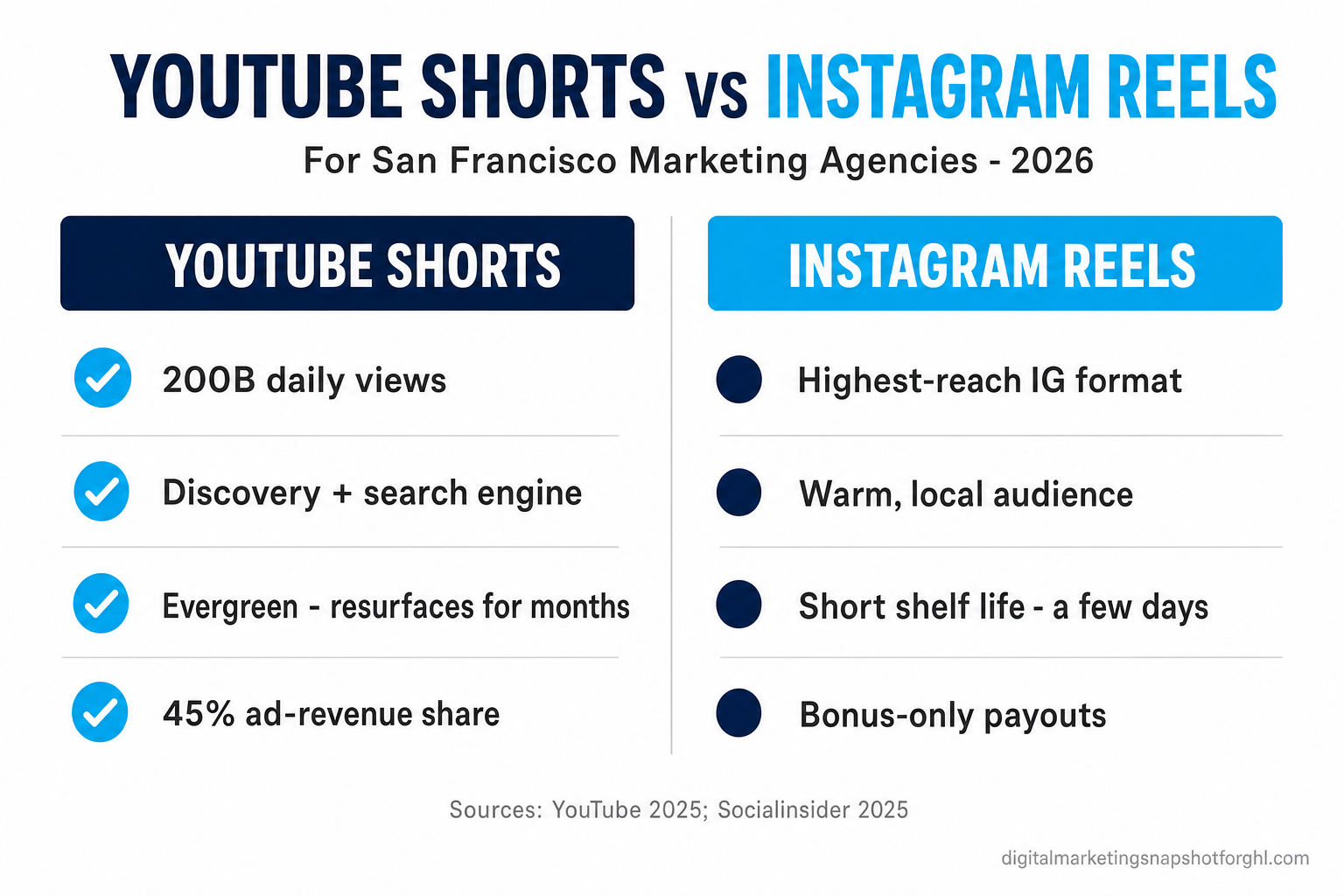
Table of Contents
- The short answer for San Francisco agencies
- Why short-form video is non-negotiable in 2026
- Shorts vs. Reels: the head-to-head
- Reach and discovery: where a cold prospect finds you
- Monetization and longevity: Shorts pays, Reels rents
- The 2026 platform changes that shift the math
- So where should a San Francisco agency post?
- The catch: two platforms, twice the work
- FAQ
The short answer for San Francisco agencies
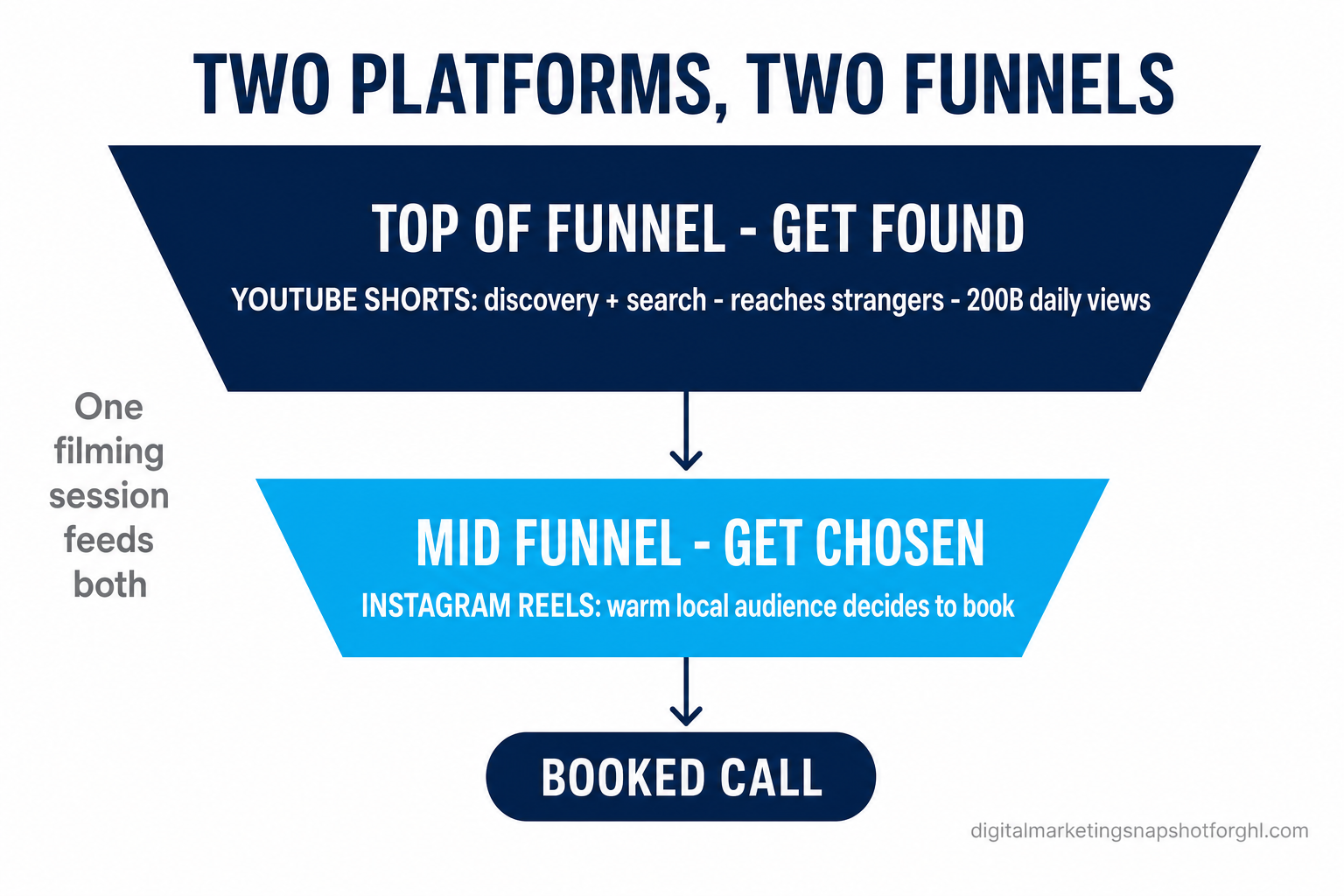
Post the same client video — cut and captioned for vertical — to both YouTube Shorts and Instagram Reels, and treat them as two different funnels rather than two copies of the same post.
YouTube Shorts behaves like a discovery and search engine: it surfaces your video to people who have never heard of your agency, and it keeps surfacing it for weeks because YouTube is a searchable library, not just a feed. That’s top-of-funnel — how a founder in SoMa who searched “how to fix our Google Ads” stumbles onto your 45-second breakdown.
Instagram Reels behaves like a relationship engine: it reaches your existing followers and the warm, local audience adjacent to them, and it rewards content that holds attention. That’s mid-funnel — how the prospect who already follows you decides you’re the agency worth a discovery call.
You don’t choose one funnel. You feed both, from one filming session. The rest of this article is the evidence behind that answer, and the operational reality of doing it every week.
Why short-form video is non-negotiable in 2026
Before comparing the two platforms, it’s worth being blunt about the format itself: short-form video isn’t a channel you can opt out of anymore. It’s where attention has concentrated, and it’s where marketers report the best return.
Short-form video is the most-used content format among marketers (about 60%), and 21% name it their single highest-ROI format — the top answer for several years running (HubSpot, 2025). Zoom out and 91% of businesses use video as a marketing tool, with the overwhelming majority reporting a positive return (Wyzowl, 2025).
The attention data explains why. Online adults spend roughly 6 hours 37 minutes a week — just under an hour a day — watching Reels, TikToks, and Shorts, according to DataReportal’s Digital 2025 report. Broken down by app (Android active users, via Similarweb), the daily averages look like this:
Average daily minutes per app, Android active users. Source: DataReportal, Digital 2025 April Global Statshot (Similarweb App Intelligence).
For a San Francisco agency, the takeaway is simple: your prospects are already spending an hour a day inside these two apps. The only question is whether they ever see you there.
Shorts vs. Reels: the head-to-head
The two products look identical — a vertical video in an infinite feed — but they behave differently in the ways that matter to an agency using them for lead generation.
| What you’re comparing | YouTube Shorts | Instagram Reels |
|---|---|---|
| Primary job | Discovery + search (evergreen) | Warm audience + local reach |
| Scale | 200B daily views (SEJ, 2025) | ~2B monthly users on IG (Sprout, 2025) |
| Content shelf life | Long — resurfaces for weeks/months | Short — mostly a few days |
| Best for | Reaching people who don’t follow you | Converting people who already do |
| Max length (2026) | 3 minutes (since Oct 2024) | 3 minutes (since Jan 2025) |
| Top ranking signal | Viewer retention / completion | Watch time (per Mosseri) |
| Creator payout | Standing 45% ad-rev share | Selective, bonus-based |
| Funnel stage | Top-of-funnel | Mid-funnel |
Neither column is “better.” A Shorts-only agency builds reach with strangers but never deepens the relationship with the audience it already has. A Reels-only agency polishes its warm audience but starves the top of the funnel. The agencies that grow in a market like San Francisco run both lanes on purpose.
Reach and discovery: where a cold prospect finds you
On Instagram, Reels is the format that reaches beyond your follower list. Across a 2025 study of 35 million posts from 447,613 profiles, Socialinsider found Reels drive roughly 36% more reach than carousels — the single biggest reason to prioritize video if your goal is new prospects, not applause from existing followers.
Engagement rate is a closer race than most agencies assume, though:
Instagram average engagement rate by format, 2025. Source: Socialinsider Instagram Benchmarks (35M posts, 447,613 profiles).
Reels sit at 0.52% engagement — just behind carousels (0.55%) and well ahead of static images (0.37%) (Socialinsider, 2025). The lesson isn’t “abandon carousels.” It’s that Reels buy you reach — the top of the funnel — while carousels earn deeper engagement from people already in your orbit. That’s the same top-vs-mid split you saw with Shorts and Reels, playing out inside Instagram itself.
YouTube Shorts extends the top of the funnel further than any Instagram format can, because Shorts are indexed and searchable. A Reel you post today is essentially invisible by next week; a Short answering “how much should a small business spend on Facebook ads” can keep pulling in San Francisco founders for months. With YouTube Shorts reaching over 2 billion monthly logged-in users (Hootsuite, 2025), that evergreen discovery is the reach a warm-audience-only strategy leaves on the table.
Monetization and longevity: Shorts pays, Reels rents
This is where the two platforms diverge most, and it matters even for an agency that isn’t trying to be a “creator.”
YouTube gives Shorts creators a standing 45% share of Shorts ad revenue, pooled monthly and paid out proportionally by views, whether or not you use music (YouTube Help). It’s a real, predictable revenue-share program with published rules — once you clear the eligibility bar, the model is stable.
Instagram has no equivalent standing share. Its creator payouts are selective and bonus-based — invite-only programs like the “Breakthrough Bonus” (reported at up to $5,000 over three months) that appear, change, and get pulled market by market (MediaPost, 2025). You can’t build a reliable plan around a bonus that might not exist next quarter.
For most San Francisco agencies, monetization isn’t the point — the point is what it signals. A platform that pays a standing share is investing in keeping content and creators, which is why Shorts also behaves like a durable, evergreen library. Reels, by contrast, is a rented audience: powerful for reach now, but you don’t own the distribution and it doesn’t compound.
The 2026 platform changes that shift the math
Both platforms moved toward each other in the last 18 months, which is good news if you want one video to serve both:
- YouTube Shorts extended to 3 minutes (from 60 seconds) on October 15, 2024 — room to tell a fuller story or answer a real question (Hootsuite, 2025).
- Instagram Reels extended to 3 minutes in January 2025; Adam Mosseri said 90 seconds felt “too short” for the stories creators wanted to tell (Metricool, 2025).
- Watch time is now the #1 ranking signal for Reels distribution (per Mosseri). Retention beats production value — a clear hook and a tight edit matter more than a cinematic camera.
- Shorts view-counting changed in March 2025 to count a play immediately, so track subscribers and retention, not vanity views (Hootsuite, 2025).
Because both caps now sit at three minutes and both algorithms reward retention, a single well-edited vertical clip can genuinely serve both surfaces. You are no longer forced to produce different videos for different platforms — you’re forced to distribute one video to both, consistently. That distinction is the whole game.
So where should a San Francisco agency post?
Both — with intent, not as a copy-paste. Here’s the operator’s rule of thumb:
- Use YouTube Shorts to be found. Answer the questions your ideal San Francisco client actually searches. These are evergreen assets that keep working long after you post them, and they feed your top of funnel with strangers.
- Use Instagram Reels to be chosen. Show client wins, behind-the-scenes proof, and quick strategy takes for the warm, local audience deciding whether to book. Keep them tight — watch time rules.
- Add carousels for depth, static images sparingly, and let Reels carry your reach on Instagram.
- Post consistently. Buffer’s analysis of roughly two million posts found accounts publishing 3–5 times a week grow their following about twice as fast as those posting once or twice (Buffer, 2025). Cadence, not perfection, is what compounds.
If you want the mechanics of turning one filming session into a month of posts, our playbook on turning one video into 30 days of content walks through the assembly line.
The catch: two platforms, twice the work
Here’s the part every agency underestimates. “Post to both” sounds free. In practice it means: film, edit a vertical cut, write two platform-native captions, size and caption for each feed, publish on a schedule, then reply to every comment and DM before the algorithm decides you’ve gone quiet — five days a week, for your own brand, on top of client work.
That is a real role. A designer, a video editor, a social manager, and a community manager together run $4,000–$8,000 a month. And it’s the exact work that slips first: “post to our own channels today” never beats a client deadline, so the grid goes quiet, and the next prospect comparing agencies quietly assumes you aren’t busy — or aren’t good.
This is the gap our done-for-you social media system is built to close. We post five days a week across nine channels — including YouTube Shorts and Instagram Reels, each cropped and captioned per platform — and our AI agents reply to comments and DMs and book discovery calls straight into your CRM, all white-label, from $397/month. It’s the same Instagram DM automation and cross-posting engine we build for agencies in Dallas and beyond, so your feed stays alive without stealing hours from billable work.
Frequently asked questions
Should a San Francisco marketing agency post to YouTube Shorts or Instagram Reels?
Both. YouTube Shorts is a discovery and search surface that reaches people who don't follow you yet and keeps working for months, while Instagram Reels reaches your warm, local audience and out-reaches every other Instagram format. Post the same vertical clip to both, with a platform-native caption, rather than choosing one.
Which platform gets more views, Shorts or Reels?
YouTube Shorts averages about 200 billion daily views globally (Search Engine Journal, 2025), but YouTube counts a view the moment a Short starts playing, so raw view counts aren't directly comparable to Instagram. Judge Shorts on retention and subscribers gained, and Reels on reach and engagement, rather than the headline number.
Can I post the exact same video to both Shorts and Reels?
Largely yes. Both now cap at three minutes and both algorithms reward watch time, so one well-edited vertical clip can serve both. Best practice is to keep the video itself the same but write a caption suited to each platform and avoid a visible watermark from the other app.
How often should an agency post short-form video?
Aim for 3–5 times a week. Buffer's analysis of roughly two million posts found accounts posting 3–5x weekly grow their following about twice as fast as those posting once or twice. Consistency compounds more than production polish.
Is short-form video actually worth it for a B2B agency?
Yes. Short-form video is the most-used content format among marketers (about 60%) and 21% name it their highest-ROI format (HubSpot, 2025). For an agency, it's also proof of competence — a live, useful feed is what convinces a comparing prospect that you're the shop worth booking.
About the author
Priya Naidoo is a Client Retention & Growth Consultant based in Raleigh, NC. She has helped boutique social and content agencies cut churn and turn their best clients into a steady referral pipeline, with a focus on the right touchpoint at the right moment — automated so nothing slips. She writes about client portals, review and referral engines, and the content systems that keep an agency visible without constant hustle.