
You book the demo because the website would not tell you the price. You sit through forty minutes of screen-share, answer the “how big is your team” question, watch a slide with your own logo on it, and at the end the rep says they will “put together a proposal.” A day later a number lands in your inbox. It is bigger than you expected, it has an onboarding line you did not ask about, and it is good for thirty days.
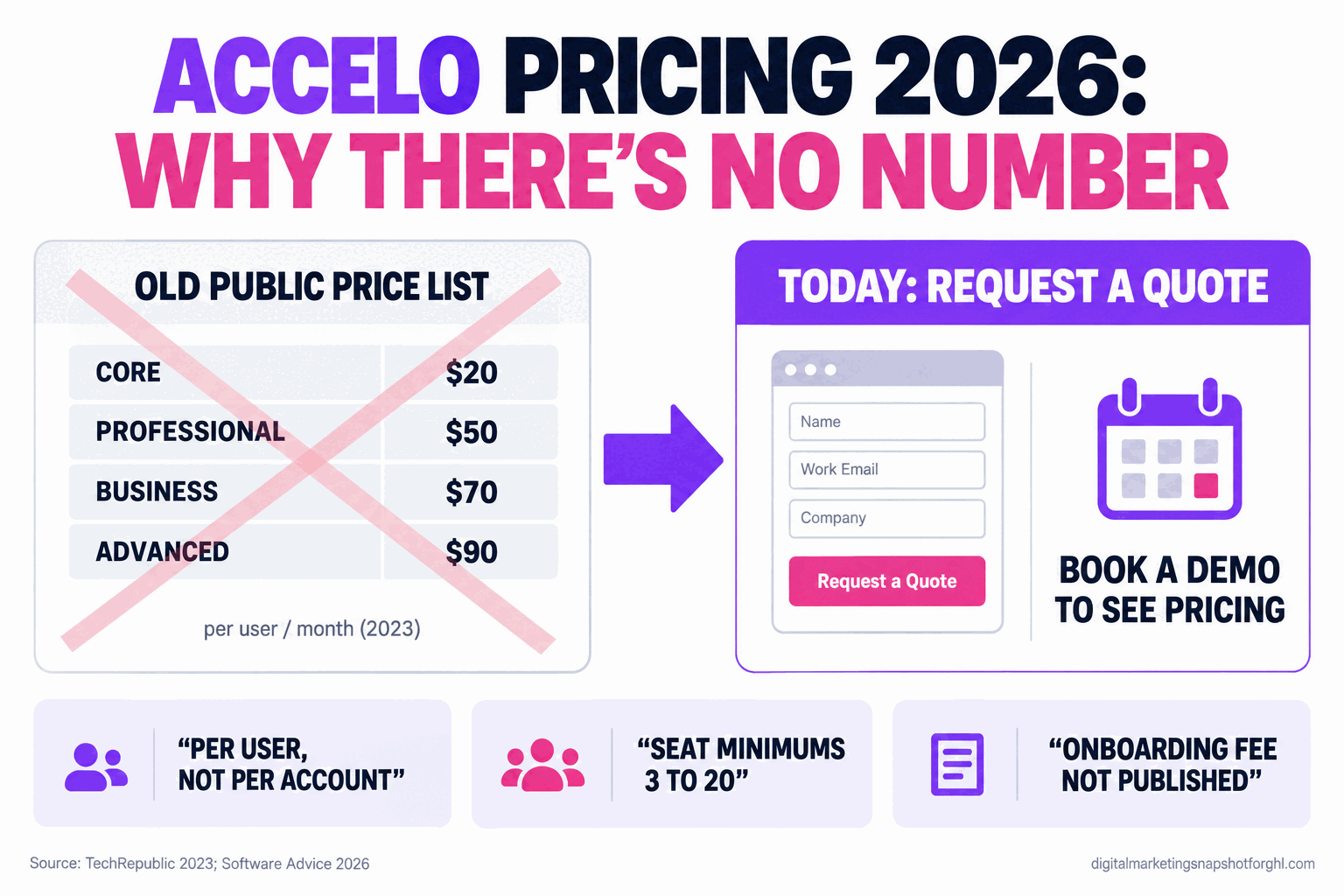
That sequence is the point. Accelo used to publish a four-tier price list anyone could read. Then it took the numbers down and replaced the page with a “request a quote” form (PricingSaaS, 2026; Software Advice, 2026). A vendor hides pricing not because the number is low, but because it depends on what they think you will pay, and they would rather learn that first.
Here is the short answer, so you do not have to sit through the call to get it.
What this article covers
- Why there is no price on the page
- The last numbers Accelo published
- The parts of the quote nobody mentions
- Three scenarios: solo, 10 people, 25 people
- Four ways the pricing bites a small agency
- Steal this: the demo script and the true-cost formula
- What Accelo does not replace
- The compliance cost no quote includes
- Objections
- FAQ
Why there is no price on the page
Quote-only pricing is a sales tactic, not an accident. When the number is public, you anchor to it before you talk to a human. Take the list down and the rep controls the anchor instead: they learn your head count, stack and budget first, then name a figure shaped to all three.
Accelo is not alone. A handful of agency platforms hide the real number behind a demo, while HighLevel, ClickUp and AgencyAnalytics publish theirs. The pattern is reliable: tools that compete on price tell you the price, and tools that compete on the sales conversation make you have the conversation.
It matters more in 2026 because the margin underneath you is thinner. Billable utilization across professional-services firms fell to 66.4% in 2025, a record low, against the 75% the benchmark treats as the high-performer line (SPI Research 2026 Benchmark, 509 firms, via Deltek; Certinia, 2026). When a third of your paid hours are not billable, a software bill that climbs with head count and hides its own number is the last line item you want. Lifting that number is its own project, covered in how to lift billable utilization.
The last numbers Accelo published
Before Accelo went dark, it ran a four-tier per-user model that reviewers captured. These are the last public figures, and the best guide you have to where the quote starts, even though Accelo no longer stands behind them in print (TechRepublic, 2023):
- Core, about $20 per user per month, three-user minimum. The stripped tier.
- Professional, about $50 per user per month, five-user minimum.
- Business, about $70 per user per month, five-user minimum. The tier most agencies were steered into.
- Advanced, about $90 per user per month, ten-user minimum.
- Elite, custom quote, twenty-user minimum. Already quote-only even then.
Everything was billed annually, with a short trial and no free plan. TechRepublic scored Accelo’s pricing 1.4 out of 5, and transparency was the reason.
Last publicly listed Accelo prices, per user per month, billed annually, before the move to quote-only. These are 2023 figures and are no longer published by Accelo. Source: TechRepublic, 2023.
Two things about that list have not changed, because they are structural. The price is per user, and every tier has a seat minimum underneath it. Those two facts turn a friendly per-user number into a bill that does not match your head count math.
There is also an older wrinkle worth knowing. Accelo historically charged per product module, so a team that wanted sales, projects and retainers paid for each, with reporting as a paid add-on (Software Advice, 2026). Whether the current quote bundles everything or still itemizes modules is something only the proposal will tell you, which is the whole problem.
The parts of the quote nobody mentions
The subscription is the part you expect. These other lines move the number.
Onboarding is mandatory and priced separately. Accelo sells implementation packages and routes new accounts through a paid one, and the fee is not published anywhere (Software Advice, 2026). A real setup taking work is fair enough. What is not fair is that you cannot see the number until it is already in the proposal, bundled with the subscription, where it is easy to wave through.
The annual commitment is the default. The last public pricing was annual billing, and quote-only vendors lean on annual terms because they lock the number in before you have lived with the tool (Capterra, 2026). You find out whether it fits in month two. You find out whether you can leave in month twelve.
The seat minimum is a floor, not a starting point. A five-user minimum on the Business tier meant a three-person shop paid for five seats on day one. Guests and clients you invite do not change that. You are buying the floor, not the usage.
Three scenarios: what it actually comes to
The honest way to price a quote-only tool is to run your own numbers off the last known rates, treat them as the floor, and assume the real quote lands at or above them. Here are three shops, using the last published Business-tier rate of about $70 per user per month. Confirm your own quote before signing, because Accelo no longer stands behind these in print.
The solo operator or two-person shop
The minimum makes you pay for a small team either way. Professional’s five-seat floor meant a solo founder paid for five seats, roughly $250 a month or $3,000 a year plus onboarding, to run a tool built for five. That math rarely clears for one or two. A solo shop is better served by a flat tool with no floor, with the time better spent on pricing your retainers properly than on configuring an enterprise ops platform.
The 10-person agency
This is Accelo’s sweet spot and where the per-seat model is at its most convincing. Ten seats on the last Business rate is about $8,400 a year before onboarding. The platform genuinely does a lot for that. The question is not whether it works, but whether $8,400-plus, climbing every time you hire, beats a flat platform at a fixed fee. A flat plan at $297 a month is about $3,564 a year for any number of users (GoHighLevel pricing). That is less than half, and it does not move when you add a coordinator.
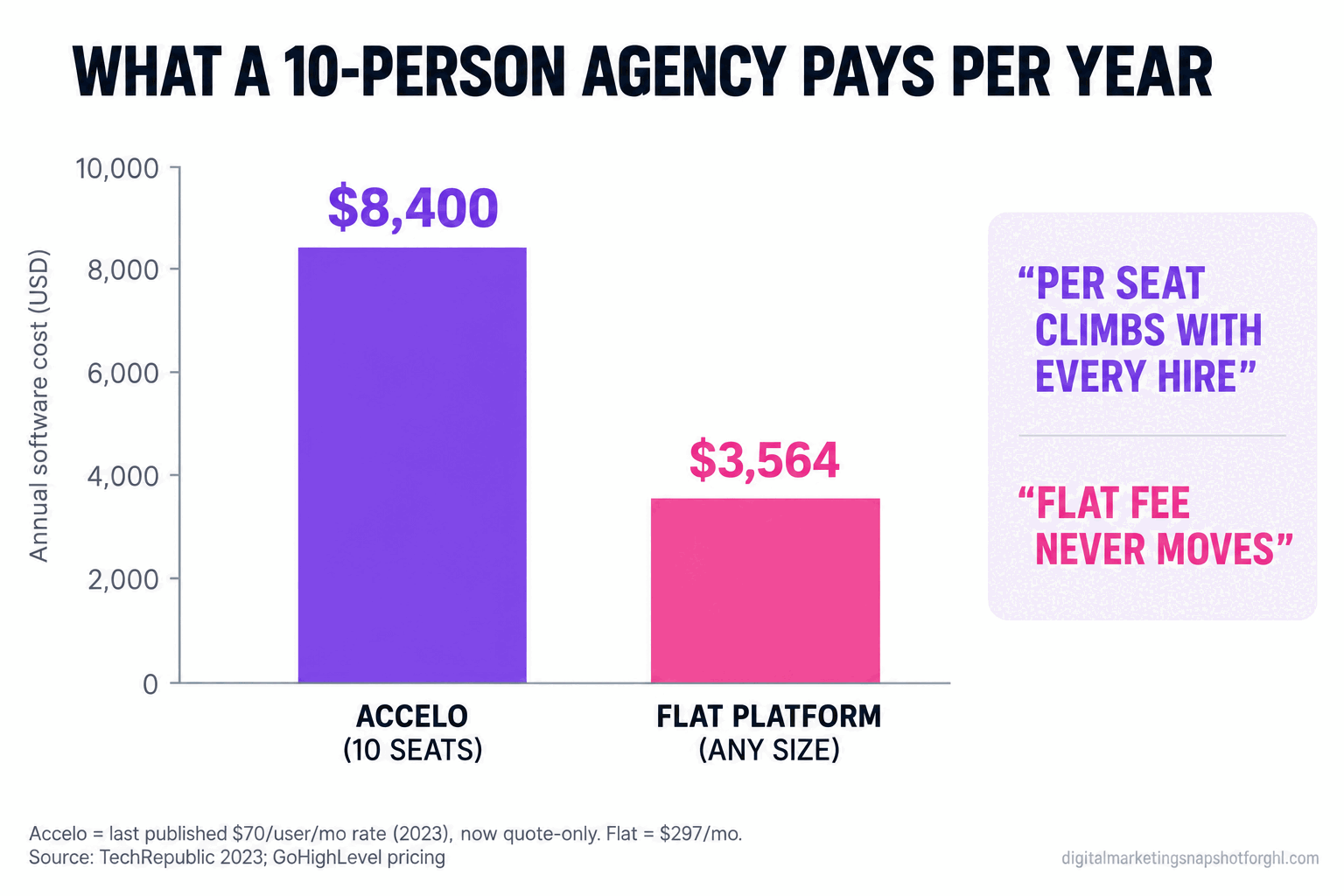
Estimated annual cost (USD) for a 10-person agency, before Accelo onboarding. The Accelo figure uses the last publicly listed Business rate of $70/user/mo (2023), now quote-only, so treat it as a floor. Flat platform = $297/mo. Sources: TechRepublic, 2023; GoHighLevel pricing.
The 25-person agency
Here you are pushed toward Advanced or Elite, where the per-seat rate is higher and the top tier is quote-only by design. Twenty-five seats at the last Advanced rate of $90 is about $27,000 a year, before onboarding, module add-ons or the annual increase. A flat platform is still $3,564. The gap is now large enough that the per-seat model only makes sense if Accelo does something the flat tool genuinely cannot, and you should make the rep prove exactly what that is.
Four ways the pricing bites a small agency
The sticker is not where small shops lose money on a quote-only tool. These five are.
1. You negotiate without an anchor
Walking into the demo with no public price means the rep sets the number first. Do this: bring the last known rates (Core $20, Professional $50, Business $70, Advanced $90) into the call and ask the rep to quote against them directly. Making them explain a gap is far easier than guessing at one.
2. The seat minimum taxes the smallest shops hardest
A five-seat floor means a two-person agency pays 250% of what it uses. The model is upside down for exactly the people most sensitive to price. Do this: if you are under the minimum, price the tier as a full-floor purchase and ask whether you would buy five seats of anything right now.
3. Onboarding gets waved through inside the proposal
A four- or five-figure onboarding line is easy to approve when it is bundled with an annual subscription you are already saying yes to. Do this: make onboarding a separate line with its own number and its own deliverables, in writing, before you sign. If they cannot quote it standalone, that is the answer.
4. Every hire raises the bill before it raises revenue
Hire a project manager in January and your Accelo bill rises in January, but the revenue that hire brings might not land until March. For a shop managing cash flow between retainers, that timing runs backwards. And because the term is annual, you learn whether the tool fits in month two but cannot act on it until month twelve. Do this: model the fully loaded seat cost into hiring (a $70 seat is $840 a year), and push for a quarterly term or a documented exit in year one.
Steal this: the demo script and the true-cost formula
You will end up on the call, because that is the only way to get a number. Walk in with these questions and a formula, and the forty minutes works for you.
The six questions to ask on the demo, in order:
- “What is the per-user monthly rate on annual billing for the tier you are recommending, in writing?”
- “What is the seat minimum on that tier, and does it apply to my current head count?”
- “Is this all-in, or are sales, projects, retainers, billing and reporting priced as separate modules?”
- “What is the onboarding fee as a standalone line, and what exactly does it deliver?”
- “What is the contract term, and what happens to the price at renewal?”
- “What is the all-in first-year total, subscription plus onboarding, for my exact team size?”
Any rep selling a tool worth buying can answer all six on the call. If “I’ll have to get back to you” shows up more than once, you have learned how the renewal conversation will go.
The true-cost formula, so the quote cannot hide anything:
First-year total = (per-seat rate × greater of your head count or the seat minimum × 12) + onboarding fee + any per-module add-ons
Then divide by 12 for a real monthly, and compare that to a flat platform fee that does not change with head count.
Run that before the proposal expires, not after. The thirty-day validity exists to stop you doing exactly this math with a clear head.
Disclosure: the GoHighLevel link above is an affiliate link. If you start a plan through it we may earn a commission at no extra cost to you. The prices come from GoHighLevel’s public pricing page.
What Accelo does not replace
This is the part the per-seat quote leaves out. Accelo is an internal operations platform: time, projects, retainers and billing for your own team. It is strong at that, but it is not the client-facing layer.
It is not a lead CRM that texts a prospect back in sixty seconds, it does not run your clients’ email and SMS campaigns, and it does not build the white-label dashboard your client logs into. For that layer most agencies pay a reporting tool, commonly AgencyAnalytics at around $20 per client per month annually (Reporting Ninja, 2026), a meter that climbs every time you win a client. We mapped the ways off that in AgencyAnalytics alternatives that do not charge per client.
So the honest total for a small agency on Accelo is usually two per-unit meters at once: Accelo per seat, a reporting tool per client. One climbs when you hire, the other when you win. That is why a flat platform bundling CRM, client messaging and white-label reporting under one fee can beat a two-tool stack even when neither tool is overpriced alone. The project side of that comparison is in HighLevel versus ClickUp for agencies.
The compliance cost no quote includes
Whatever you land on for operations software, the client-facing sends carry a cost that never appears on any proposal, and getting it wrong costs far more than any seat.
If you send SMS on behalf of clients, US carriers require A2P 10DLC registration, and an agency registering campaigns for other brands needs a reseller identifier most small shops get wrong the first time. Unregistered traffic gets blocked, so the texts you paid to send never land. The step-by-step is in setting up A2P 10DLC when you send SMS for clients.
If you automate review collection, the rules tightened. The FTC’s 2023 Endorsement Guides removed the blanket “results not typical” cover and put incentivized and employee reviews in scope (FTC business guidance), and a separate FTC rule in effect since October 2024 bans buying, selling or incentivizing fake reviews outright, with penalties running to tens of thousands per violation (FTC, 2024). An ops platform checks none of this for you.
Objections
“The demo was good and the product clearly does a lot. Isn’t it worth it?”
The product probably is good, but that is not the question. The question is whether the all-in, per-seat, annually-climbing number beats a flat alternative for your size, and you cannot answer that until you have the written total from question six above. A strong product at a number you negotiated blind is still a number you negotiated blind.
“Everyone hides pricing now. Why single out Accelo?”
Not everyone does. HighLevel, ClickUp and AgencyAnalytics publish real figures with only an enterprise tier held back. Accelo took down a price list it used to publish and replaced the whole thing with a form (PricingSaaS, 2026). Removing transparency you previously offered is a choice worth noticing.
“We already run Accelo. Is switching worth the disruption?”
If the per-seat total is close to a flat alternative, probably not this quarter, because migration costs real time. If you are at fifteen-plus seats and the gap is five figures a year and widening with every hire, the switch pays for itself inside a year. Run the true-cost formula and let the number decide, not the sunk cost.
FAQ
How much does Accelo cost in 2026?
Accelo no longer publishes prices. Its pricing page is a demo-request form, so there is no public per-user figure in 2026. The last publicly listed prices, from 2023, ran from about $20 per user per month on a Core tier to about $90 on an Advanced tier, billed annually, with a custom Elite tier above that. Treat those as a floor and get a written quote for your exact team size.
Why doesn't Accelo show its pricing?
Accelo removed its four-tier public pricing page and replaced it with a custom-quote form, as tracked by pricing monitors and confirmed on review sites. Quote-only pricing lets a rep learn your team size, stack and budget before naming a number, which removes your ability to anchor to a published price. It is a sales tactic, not a sign the price is low.
Is there a seat minimum on Accelo?
Historically yes. The last public tiers carried minimums from three users on the entry tier up to ten or twenty on the higher tiers, so a small shop paid for the floor whether or not it used every seat. Confirm the current minimum in your quote, because a seat floor is a major reason the real bill exceeds head count times the per-seat rate.
Does Accelo charge an onboarding fee?
Yes. Accelo sells paid implementation packages and routes new accounts through one, but the fee is not published. Ask for onboarding as a standalone line item, with its own price and deliverables, before you sign. If a rep cannot quote it separately from the subscription, that itself tells you how the proposal is structured.
What does a 10-person agency really pay for Accelo?
Using the last published Business rate of about $70 per user per month, ten seats is roughly $8,400 a year before onboarding, climbing with every hire. A flat-fee platform that does not meter seats is about $3,564 a year for any team size, less than half, so at ten people the per-seat model is already working against you on cost.
Does Accelo replace a CRM and client reporting?
No. Accelo is an internal operations platform covering time, projects, retainers and billing for your own team. It is not a lead CRM, it does not run client email or SMS campaigns, and it does not provide the white-label dashboard your clients log into. Most agencies run a per-client reporting tool alongside it, which means two separate meters.
When does a flat-fee platform beat Accelo on cost?
Roughly once you are past a handful of seats, because a flat platform fee (about $3,564 a year for any number of users) stops climbing while Accelo's per-seat bill keeps rising. A 25-person shop on the last Advanced rate would pay around $27,000 a year before onboarding, because per-seat billing never caps.