
It is the first Monday of the quarter and you just closed your best month in two years, three new retainers in three weeks. You hired, you celebrated, you stopped chasing leads. Fast forward eleven weeks: two retainers wrapped, one client paused, and the pipeline behind them is empty because you spent those months delivering, not selling. Now you are back on LinkedIn at 11pm, hoping someone needs you before payroll.
That swing has a name every agency owner knows: feast or famine. Agencies ride it because new business depends on referrals they cannot control, and referrals dry up the moment they get busy enough to stop asking. It is a system problem, not a sales-skill problem: you have a way to deliver work but no repeatable way to fill the funnel. Below is why it happens, what the dry quarter costs, and a six-stage system that keeps your pipeline running while you are heads-down on client work.
Table of contents
- What the feast-or-famine cycle actually is
- What the dry quarter costs you
- Why referrals alone keep you stuck
- The six-stage always-on pipeline
- Stage 1: sharpen one offer worth referring
- Stage 2: open always-on lead capture
- Stage 3: reply in minutes, not days
- Stage 4: nurture the not-ready list
- Stage 5: run a repeatable sales process
- Stage 6: build a retention and referral engine
- Run it for your size: solo, mid, and 20-plus
- Compliance you cannot skip
- Objections, answered honestly
- FAQ
What the feast-or-famine cycle actually is
The cycle is a four-stage loop, and you have lived every one. You win work, so you go heads-down delivering it. Because you are delivering, you stop prospecting, nurturing, and asking for referrals, and the pipeline empties behind you without you noticing. Then a project ends, you look up, there is nothing there, so you scramble, discount to close fast, and the loop restarts. It is so hard to break because of timing: a dry December is caused by a quiet September you could not feel, because September was your best month.
What the dry quarter costs you
This is not a someday problem.
You discount to close fast. A desperate pipeline is a weak negotiating position. When rent is due and nothing is signed, you cut your rate to get a yes, and that discount sticks for the life of the account.
You take bad-fit clients. With an empty pipeline you say yes to the next body that shows up, and those are the ones who churn and scope-creep, which starts the next famine early. More in why agency margin shrinks as you grow.
Your cash flow whipsaws. Revenue that swings quarter to quarter makes payroll, hiring, and your own pay impossible to plan. We cover smoothing it in managing agency cash flow between retainers.
It drags your utilization. Billable utilization, the share of paid hours a client actually funds, fell to 66.4% in 2025, the lowest on record (SPI Research 2026, 509 firms). In the feast you overstaff for the peak; in the famine those people sit idle and unbilled.
How long a new agency lead takes to move through the sales process, 2025. Only about 55% close inside six weeks, so a pipeline you fill only when desperate pays out weeks too late. Source: SparkToro State of Digital Agencies 2025.
Why referrals alone keep you stuck
Referrals are the best leads you will get, so the problem is not that they are bad, it is that they are the whole plan for most agencies. A plan you cannot switch on when you need it is not a plan. Referrals remain by far the biggest driver of new business, with partner referrals the top source for about 15% of agencies (SparkToro 2025).
A referral arrives on its own schedule and goes quiet when you are too busy to prompt it. Referrals are the feast. The pipeline is the floor under the famine.
The six-stage always-on pipeline
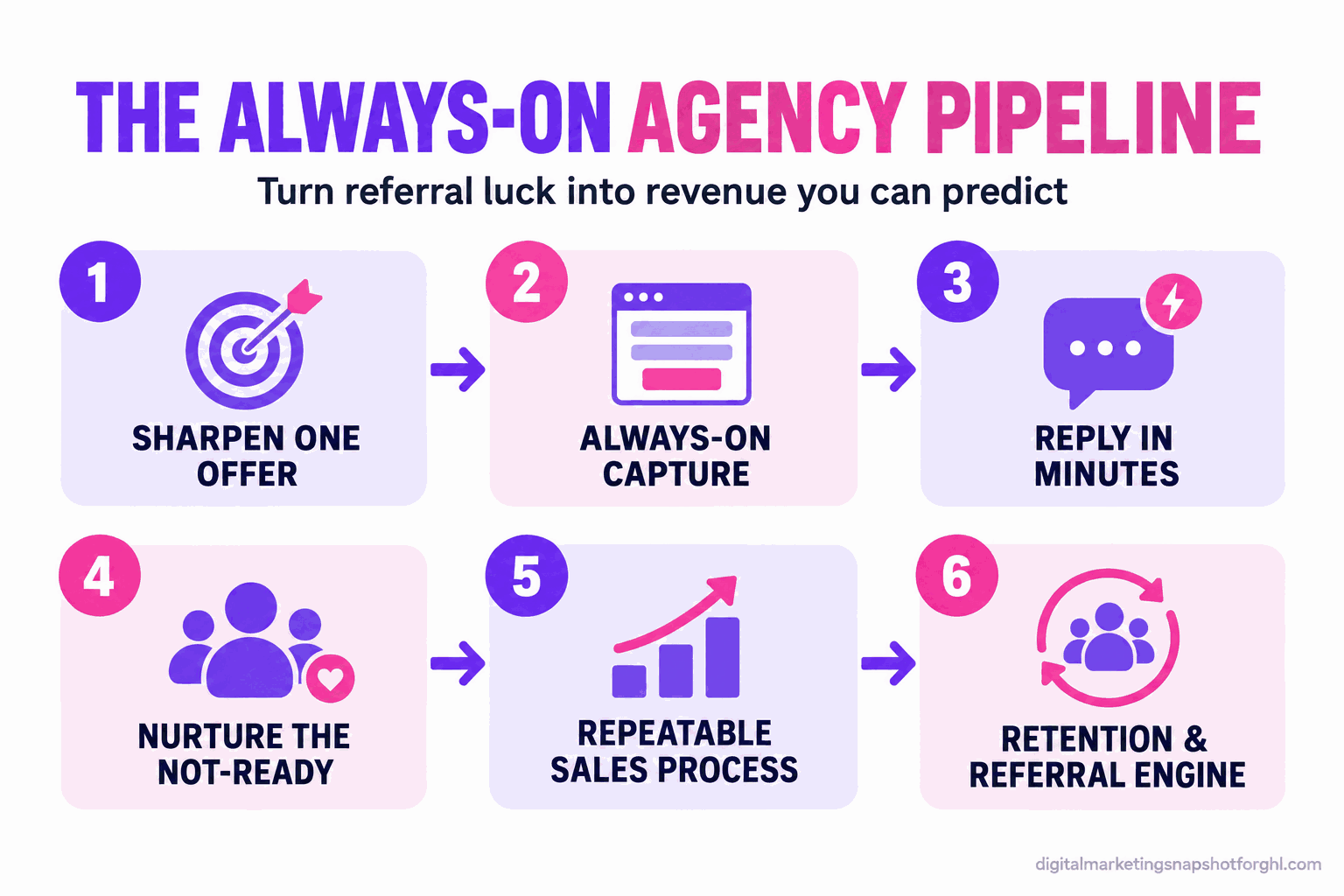
You break the loop by building one thing that runs while you are buried in client work: a pipeline that captures, responds, nurtures, and closes without you pushing it every day. Six stages, in order. Each has a way it breaks, because knowing the failure mode is what keeps you from quitting in week three.
Stage 1: sharpen one offer worth referring
A pipeline needs something specific to sell. “We do marketing” attracts nobody and refers to nobody, because a happy client cannot repeat it. Pick one clear outcome for one clear type of client and name it. “We get home-service businesses more booked jobs from Google” is referable, and the sharper it is, the easier every other stage runs.
How it breaks. You keep every option open so you never turn anyone away, the offer goes soft, and the pipeline fills with tire-kickers. Narrow on purpose.
Stage 2: open always-on lead capture
Right now your lead capture is probably your inbox and whoever messages you on LinkedIn. Always-on capture means every way someone finds you points at something that collects their details whether you are awake or not: a conversion-built website, a lead magnet worth an email address, a booking link, and a chat widget. The website is the hub, and if yours is a brochure with a contact form nobody fills, it is leaking demand you already earn, so a website built to turn visitors into booked calls is the cheapest upgrade most agencies can make. Behind the forms, every submission should land in one place and fire the first follow-up automatically, which is what a CRM like GoHighLevel does.
How it breaks. You put up forms with no automation behind them, so submissions pile up and go cold.
Stage 3: reply in minutes, not days
Speed is the highest-return habit in your whole pipeline. Research on lead response has held up for years: contacting a web lead within five minutes makes you far more likely to qualify it than waiting even half an hour (Harvard Business Review). The fix is the first touch automated and instant: a text and email within sixty seconds, plus an automatic text back on any missed call. We cover the build in speed-to-lead for agencies and missed-call text-back in GoHighLevel. Copy you can use today:
How it breaks. The automated reply goes out instantly but the human follow-up takes two days, so you trained the lead to expect speed and then let them down. Automation only buys the first few minutes.
Stage 4: nurture the not-ready list
Most people who find you are not ready to buy today, and the agency that stays in front of them until they are wins the work. This is the stage that smooths the cycle, because a nurture list is demand you can tap on a slow Monday. Every “not right now” and every stalled proposal is a warm list most agencies let rot. Nurture is not a newsletter, it is a light, useful touch every couple of weeks.
How it breaks. You send pure “just checking in” with no value, so the list tunes you out. Every touch gives before it asks.
Stage 5: run a repeatable sales process
This is where agency pipelines leak the worst, because the sales process lives in the founder’s head and runs on vibes. A repeatable process is just named stages in your CRM, each with a follow-up that fires on its own: new inquiry, qualified, call booked, proposal sent, verbal yes, signed. The follow-up after a proposal is where deals are won and lost, and most agencies send one and go quiet. Here is a three-touch sequence that closes the ones you would otherwise lose to silence:
How it breaks. You build the stages but keep closing deals in DMs and in your head, so the pipeline view lies and your forecast is fiction. Run every deal through the stages.
Stage 6: build a retention and referral engine
Keeping a client is worth more than winning one, and a happy client is your next referral, so retention and referral are the same engine. Two moves compound: prove your value on a schedule with white-label reporting so the client never forgets why they pay you, and ask for the renewal and referral on purpose instead of hoping. Retainers are the structural fix, because recurring revenue does not leave a hole when a project ends. We cover structuring them in structuring agency retainers to cut churn, the full playbook in referrals as a growth engine, and the onboarding that sets it up in onboarding clients in minutes, not weeks.
How it breaks. You only ask when desperate, and it reads through the screen. Ask right after a win.
Run it for your size: solo, mid, and 20-plus
The six stages are the same at every size. What changes is who runs them and how much you lean on automation versus people. Most agencies stayed flat or went backward on pipeline in 2025 (SparkToro 2025), which is what riding referral luck looks like at scale.
Solo operator (you are the agency). You feel the cycle hardest because you cannot sell and deliver at once. Delegate to systems, not people you do not have: automate capture, the instant reply, and the nurture list so the pipeline runs while you are on client work. Then block two hours every Friday for pipeline only, which beats a frantic month of prospecting once the famine hits.
Mid-size team (5 to 15 people). The failure mode is that nobody owns new business, so everybody assumes it is handled and it is not. Give one person the pipeline, even part-time, and wall off their time so delivery and sales stop competing.
Large shop (20-plus). The cycle shows up as whole-team peaks and troughs that wreck utilization, already near 66% industry-wide (SPI Research 2026). You need the pipeline predictable enough to staff against, tracking lead volume and stage conversion, not just closed revenue. A dedicated new-business function and an always-running nurture program keep the troughs from draining your margin.
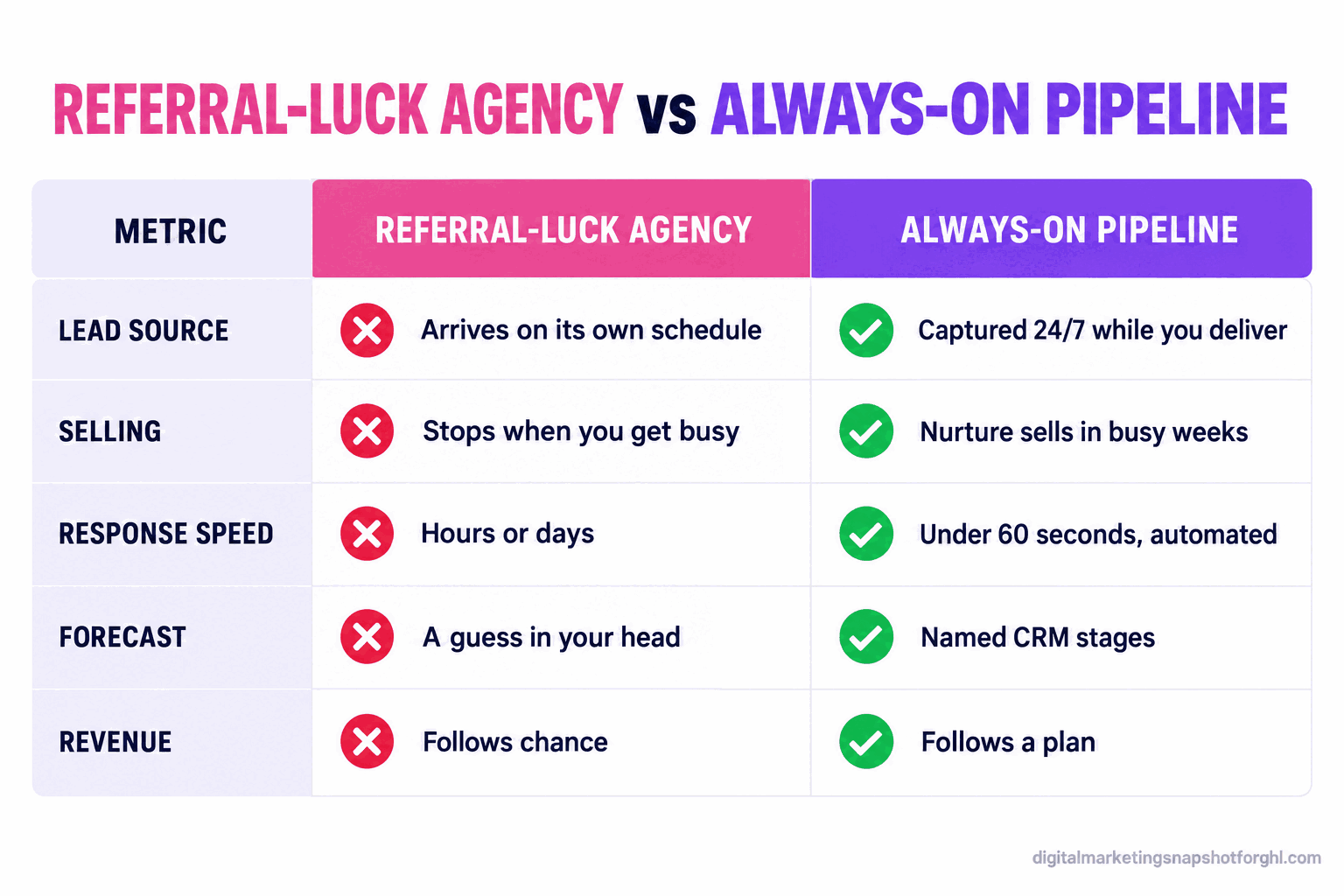
Referral-luck agency vs always-on pipeline agency
| Plan | Referral-luck agency | Always-on pipeline agencyRecommended |
|---|---|---|
| Price | Revenue follows chance | Revenue follows a plan |
| Feature 1 | Leads arrive on their schedule, not yours | Capture runs 24/7 while you deliver |
| Feature 2 | Selling stops when you get busy | Nurture sells in your busy weeks |
| Feature 3 | First reply takes hours or days | First reply under 60 seconds |
| Feature 4 | No nurture, warm leads go cold | Warm list you tap on a slow Monday |
| Feature 5 | Deals live in your head | Named CRM stages, a real forecast |
| Feature 6 | Referral asks only when desperate | Asks for renewals and referrals on schedule |
| Install it for $997 → |
Compliance you cannot skip
The moment you run your own outreach or email a nurture list, you are a marketer who has to follow the rules you would hold a client to. Three matter.
A2P 10DLC for your texts. Every US carrier now blocks application-to-person SMS from unregistered numbers, so if your CRM sends texts you must register your brand and campaign through The Campaign Registry before anything reliably delivers (The Campaign Registry). If you also send on behalf of clients, you register as the provider and supply brand and campaign details for each client, a reseller step most agencies get wrong. Our TCPA-compliant SMS opt-in script has the consent language.
CAN-SPAM for your emails. Every marketing email needs accurate header and subject lines, a real physical mailing address, and a working unsubscribe you honor within 10 business days (FTC CAN-SPAM guide). It applies to your nurture list exactly as it applies to a client’s, and the full breakdown is in email compliance for agencies.
One rule that is not back. Do not let anyone scare you into thinking the FCC’s “one-to-one consent” rule governs your lead forms. It was vacated by the Eleventh Circuit in January 2025 before it ever took effect (Morrison Foerster). Clear opt-in is still smart and still the law under the TCPA generally, but that specific restriction does not apply. And if an EU resident hits your form, GDPR applies from that moment.
Objections, answered honestly
“I get all my clients from referrals, why build a pipeline?” Because the quarter referrals go quiet is the quarter you cannot make them come back. A pipeline is the floor that catches you when the well runs dry.
“I don’t have time to market my own agency, I’m slammed.” That is the mechanism of the trap, which is why the system leans on automation. Capture, the instant reply, and the nurture touch run without you, and the only part that needs a human is two focused hours a week.
“Isn’t cold outreach spammy? I don’t want to hurt my brand.” Then do not lead with it. The highest-return parts are warm: a converting website, instant response to inbound, and a nurture list of people who already raised their hand. You can build a predictable pipeline without a single cold email.
FAQ
Agency feast or famine: quick answers
What causes the feast-or-famine cycle in agencies?
It is a timing problem. When you win work you go heads-down delivering and stop prospecting, so the empty pipeline you create during the busy months shows up weeks later as a dry stretch. Because referrals are the biggest source of new business for most agencies (SparkToro 2025) and cannot be dialed up on demand, revenue follows luck, not a plan.
How do I get a predictable stream of agency clients?
Build a pipeline that runs without you: a conversion website and lead magnet to capture demand 24/7, an automated reply within 60 seconds, a nurture sequence for everyone not ready to buy yet, named sales stages in your CRM, and a retention and referral engine. It keeps the funnel moving in your busiest weeks, when referral-only agencies go quiet.
Are referrals a bad way to get clients?
No, referrals are the best leads you will get. The problem is making them your only plan, because a referral arrives on its own schedule and goes quiet when you are busy. An always-on pipeline adds a second source you control.
How fast should I respond to a new agency lead?
Within minutes. A web lead is contacting your competitors too, and the first real response usually wins. Harvard Business Review research found contacting a lead within five minutes makes you far more likely to qualify it than waiting even 30 minutes. Automate an instant text and email, then follow up the same day.
How many leads do I need in my pipeline to stay busy?
Enough to cover your sales cycle and close rate. Only about 55% of agencies close a new lead inside six weeks (SparkToro 2025). If you need two clients a month, close one in four conversations, and each takes six weeks, you need roughly eight qualified leads in motion at any time.
Feast or famine is not proof you are bad at sales. It is proof your agency has a way to deliver work and no system to fill the funnel. Sharpen one offer, capture demand around the clock, reply in minutes, nurture the not-ready, and ask for the renewal and referral on purpose. Build the floor before the next famine, not during it.