
It is the 14th of the month and you are reconciling the bank feed against your client list. Three retainers that should have hit on the 1st are not there: one card expired in October, one client switched banks and never told you, one invoice sat in a draft folder after the person who sent it left in August. That is roughly $9,400 of booked revenue you already spent in your head, gone, and nobody flagged it. You did not lose those clients. You just never collected.
Here is the short version. The money leaking out of your agency is not only the clients who quit, it is the retainers you already sold and failed to charge. A billing system that auto-charges a card on file, chases failed payments on a fixed schedule, and reminds clients to renew before the term ends plugs almost all of it, so cash shows up without anyone chasing it. This guide builds that system in six stages, with the copy, the timing, and the ways each stage breaks.
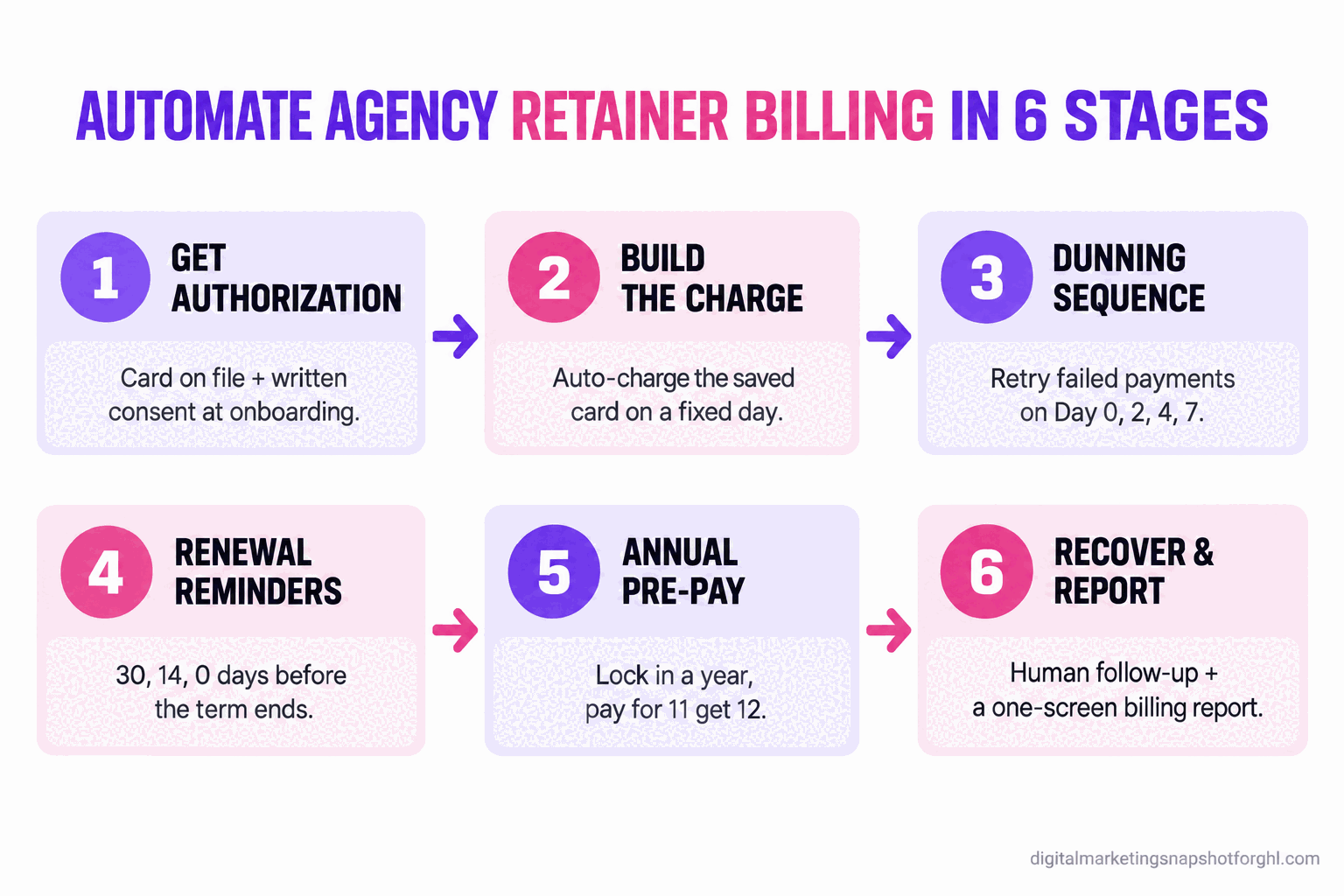
What this guide covers
- What silent billing leaks really cost you
- Stage 1: Get authorization and a card on file
- Stage 2: Build the recurring charge
- Stage 3: Run a failed-payment dunning sequence
- Stage 4: Send renewal reminders before the term ends
- Stage 5: Offer an annual pre-pay lock-in
- Stage 6: Recover the stragglers and report
- Three scenarios: solo, mid-size, 20-plus
- The compliance you cannot skip
- Objections
- FAQ
What silent billing leaks really cost you
Agencies obsess over voluntary churn, the client who emails to cancel. The quieter killer is involuntary churn: the client who never meant to leave, whose card simply failed, invisible until the renewal that never comes.
It is not a rounding error. For B2B subscription businesses, involuntary churn runs about 6% a year, which is 16% of all churn (Churnkey, 2025, on Stripe 2024 data). One widely cited analysis pins roughly half of all subscriber churn on failed payments (PYMNTS, 2023, via Stripe). Cards are the cause: around 13% of recurring transactions decline in a given month on older benchmarks, between expired cards, switched banks, insufficient funds, and fraud blocks (Recurly).
There is a time cost too: chasing declined cards by hand is non-billable work a system does for free, and US agencies ran a record-low 66.4% billable utilization in 2025 (Certinia).
Failed payments are the most recoverable revenue you have, because the client already agreed to the retainer and wants to pay. The chart below compares a structured recovery program with a single retry.
Share of failed charges recovered, baseline vs optimized retry. Source: Recurly, 2026.
Stage 1: Get authorization and a card on file
You cannot automate a charge you were never authorized to make, and skipping this at onboarding is why agencies end up invoice-chasing forever.
The setup. When the retainer is signed, collect a payment method and explicit written authorization to charge it recurringly. Use a hosted, tokenized form so you never touch raw card numbers, and store the token against the client record, tied to the signed agreement for a record of consent.
The copy you can steal. Put this clause in the retainer and a matching checkbox on the payment form:
How it breaks. Collecting a card without the authorization language leaves you exposed on a chargeback. And letting a client start work before the card is on file kills your power to collect it, so hold the kickoff until the payment method is saved. Our agency retainer agreement template covers the clauses that pair with this.
Stage 2: Build the recurring charge
The setup. Create a recurring invoice with the amount, billing day, start date, and mid-month proration rule fixed, set to auto-charge the saved card rather than email and wait. Put most clients on one billing day (the 1st is clean) so cash lands predictably, and prorate any partial first month before the standard cycle begins.
The copy you can steal. A clear receipt prevents the “what is this charge?” dispute, and its one-line status is the cheapest retention move here: “Payment received, thank you. We charged $[amount] to your [Visa ending 4242] for your [Month] retainer. Next charge: [date]. This week’s work: [1-line status, e.g. ranking report sent, 3 new leads].” A client who sees proof of work next to the charge does not question it.
How it breaks. Proration errors create a wrong first charge, so test it on a dollar first. A silent charge with no receipt breeds disputes, so never turn the receipt off. Platforms like GoHighLevel handle recurring invoices and auto-charge natively, and in reselling mode rebill clients for their own sub-accounts (GoHighLevel). Affiliate link; we may earn a commission at no extra cost to you. See GoHighLevel SaaS mode for recurring revenue.
Stage 3: Run a failed-payment dunning sequence
This is the stage that pays for the whole system. “Dunning” is the fixed sequence of retries and messages that runs when a charge fails: without it a declined card equals a lost client, with it most charges clear within a week.
The setup. When a charge fails, do not retry at random. Space four retries and attach a message to each, escalating from friendly to firm: a soft retry plus a heads-up email on Day 0, a retry plus an update-card email on Day 2, a retry plus an SMS on Day 4 (email gets buried, a text does not), and a final retry plus a “work pauses” email on Day 7. Retry on weekday mornings, and always give a self-service update link.
The copy you can steal.
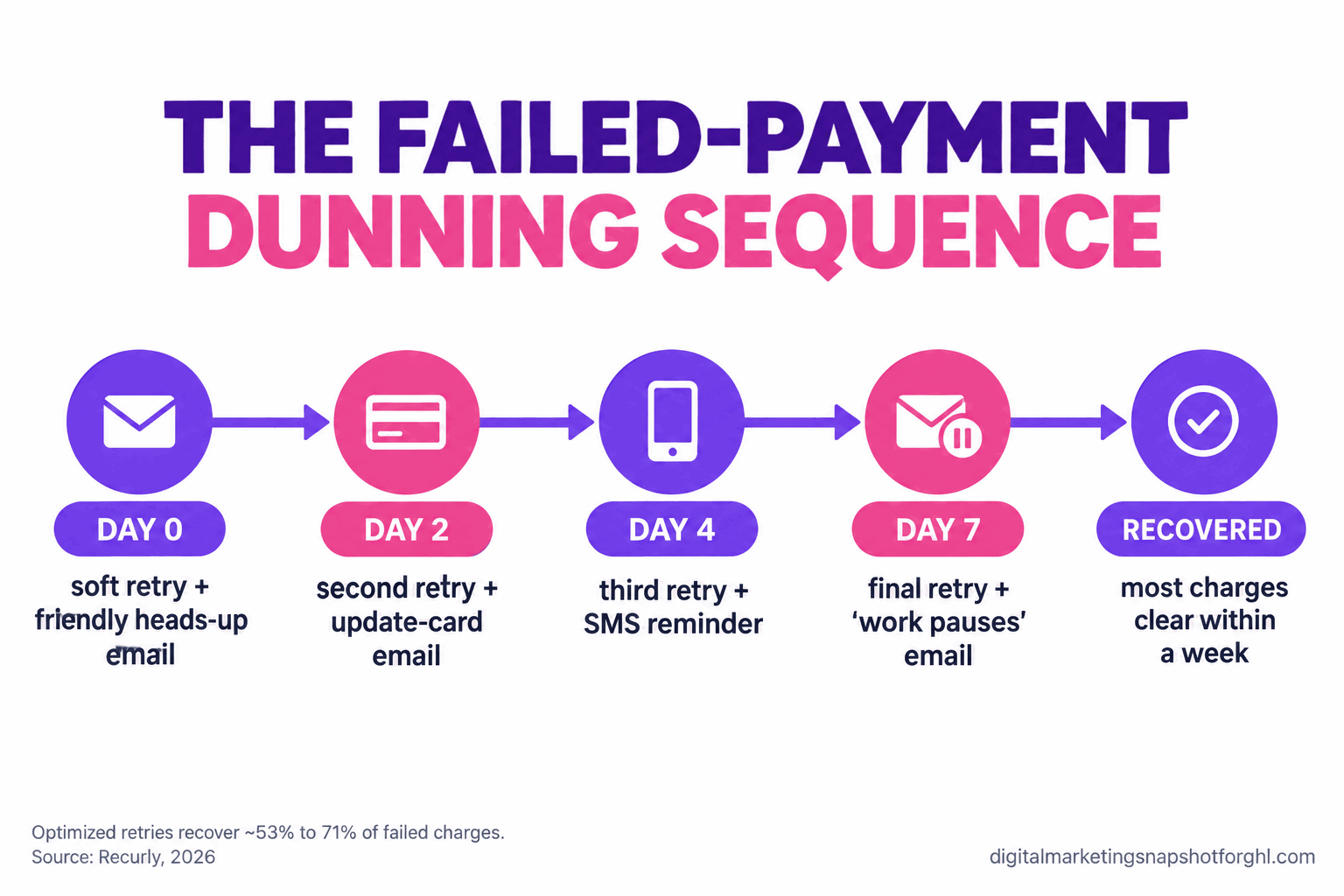
How it breaks. Retrying too fast burns attempts against a hard decline and can trigger fraud flags, so respect the spacing. Going quiet after the first failure is the most expensive mistake, because the client assumes it resolved itself. And threatening to cut off a good client on day one reads as hostile, so keep the first two touches warm and save the consequence for last. A card-account-updater service from your processor, which refreshes expired card numbers automatically, heads off many of these failures before they start.
Stage 4: Send renewal reminders before the term ends
Failed payments lose you money mid-term. Lapsed renewals lose you the client at the term boundary, and they are even quieter, because nothing fails, the relationship just runs out of road. The fix is a reminder cadence tied to the renewal date.
The setup. Store a renewal date on every client record and build an automation that counts down to it with three touches: a value recap well before, a logistics reminder close in, and a confirmation on the day. The goal is not to beg them to stay, it is to make renewal the default.
The copy you can steal.
How it breaks. A reminder that leads with price instead of value turns a continuation into a negotiation, so lead with wins. Firing it too late loses the room, so 30 days is the floor. And a renewal date that onboarding never set breaks the sequence silently, so audit for it. For the full retention mechanics, see how to structure agency retainers to cut churn.
Stage 5: Offer an annual pre-pay lock-in
Everything so far protects the revenue you have. Stage five changes the shape of your cash flow, the real problem for most small agencies: the gap between retainers, the slow month after a client offboards.
The setup. At renewal, and only at renewal, offer a choice: keep paying monthly, or pre-pay the year for a discount worth roughly one month (pay for 11, get 12). Pre-pay front-loads cash, removes eleven chances for a card to fail, and leaves a client committed in a way a monthly one never is.
The copy you can steal: “Since you are renewing anyway, here is an option worth 20 seconds. Pre-pay the next 12 months today and you pay for 11, saving $[one month] and locking this rate in before our [date] price review. Want the pre-pay link, or keep you on monthly? Either is fine.”
How it breaks. Offer pre-pay only to your best, stable clients; you do not want a year of commitment from someone about to be unhappy. Discounting too hard trains clients to expect it, so one month is plenty. And pre-pay creates a refund obligation if the relationship ends early, so write the pro-rata terms in first. If cash flow is your core worry, we go deeper in agency cash flow between retainers.
Stage 6: Recover the stragglers and report
Automation handles the bulk. Stage six is the human layer for the handful it cannot, plus the reporting that proves the machine is working.
The setup. Route anything the automation could not resolve to a person: a payment that failed all retries, a client who replied to a dunning email, a renewal that did not confirm. That is a short weekly list. Then build a one-screen billing report: collected revenue, open failed charges, recovery rate, renewals due in 30 days, MRR change. If you do not measure the recovery rate, you cannot tell whether the dunning sequence is working or just running.
For the human recovery call, keep it warm: “No drama, our system flagged your card declining and I wanted to catch it before your campaigns got interrupted. Easiest fix is a new card, I can text you a secure link right now. Does that work, or would you rather I email it?”
How it breaks. “The automation handles it” lets the straggler list grow until the 5% that needs a human (often your bigger accounts) never gets one, so put a standing 20-minute weekly slot on it. Clean billing data also feeds the client dashboards that prove your value; see stop client churn with automated reporting.
Three scenarios: solo, mid-size, 20-plus
The same six stages run differently by size.
The solo operator (1 to 3 clients of your own). The win is pure time and reliability. You do not need enterprise tooling, just a card on file for every client, auto-charge on, a receipt that doubles as a status update, and the three-touch failed-payment sequence set up once. Skip the weekly straggler meeting, but keep the renewal dates and the 30-day reminder; one lapsed renewal is a meaningful slice of your income.
The mid-size agency (4 to 15 people). This is where silent leaks hide best, because no single person owns the whole billing picture. The win is standardization: every client on the same billing day, authorization language, and dunning sequence, so it does not break when the bookkeeper is on leave. Across 20 or 40 clients, involuntary churn adds up, so the recovery-rate report earns its place.
The 20-plus agency. You are running a subscription business, so treat it like one. A card-account-updater service becomes worth it across a large base, and you will want cohort reporting, because averages hide which part of the book leaks. Compliance matters most here, because scale draws regulatory attention.
The compliance you cannot skip
Automated recurring billing touches real law, and the rules shifted recently, so build to what is in force in 2026, not what you read in an old blog post.
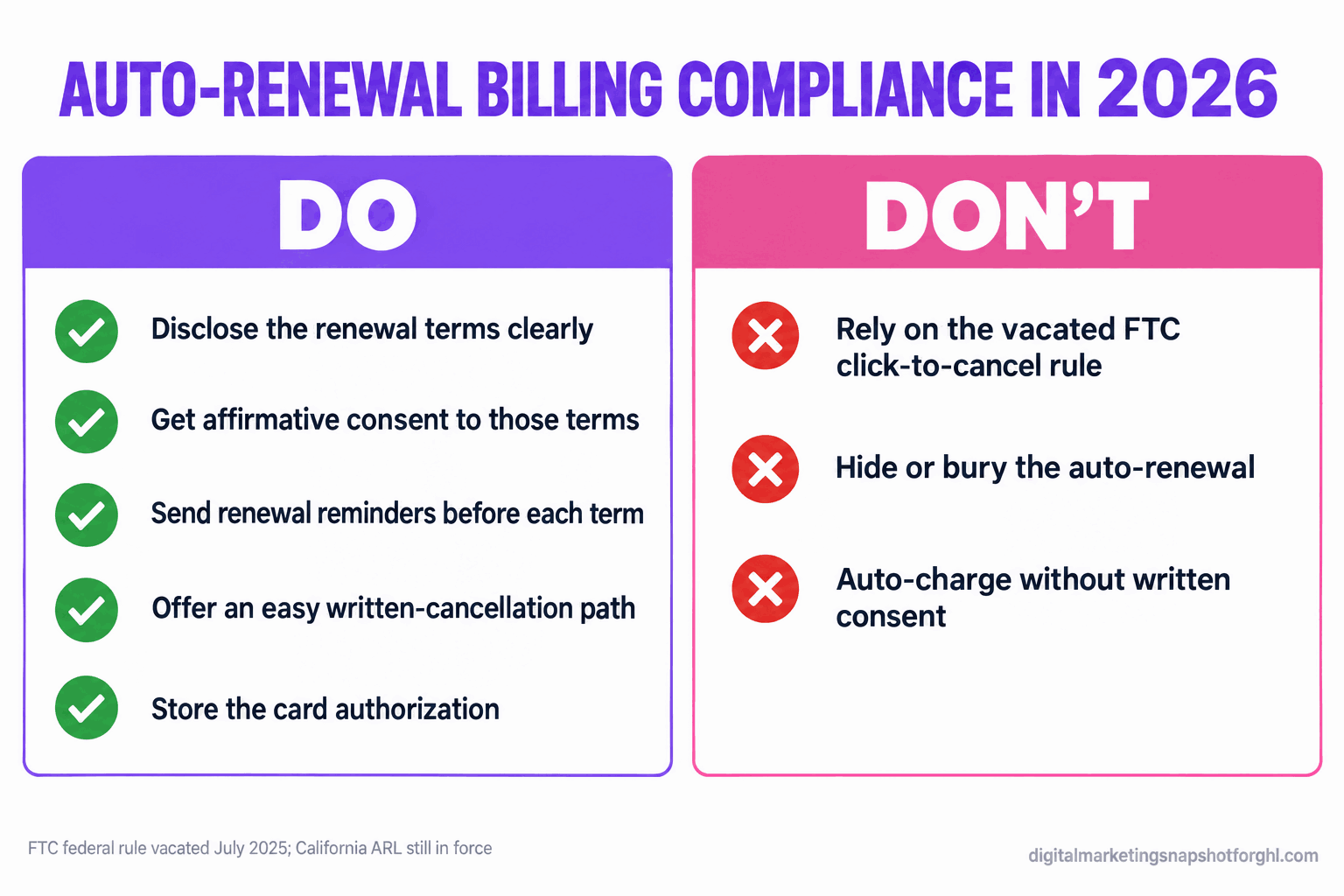
Auto-renewal law is the big one. You may have read that the FTC’s “click-to-cancel” rule requires simple cancellation and renewal reminders. The federal version, the revised Negative Option Rule, was struck down by the Eighth Circuit on July 8, 2025, days before it took effect (Mayer Brown; Steptoe), so do not cite that dead federal rule as your reason for anything. But the obligations did not disappear. California’s Automatic Renewal Law, amended effective July 1, 2025, remains fully in force, requiring clear disclosure of renewal terms, affirmative consent, an easy cancellation path, and renewal reminders (JD Supra). Roughly 30 states have similar regimes, and the FTC still enforces under ROSCA and Section 5 (FTC). So your renewal reminders and a written-cancellation path keep you compliant, not just well-liked.
Card authorization, PCI, and surcharging. The written authorization from Stage 1 protects you in a chargeback dispute, so never automate a charge without it, and use a tokenizing processor so card data never lands in your systems. If you charge EU cardholders, Strong Customer Authentication may require them to verify the first charge. And credit-card surcharging is restricted or banned in some states, so check yours or price the cost into the retainer.
Objections
“Won’t clients feel nickel-and-dimed by automated billing messages?” The opposite, done right. The receipt-with-status and the renewal value recap both give the client something real. The only transactional messages are the dunning ones, and those fire only when the client’s own card failed.
“I already use a project tool for invoicing. Why change?” Most project and PSA tools send invoices; far fewer auto-charge a card on file and run a real dunning sequence. The question is not whether your tool emails an invoice, it is what happens on day 4 when the charge fails. If the answer is “nothing automatic,” that is your leak, and you can keep the project tool and move only the billing engine.
“Do I need to be technical to set this up?” No. Every piece here is configuration, not code: a recurring invoice, an auto-charge toggle, a workflow with four scheduled messages, a renewal-date field. If you can build an email automation you can build this. Just handle the proration and authorization language carefully, because those cost real money if wrong. For a client who insists on bank transfer or check, keep the renewal cadence and store the mandate; you just lose the auto-charge, so reserve that for your largest accounts.
The close
Back to the 14th of the month, except now it looks different. The three retainers that would have gone missing never do: the expired card got refreshed before it failed, the switched-bank client updated from their phone, and the third pre-paid the year. You spent zero minutes on any of it.
That is the difference between an agency that sells retainers and one that collects them. Build the six stages once, and your cash stops depending on anyone chasing it. If you would rather not wire it by hand, the whole system comes pre-built and white-labeled, and you can see what it costs and how it installs.
Frequently asked questions
What is dunning in agency billing?
Dunning is the automated sequence of payment retries and messages that runs when a client's recurring charge fails, retrying on a schedule (for example day 0, 2, 4, and 7) with escalating reminders and a link to update the card. A structured sequence recovers most failed charges a single retry would miss.
How much agency revenue is lost to failed payments?
More than most owners realize. For B2B subscription businesses, involuntary churn (clients lost purely to failed payments) is about 16% of all churn, and one analysis attributes roughly half of all subscriber churn to payment failures. Most of it is recoverable with a retry-and-reminder sequence.
Should agencies auto-charge a card or send invoices?
Auto-charge a card on file. Send-and-wait invoicing is slower to cash, costs more admin time, and collects less. Collect a payment method and written authorization at onboarding, then auto-charge on a fixed billing day with a receipt that doubles as a proof-of-work status update.
Is automatic renewal of agency retainers legal?
Yes, with the right disclosures and consent. The FTC's federal click-to-cancel rule was vacated in July 2025, but California's Automatic Renewal Law and roughly 30 other state regimes still require clear disclosure of renewal terms, affirmative consent, an easy cancellation path, and renewal reminders.
How far in advance should I send renewal reminders?
Start 30 days before the renewal date with a value recap (the quarter's wins plus what is next), send a short logistics reminder at 14 days, and confirm on the day. Thirty days is the floor, because a reminder that fires after a client has checked out turns a continuation into a save play.
What tools do I need to automate retainer billing?
A tokenizing payment processor to hold the card, a CRM or billing tool with recurring auto-charge and scheduled message workflows, and a renewal-date field on each client record. Many agency platforms, including GoHighLevel, combine all three in one place.