
A marketing agency retainer agreement should lock down nine things in writing: scope of work, a scope-creep and change-order clause, payment terms and late fees, term and auto-renewal, termination and offboarding, response and approval windows, messaging compliance and consent, how you use client reviews, and who owns the accounts and data when it ends. Most small agencies run on a one-page proposal or a handshake, then eat the cost every time a client asks for “just one more thing.” Below is the anatomy, with sample copy for every clause. None of this is legal advice; have a lawyer in your state read the final version before you send it.
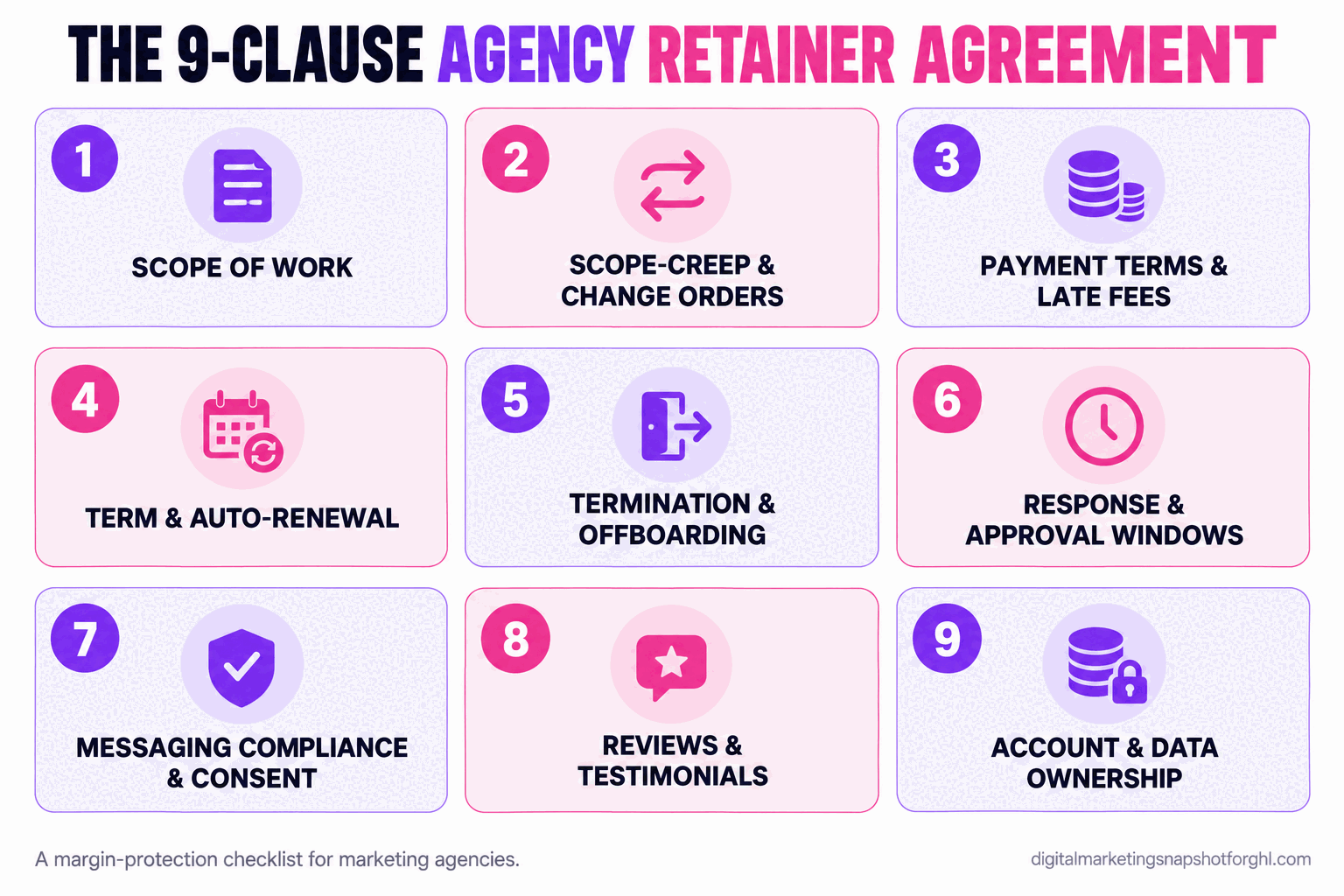
Table of contents
- Why your proposal is not an agreement
- What a weak retainer agreement costs you
- The nine clauses, with steal-this copy
- The same agreement at three agency sizes
- Objections agency owners actually raise
- How to roll this out without scaring clients
- FAQ
- Related reading
Why your proposal is not an agreement
It is a Thursday afternoon and a client Slacks you: “Hey, quick one, can you also build the landing page for the new offer? Should be fast for you guys.” You say sure, because saying no feels petty over a quick one. Three weeks later it has eaten eleven hours, delayed two other clients, and appears on no invoice. You did not get robbed. You gave it away, because nothing in writing said you would not.
That is the gap between a proposal and a retainer agreement. A proposal sells the dream. An agreement governs the relationship once the honeymoon ends, when the client wants more, pays late, goes quiet for approvals, or wants to leave. Most small agencies run on the proposal plus a monthly invoice and never make the jump. What breaks that setup is never dramatic: the slow drip of free work, late payments, and clients who treat your retainer like a buffet. The fix is boring, and it is a document.
What a weak retainer agreement costs you
Two costs stack up when the agreement is thin, both easy to underprice.
Unpaid work and scope creep. Every hour spent on a “quick one” that never made it to a change order is an hour you cannot bill, and it drags your utilization down. Billable utilization across professional services fell to a historic low of 66.4% in 2025, under the 70% most firms consider healthy, while high performers held 75.0% (SPI Research 2026 Benchmark, 509 firms). It is a real sector problem too: in a 2025 survey of 263 managed service providers, 58.7% named scope creep their most common challenge, up from 46% a year earlier (Moovila, 2025). Weak contracts are a big reason the gap exists, as our breakdown of billable utilization for agencies spells out.
Late and missing payments. How you word your payment terms predicts whether you get paid on time. In QuickBooks’ 2026 data, businesses on net-30 terms were more than twice as likely to carry 30+ day overdue invoices as those billing on immediate terms, and those with unpaid invoices were owed $17.7K on average (QuickBooks 2026). Your contract decides which side of that line you sit on.
Share of businesses carrying invoices 30+ days overdue, by payment terms. Source: QuickBooks Small Business Late Payments data, 2026.
The nine clauses, with steal-this copy
For each clause: what it does, the copy you can adapt, and how it breaks. Swap the bracketed parts for your own terms.
Clause 1: Scope of work and deliverables
This is the fence: everything inside is covered by the retainer, everything outside is a change order. Name deliverables, quantities, and cadence, not outcomes.
How it breaks: you write scope as a promise of results (“grow your traffic”) instead of a list of deliverables. Results depend on the client’s offer and market, so promising them is both a scope hole and a claim you cannot stand behind. Bill for the work, never for a guaranteed number.
Clause 2: The scope-creep and change-order clause
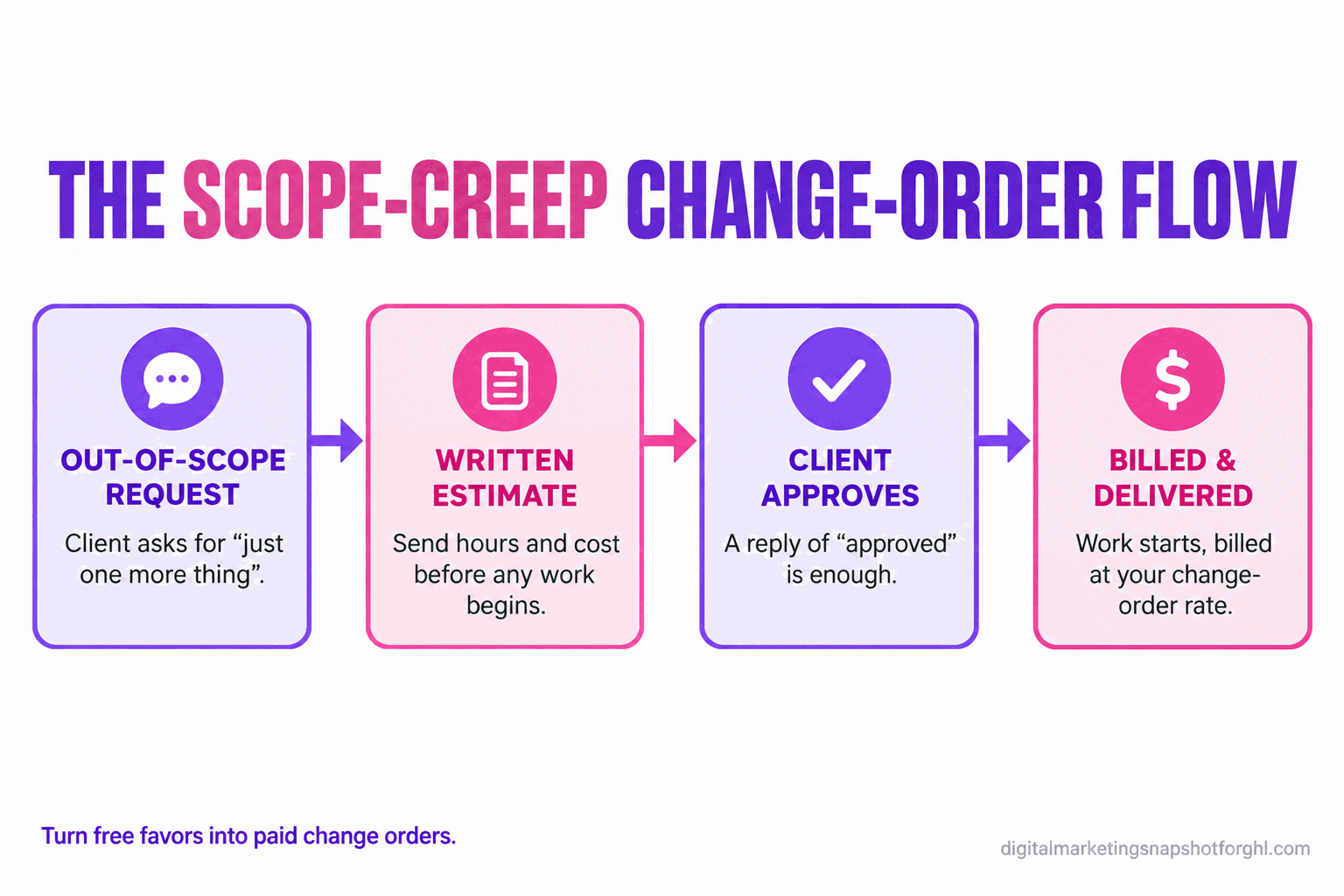
This is the clause that pays for itself. It does not forbid extra work; it prices it in writing before you start, so “just one more thing” becomes a normal paid conversation, not a favor.
Pair it with a revision cap so “one more round” does not become six: “Each deliverable includes up to [2] rounds of revisions. Further revisions are billed as a Change Order at the rate above.”
How it breaks: you write the clause and never use it, because invoking it feels awkward. It only works if “let me send you a quick change order for that” becomes your reflex reply. Automate the reflex with a saved reply and a one-click estimate, so saying yes to the client takes 20 seconds.
Clause 3: Payment terms and late fees
The data above is blunt: how you bill decides whether you get paid. Bill in advance, auto-charge a card or ACH on file, and put teeth on late payment. A retainer is prepaid, so you should never finance a client’s month.
How it breaks: you offer net-30 “to be nice,” then become the client’s interest-free lender and chase the invoice on day 45. If a client cannot put a card on file for a service they claim to value, that is information. For the cash-flow side, see how agencies survive the gap between retainers.
Clause 4: Term and auto-renewal
A month-to-month retainer you re-sell every 30 days is a part-time sales job you did not sign up for. A rolling term with auto-renewal flips the default so the client stays unless they actively leave.
How it breaks: auto-renewal without an easy cancellation path reads as a trap and costs you referrals and reviews even from clients who liked the work. Keep the notice window reasonable (30 days is standard) and make cancelling as simple as the clause says. For the retention structure around this, read how to structure agency retainers to cut churn.
Clause 5: Termination and offboarding
Every retainer ends. The agreement should make the ending orderly, not a fight over the final invoice or account access.
How it breaks: no notice period means a client can vanish mid-month and dispute the charge, and no offboarding terms turn every exit into an argument. Tie asset handover to a paid-in-full account and the exit stays civil.
Clause 6: Response and approval windows
Half your delays are the client sitting on an approval for nine days, then wondering why the campaign is late. Put service levels on both sides so the clock is shared.
How it breaks: you promise fast turnarounds but never set an expectation on the client’s side, so every slipped deadline looks like your failure. A shared clock is fair, and it keeps your calendar off the hook for a client’s indecision.
Clause 7: Messaging compliance and consent
The moment you send SMS or email on a client’s behalf, their compliance problem becomes yours. The contract has to say who owns consent, or carriers and regulators come looking for you.
The rules are real and current. Carriers block unregistered SMS traffic, and registering campaigns for clients usually needs a reseller or referral relationship recorded correctly, which is where most small agencies trip. See our A2P 10DLC setup guide and the TCPA-compliant opt-in script. On email, every send still has to meet CAN-SPAM, and a single EU lead pulls you into GDPR.
How it breaks: you assume the list is clean because the client said so. Carriers and regulators do not accept “the client told me it was fine” when you are the sender of record. The indemnity clause backstops you; it is not a license to blast a scraped list.
Clause 8: Reviews, testimonials and case studies
You want to use client wins in your marketing, and you may run review collection for them. Both are governed by the FTC, so this clause does double duty: permission plus honesty.
The FTC’s position is plain: endorsements must reflect an endorser’s honest opinion, incentives conditioned on positive reviews are a problem, and material connections “should be disclosed clearly and conspicuously” (FTC Endorsement Guides). The 2023 update also made clear that “results not typical” disclaimers will not save a misleading testimonial. If you run review automation as a service, read the FTC review rules for agencies first.
How it breaks: you build a review flow that routes happy customers to public sites and quietly diverts unhappy ones. That gating is exactly what the FTC’s review-manipulation principle targets. Collect reviews from everyone and answer the bad ones in public.
Clause 9: Account, data and IP ownership
When the relationship ends, who owns the ad account, CRM, phone number, content, and data? Decide it on day one, in writing.
How it breaks: you build everything inside your own sub-account and never clarify ownership, so leaving means the client loses their data or you lose a weekend untangling access. Settle it up front and nobody is surprised at the exit.
The same agreement at three agency sizes
The nine clauses do not change. How formal and automated they get does. Run the framework at the size you actually are.
| Clause area | Solo / freelancer | Small team (1-10) | Growing shop (11-20) |
|---|---|---|---|
| Format | A clean 2-3 page agreement, e-signed | Standardized template, one per service line | Master services agreement plus per-client order forms |
| Scope and change orders | Tight scope, hourly change-order rate | Capped revisions, saved change-order template | Change orders routed through a PM with sign-off |
| Payment | Auto-charge card, prepaid monthly | Auto-charge plus a late-fee clause you enforce | Net terms only for enterprise, with deposits |
| Term | Short initial term, monthly rollover | 3-month initial, 30-day notice | 6-12 month terms for larger accounts |
| Compliance | Client owns consent, you keep proof | Documented A2P registration per client | Compliance checklist in onboarding, reviewed quarterly |
| Ownership | Simple “your data is yours” line | Clear asset handover checklist | Formal data-processing terms, legal-reviewed |
Solo operators should not skip the contract because clients feel like friends; friendly clients are the ones who assume the quick ones are free. Small teams (1-10) are where leaks get expensive, because now it is three people each saying yes to a quick one, which is where a weak contract and poor margin as you grow compound. Growing shops (11-20) move to a master services agreement with per-client order forms and lawyer-reviewed compliance and data terms.
Objections agency owners actually raise
“Won’t a formal contract scare clients off?” The clients a clear agreement scares off are the ones who planned to treat you like a buffet. Serious businesses sign contracts every week, and a clean, plain-English agreement reads as professional, not hostile. A defined scope and change-order process makes buying more work easier.
“My clients are friends, we do a handshake.” Handshakes are great until the friend’s business gets tight and your invoice is the one they slow-pay, or a “quick favor” balloons and neither of you remembers what was agreed. A contract protects the friendship by removing the ambiguity.
“Do I need a lawyer for this?” You can draft and e-sign from the clauses above, but have a lawyer in your state review it once before you use it at scale, especially the payment, termination, compliance, and indemnity language. One review covers a template you reuse for years.
“I already have clients on old, loose terms.” Do not rip up existing deals. Introduce the new agreement at the natural moment: a renewal, a price change, or a new service add-on. “We are standardizing our agreements this quarter” is reason enough. Put new clients on it now and migrate the rest at renewal.
How to roll this out without scaring clients
Build the agreement once, then make it run itself: automate the change order (a saved reply plus a one-click estimate), the money (prepaid, auto-charged on the first), and renewal and offboarding (a rolling term plus an asset-handover checklist). For the pricing logic behind it, see how to price marketing agency retainers and retainer vs project vs performance pricing.
That Thursday afternoon ask does not have to cost you eleven unbilled hours. With the scope clause, your reply is “love it, sending you a quick change order now.” With auto-charge, next month is paid. With auto-renewal, the client is still there in 90 days without a re-sell. The document is boring. The margin it protects is not.
FAQ
What is the difference between a retainer agreement and a proposal?
A proposal sells the engagement. A retainer agreement governs the relationship after they sign: out-of-scope requests, late payments, approvals, renewals, compliance, and the exit. The proposal wins the deal; the agreement protects the margin on it.
How do I write a scope-creep clause that actually works?
List the in-scope deliverables specifically, cap revisions, and state that anything outside the list is a paid change order approved in writing before work starts, at a stated hourly rate. It only works if you reflexively reply to every extra ask with a quick written change order.
Should marketing agency retainers be billed in advance or in arrears?
In advance, auto-charged to a card or ACH on file. Businesses on net-30 terms were more than twice as likely to carry overdue invoices as those on immediate terms, per QuickBooks' 2026 data. A retainer is prepaid by definition, so billing in arrears makes you your client's interest-free lender.
Is auto-renewal on a retainer advisable?
Yes, as long as you pair it with a clear written-notice window (30 days is standard) and an easy cancellation path. The goal is to remove the monthly re-sell, not to trap anyone, since trap-style renewals cost you referrals and reviews even from happy clients.
Who is responsible for SMS and email compliance when an agency sends for a client?
As the sender of record, you share the risk, so the agreement must state the client is responsible for lawful consent and registration, including A2P 10DLC for SMS, while you follow TCPA, CAN-SPAM and GDPR and honor opt-outs. An indemnity clause backstops you, but it is not a license to blast a scraped list.