
It’s 4:50pm on a Friday and the Slack message says “hey, quick one.” You already know it is not quick. The client wants one more landing page variant, a tweak to last month’s report, and “while you’re in there” a fresh set of ad creatives for a promo they decided on this morning. None of it is in the retainer. You say yes, because saying no feels like picking a fight over something small, and because it is only an hour. You do it over the weekend.
Here is the part nobody tells you. That hour was not free. It came straight out of your margin, and you will do a version of it again next week. Scope creep does not arrive as one big unreasonable demand. It arrives as a steady drip of small, reasonable-sounding yeses, each too minor to bill for, that together turn a profitable account into one you resent. This is a map of where that drip starts, what it costs you, and the word-for-word copy to turn it off without turning off the client.
What this article covers
- Scope creep is a hundred small yeses, not one big ask
- What free work is actually costing you
- The six places scope creep sneaks in
- Steal this: the scope-protection copy
- Three scenarios: solo, ten-person, twenty-plus
- The contract and compliance angle you can’t skip
- Objections, answered straight
- FAQ
Scope creep is a hundred small yeses, not one big ask
Scope creep is any work you do that was not in the agreement the client is paying for. The trap is that it almost never looks like scope creep in the moment. It looks like good service: “a quick change” to a deliverable, an “extra” report, “just one more” revision round, a bit of strategy on a call that was meant to be a status update. Each one is small, each one is easy to say yes to, and each one is unbilled.
The reason it is so hard to catch is that the cost is invisible per favor and brutal in aggregate. One hour of free work on a Friday does not register, but a client who gets twelve of those a quarter is paying for a retainer and receiving a retainer-plus-a-quarter. It is not a rare failure, either: PMI’s widely cited research found that more than half of projects experience scope creep, up from closer to 40% five years earlier (PMI, Pulse of the Profession). And it compounds, because every free favor resets the client’s idea of what the fee buys.
What free work is actually costing you
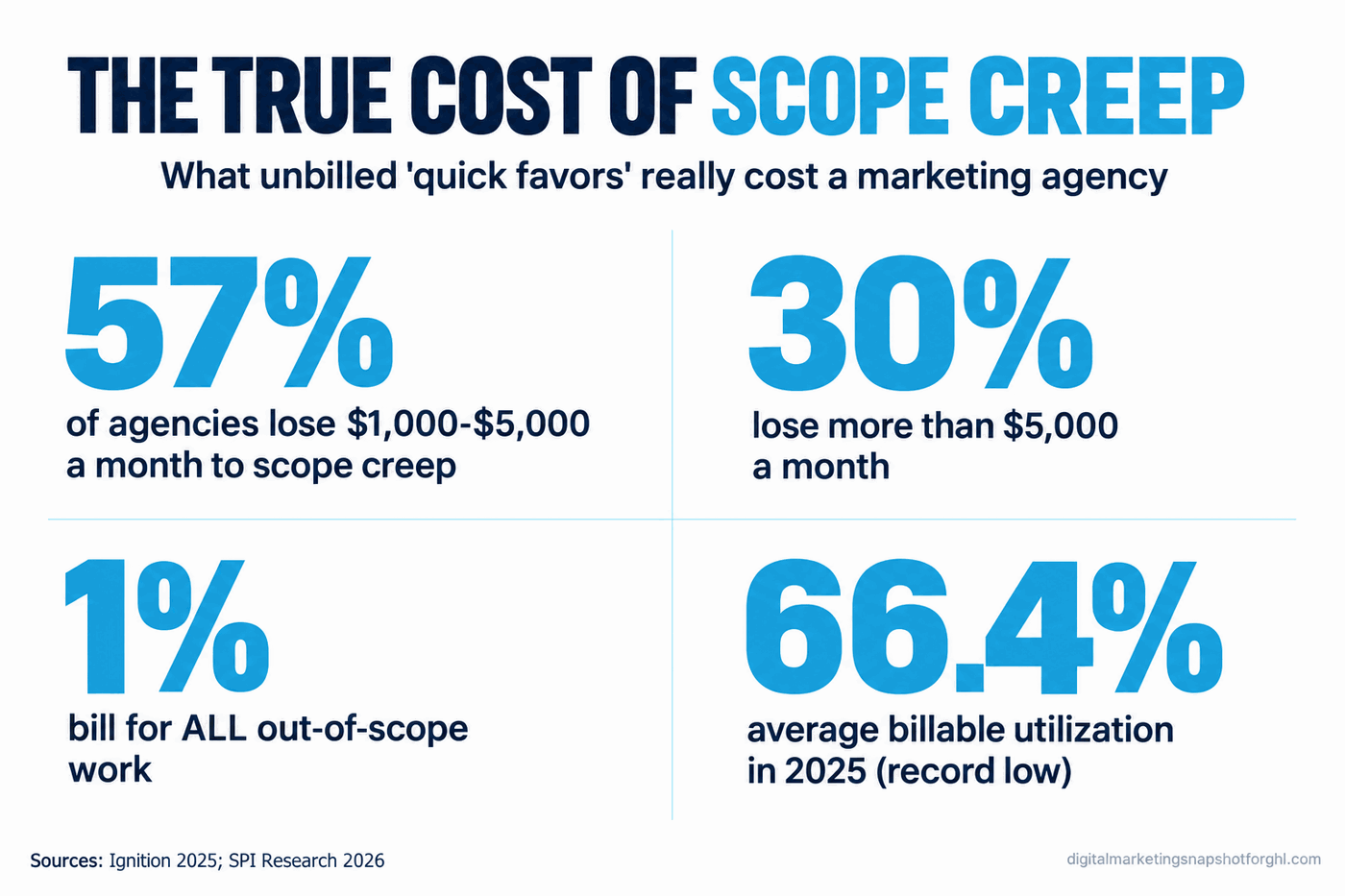
Put a number on it and the Friday favor stops looking harmless. In Ignition’s 2025 survey of roughly 273 agency leaders, 57% of agencies said they lose between $1,000 and $5,000 a month to scope creep, another 30% lose more than $5,000 a month, and a remarkable 1% manage to bill for all of their out-of-scope work (Ignition, 2025). On top of that, 78% said they rarely or only sometimes charge for out-of-scope requests at all. For a lot of shops, the unbilled work is the gap between a good year and a flat one.
Share of agencies by monthly scope-creep loss, and the share that bills for every out-of-scope request. Source: Ignition, 2025 Agency Pricing and Cash Flow Report.
The leak shows up in two numbers you already track. The first is billable utilization, the share of your paid hours a client actually pays for. In 2025 it averaged 66.4%, the lowest in the benchmark’s history, against the roughly 75% considered healthy (SPI Research, 2026). Every hour you give away free is payroll with no invoice behind it, and it drags that number straight down; the playbook for lifting it is in how to calculate and raise billable utilization.
The second is margin. Unbilled scope thins it because the free work scales with your client count while the revenue does not. In AgencyAnalytics’ 2026 survey of 494 agencies, “managing time and billable expenses” was the single biggest internal challenge agency leaders named, cited by 28% (AgencyAnalytics, 2026). It is one of the six leaks in why your agency makes less money as it grows. Scope creep is not a service problem; it is a profit problem wearing a friendly face.
The six places scope creep sneaks in
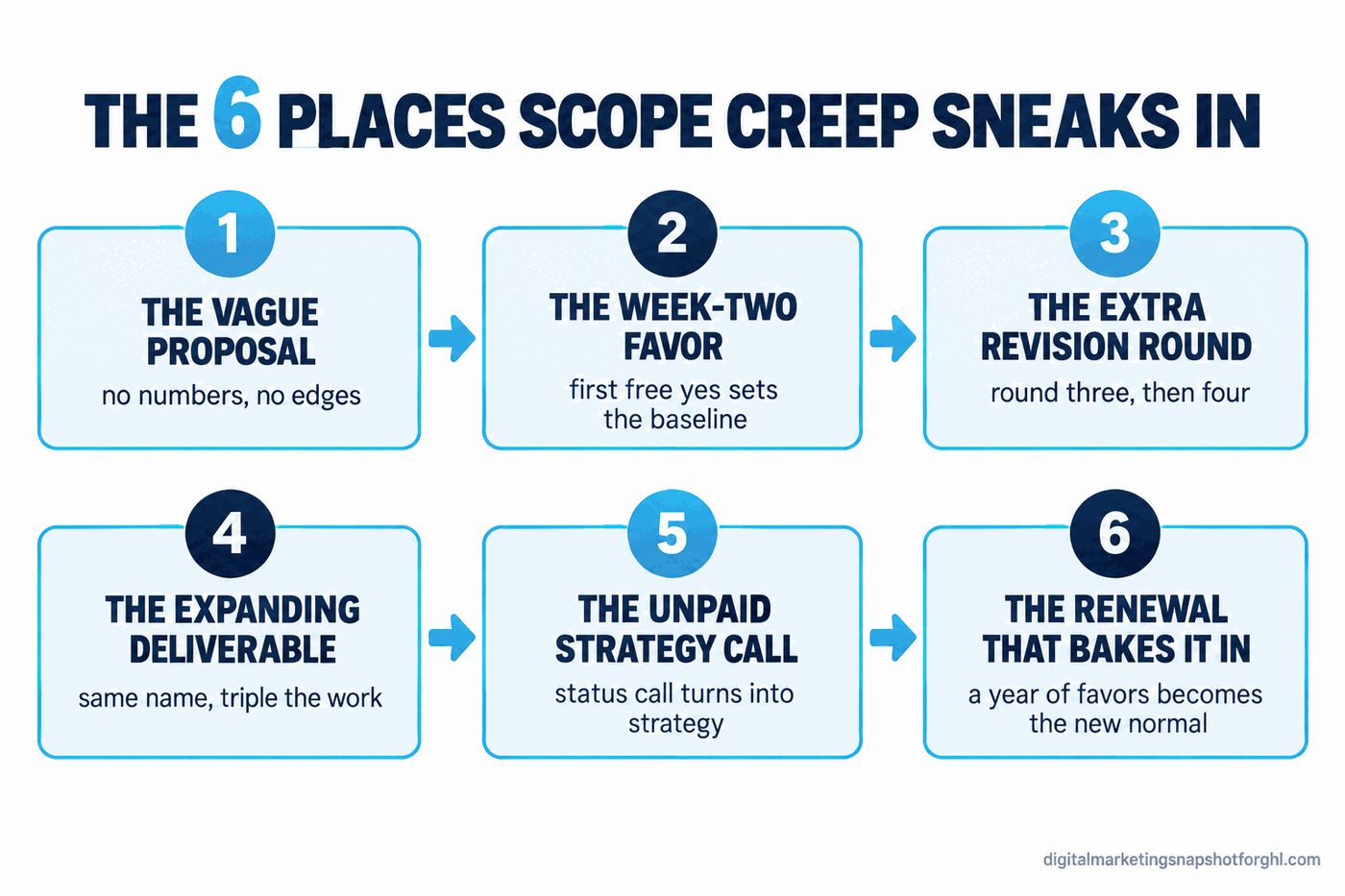
Scope creep is predictable. It enters at the same six points on almost every account. For each one: the warning sign, how it breaks, and the fix.
Place 1: The vague proposal
Every scope problem starts in the document that was supposed to prevent it. A proposal that says “social media management” or “SEO services” with no numbers is an open invitation, because nobody can be out of scope when there is no scope.
Warning sign: your agreement describes what you do (“content marketing”) but never how much. The fix: quantify every deliverable. “Four blog posts per month, up to 1,500 words, two revision rounds each” is a fence; “blog content” is a field with no edges. The copy for a scope line that holds is in steal this.
Place 2: The week-two “quick favor”
The account is new, you want to impress, and the first out-of-scope ask lands in week two. You say yes to start the relationship warm. The problem: the first favor sets the baseline for every one after it.
Warning sign: you find yourself thinking “I’ll just do this one to build goodwill” in the first month. The fix: say yes and name the scope in the same breath, warmly. You are not refusing; you are labeling. “Happy to, and just so you know, that one is outside the plan, so I’ll roll it in as a quick add-on.” Label the first favor and every later one feels normal instead of awkward.
Place 3: The extra revision round
Revisions are where scope quietly doubles. The agreement says two rounds, round three arrives, and you do it because stopping to talk about it feels petty. Then round four. Creative and web shops lose more hours here than anywhere else.
Warning sign: you have lost count of how many times a deliverable has been “nearly approved.” The fix: cap rounds in the scope and treat the cap as real. When the next round lands past it, that is a change order, not a fight: “This is round three, past the two we scoped, so I’ll quote it as a small add-on before we proceed.” Open-ended revisions are only free to the person not paying for them.
Place 4: The expanding deliverable
This one is sneaky because the deliverable keeps its name while its size balloons. “The monthly report” grows three new sections. “The newsletter” becomes a newsletter plus two social cutdowns. Same label, triple the work, no change in fee.
Warning sign: a deliverable takes noticeably longer than it did three months ago, and you cannot point to when it changed. The fix: periodically re-measure your deliverables against the scope they were sold at. When reporting is the thing that has ballooned, the real answer is to stop doing it by hand; see why client reporting eats your weekend. Automation turns a swelling deliverable back into a fixed cost.
Place 5: The unpaid strategy call
The status call that turns into a strategy session is scope creep in its most expensive form, because your thinking is the highest-value thing you sell and you are giving it away as small talk.
Warning sign: your “15-minute check-in” regularly runs to 45 minutes of solving a problem that was never on the agenda. The fix: separate the cadences. A status update is included and short; strategy is scheduled, named, and billable. “Great question, that one’s worth doing properly rather than squeezing in here, let me put a quick scope together.” You are not withholding value; you are pricing it.
Place 6: The renewal that bakes it in
By renewal, a year of small favors has reset the client’s idea of what your fee covers. Renew at the same scope and price and you are locked into delivering the inflated version for another year.
Warning sign: at renewal you realize you are delivering noticeably more than you sold, and nobody has mentioned paying for it. The fix: use the renewal to re-baseline honestly. Recap what the plan includes, name the extras that have crept in, and either fold them into a higher tier or move them to add-ons. This is easier inside a real value conversation, where expansion lives too; the structure is in how to structure agency retainers to cut churn.
Steal this: the scope-protection copy
A system only works if you actually send the words. Here is the copy. Change the names and use it.
The scope line that holds (put this in every proposal and SOW).
“This retainer includes: [4 blog posts per month, up to 1,500 words, 2 revision rounds each], [8 social posts across 2 channels], and [1 monthly report]. Work beyond this list is welcome and quoted as an add-on before it starts. Unused deliverables don’t roll over.”
The change-order one-liner (when an out-of-scope ask lands).
“Happy to take this on. It sits just outside the current plan, so here’s a quick add-on: [scope] for [price], delivered by [date]. Reply ‘go’ and I’ll start today.”
The warm label for the first favor (week two).
“Done, that’s handled. Quick note so nothing’s ever murky: that one was outside the retainer, so I covered it this time as a welcome-to-working-together. Next time I’ll send a two-line add-on so you always know what’s included.”
The revision-cap message (round three and beyond).
“This is round three on [deliverable], which is past the two rounds we scoped. No problem at all, I’ll quote this round as a small add-on, or if round two was close, I can point you to the two or three tweaks that get it over the line. Which do you prefer?”
The strategy-call redirect (when the status call grows legs).
“That’s a great direction and I don’t want to half-answer it on a status call. Let me put a short scope together so we give it the time it deserves. I’ll have it to you tomorrow.”
The renewal re-baseline (30 days before renewal).
“Renewal’s coming up and I want the plan to match reality. Over the year we’ve added [X and Y] on top of the original scope. I’d rather make that official than leave it loose, so here are two options: fold it into [higher tier], or keep the base plan and run those as add-ons. 20 minutes this week to pick one?”
Three scenarios: solo, ten-person, twenty-plus
The six places are universal. What changes with size is how the creep gets in.
Share of agencies by how much of their time is billable. Nearly a third sit below 60% billable, which is where unbilled scope creep lands. Source: AgencyAnalytics 2026 Marketing Agency Benchmarks.
The solo operator (three to eight clients). You are the whole agency, so every favor comes out of your own evenings and weekends. Your win is the warm label: price the favor the moment it is asked, every time, so the baseline never resets. One lost retainer is a huge share of your income, so protecting scope is protecting cash flow; see agency cash flow between retainers.
The ten-person shop (ten to twenty-five clients). This is where scope creep goes invisible, because the person doing the free favor (an account manager, a designer) is not the person who feels the margin hit (you), and favors get granted account by account with nobody tracking the total. Your win is making the change-order one-liner a team habit, not a founder’s instinct: anything outside the SOW gets a two-line add-on quote before work starts, no permission needed to say it.
The twenty-plus agency (forty-plus clients). Hand-policing scope is impossible at this size, so the risk is inconsistency: some account managers hold the line, some give the shop away. Your win is enforcing it in the system: deliverables defined per account, out-of-scope requests logged as tasks that need a quote, and a view of which accounts consistently over-deliver. When over-delivery has become structural, the deeper fix is removing the manual work entirely, which is the heart of how to scale an agency without adding headcount.
The contract and compliance angle you can’t skip
A proper scope document does more than protect your margin. It is also where you nail down who owns the compliance risk on the work you deliver, which matters the moment your scope includes outbound marketing on a client’s behalf.
If your scope covers SMS for a client, your SOW should state who registers for A2P 10DLC and who owns consent, because US carriers block unregistered traffic and agencies texting for multiple clients usually register as a reseller; the walkthrough is in A2P 10DLC registration for agencies. For email, CAN-SPAM rules on sender identity and unsubscribes apply to every send (FTC CAN-SPAM guide), and the minute a client’s list includes anyone in the EU, GDPR is in play. For reviews, the FTC’s 2024 rule bans fake and incentivized reviews outright, with civil penalties for knowing violators (FTC, 2024). None of this is legal advice, but a loose scope is a loose liability: a favor that quietly adds a new channel can hand you a compliance obligation nobody wrote down. The change-order habit prices the work and documents who owns the risk.
Objections, answered straight
“If I start quoting for every little thing, I’ll look petty and lose the client.” The opposite is usually true. Clients respect a vendor who runs a tight operation, because it signals you will run their work tightly too. What actually damages the relationship is the slow resentment that builds when you over-deliver for free and start to feel taken advantage of.
“My retainers are loose on purpose, it’s part of the service.” Flexibility is fine; unpriced flexibility is not. You can be the agency that says yes to everything, as long as the everything is scoped and paid for. A generous retainer with a clear change-order process is still generous, just not at your own expense.
“I don’t have time to write a scope for every tiny request.” You do not need one. That is what the change-order one-liner in steal this is for: two lines, ten seconds, sent from your phone. And some of what you give away, clients would happily pay for; they have just never been asked, because free is the only option you have offered. The ones who genuinely will not pay beyond the base are telling you something useful about the account’s real margin, which why agency margin shrinks as you grow puts in black and white.
FAQ
What is scope creep in a marketing agency?
Scope creep is any work your agency does that was not in the agreement the client is paying for: extra revision rounds, 'quick' out-of-scope favors, a deliverable that quietly grows, strategy given away on a status call. It rarely arrives as one big ask. It accumulates as small, reasonable-sounding yeses that together erode your margin, because no single favor feels big enough to stop and bill for.
How much does scope creep cost agencies?
A lot, and most of it is invisible. In Ignition's 2025 survey of around 273 agency leaders, 57% reported losing $1,000 to $5,000 a month to scope creep, 30% lost more than $5,000 a month, and only 1% billed for all of their out-of-scope work. It is one of the single largest unbilled leaks most agencies have.
How do you stop scope creep without losing the client?
Scope the deliverables in numbers, then make a change-order habit routine: when an out-of-scope request lands, say yes and send a two-line add-on quote before starting. Cap revision rounds, keep strategy calls separate from status updates, and re-baseline at renewal. Done warmly, this reads as professionalism, not pettiness, and clients respect an agency that runs a tight ship.
What is a change order and when should I use one?
A change order is a short, documented agreement to do work beyond the original scope for an agreed price, sent and approved before the work starts. Use one any time a request falls outside the deliverables in your retainer or SOW: an extra revision round, a new channel, an added report. It does not have to be formal; a two-line message quoting the scope, price and date, with the client replying 'go', is enough. A fixed add-on price is usually cleaner than hourly, because clients prefer knowing the number up front.
How do I handle scope creep across a team?
Make the change-order one-liner a rule anyone can use without asking permission: any request outside the SOW gets a two-line add-on quote before work begins. Define each account's deliverables in one shared place, log out-of-scope requests as tasks that need a quote, and review which accounts consistently over-deliver so you can re-baseline them at renewal. The goal is to make holding the line the default, not a judgment call.
The Friday “quick one” will land again this week. It always does. The difference, once the system is in place, is that you no longer choose between your weekend and the relationship. You say yes, you send two lines, and the work that used to come out of your margin now comes with an invoice. The client still gets their landing page. You just stop paying for it yourself.