
It is a Tuesday and you just said yes to a new retainer on a sales call, and the second it ended your stomach dropped. Not because the money is bad. Because you already know who does the work, and it is the same three people who were on Slack at 9pm last night. You will find the hours somewhere. You always do. That is the problem.
Here is the short version. Most small agencies hire by feel, so they hire too late, after the team is cooked and quality has slipped, or they panic-hire off one good month and carry the cost through the next slow one. Capacity planning replaces the feel with a number: measure the billable hours you have, set a red line you will not cross, and read a hire trigger that fires before the crunch. This guide builds that system in five stages, with the trigger rule and the scripts you can lift.
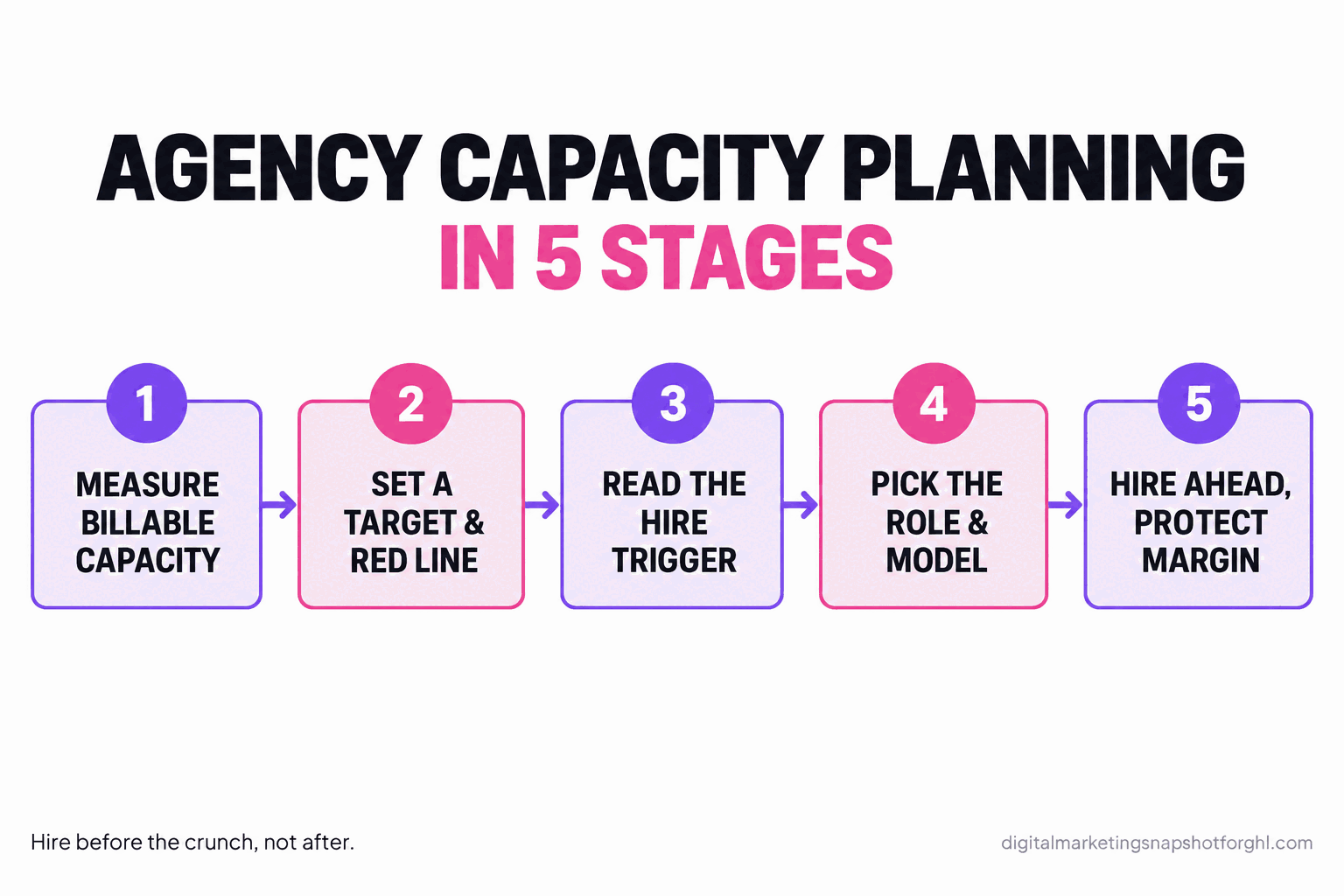
What this guide covers
- What hiring on feel costs
- Stage 1: Measure billable capacity
- Stage 2: Set a target and a red line
- Stage 3: Read the hire trigger
- Stage 4: Pick the role and model
- Stage 5: Hire ahead, protect margin
- Three scenarios: solo to 20-plus
- The compliance cost that scales
- Objections
- FAQ
What hiring on feel actually costs
Two bills land when you get capacity wrong, at opposite ends of the cycle.
Hire too late and you pay in churn and burnout. The team absorbs the overload, a deliverable misses, and a quietly happy client starts shopping. Then you pay in turnover: Gallup puts the cost of replacing one employee at one-half to two times their annual salary (Gallup). Burning out a good specialist to protect this quarter can cost more than the hire you skipped.
Hire too early, off one strong month, and you pay in bench. The salary starts on day one; the work that justifies it does not, and a few slow weeks later you are funding a seat that is not covering itself. That swing is the whiplash behind the agency feast-or-famine cycle.
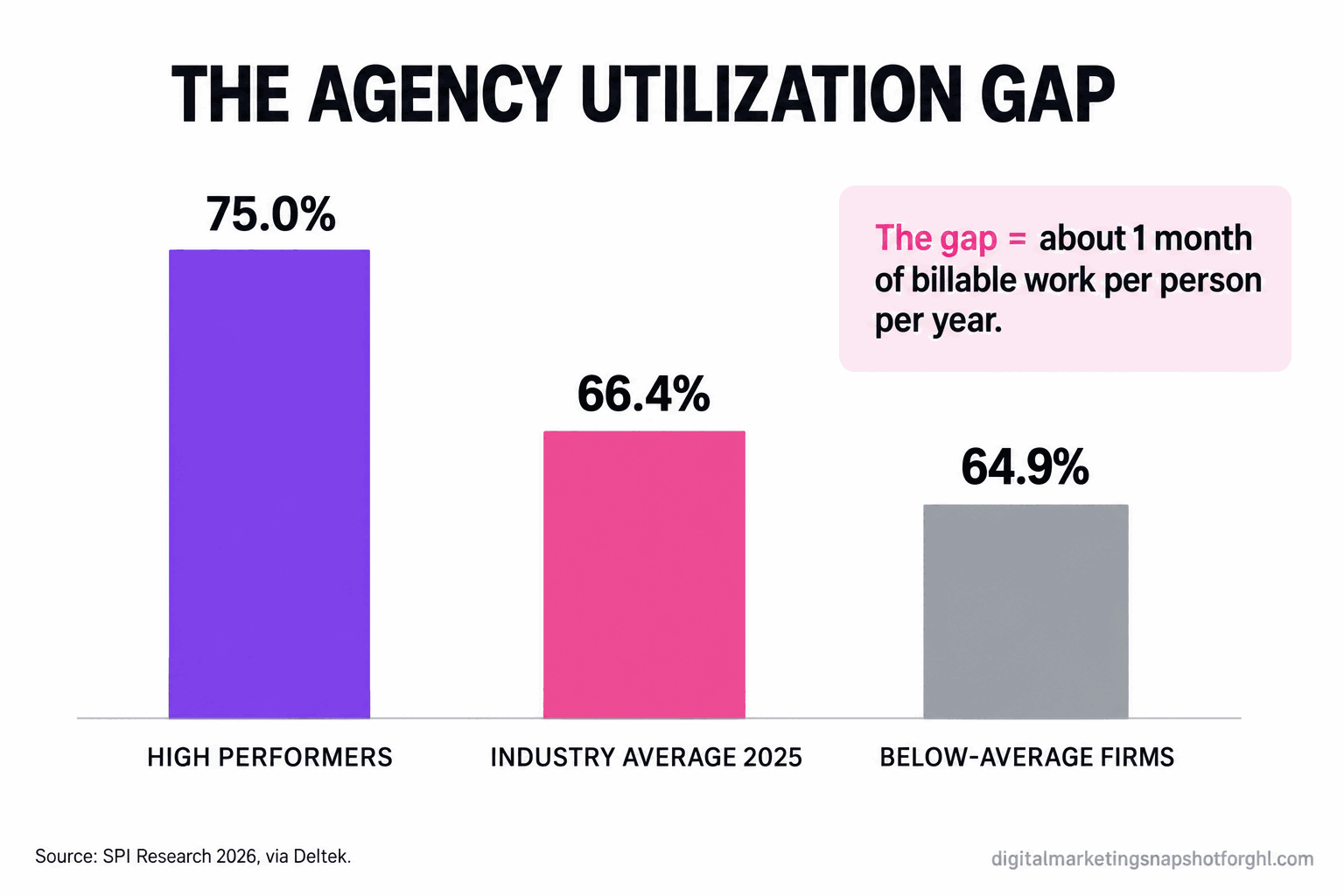
Under both sits the invisible cost: the billable time you already pay for and never use. US billable utilization fell to 66.4% in 2025, the lowest in SPI Research’s 19-year benchmark across 509 firms, while high performers hit 75.0% and everyone else sat at 64.9% (Deltek; SPI Research). The cheapest capacity you will ever buy is the hours you already have.
The distance between the top two bars is the capacity most agencies could unlock before they ever post a job.
Billable utilization by firm type, 2025. Source: SPI Research 2026, via Deltek.
Stage 1: Measure your true billable capacity
You cannot plan capacity you have never counted. A full-time person is paid for about 2,080 hours a year (40 hours times 52 weeks). Take out roughly four weeks of PTO, holidays and sick time and you land near 1,880 working hours. That is total time, not billable time, and the biggest mistake small agencies make is treating the two as the same.
The fix is a time split your team will actually keep: no stopwatch on every task, just every hour in one of two buckets so you can read your real utilization at week’s end.
Run this for two weeks and you get a real utilization number per person. For a deeper walkthrough, see billable utilization for marketing agencies.
Where it breaks: people game the buckets. Reward someone for high utilization and every meeting becomes “client strategy.” Track at the team level for decisions and individually only for coaching, never a bonus. The number you plan with has to be true, not flattering.
Stage 2: Set a utilization target and a red line
Now you have a number. Capacity planning is deciding which level is healthy and which means stop.
Set the target at 75%, where high performers run. It leaves a quarter of the week for the non-billable work that keeps the agency alive (new business, improvement, training). Chasing 90% sustained is not ambition, it is a staffing shortage you have not named yet.
Set the red line at about 85%. Above that for more than two or three weeks running, your buffer is gone: no slack for a sick day, a fire drill, or the next retainer. It is where the next yes comes out of someone’s evening, and quality and retention slide before you see it.
The distance between 75% and 85% is your planning runway: the window where you see the crunch coming and hire into it calmly, instead of reacting after a client has felt it.
The red line also sets the payoff of lifting utilization. Here is how many billable hours one person delivers a year at each rate, from about 1,880 working hours. The jump from average to target is roughly a month of billable work per head, capacity you unlock without hiring anyone.
Billable hours per person per year by utilization rate, from ~1,880 working hours (2,080 paid less four weeks off). Benchmarks: SPI Research 2026, via Deltek.
Stage 3: Read the hire trigger
A single busy week is not a reason to hire. Three signals lining up is, because any one alone lies to you.
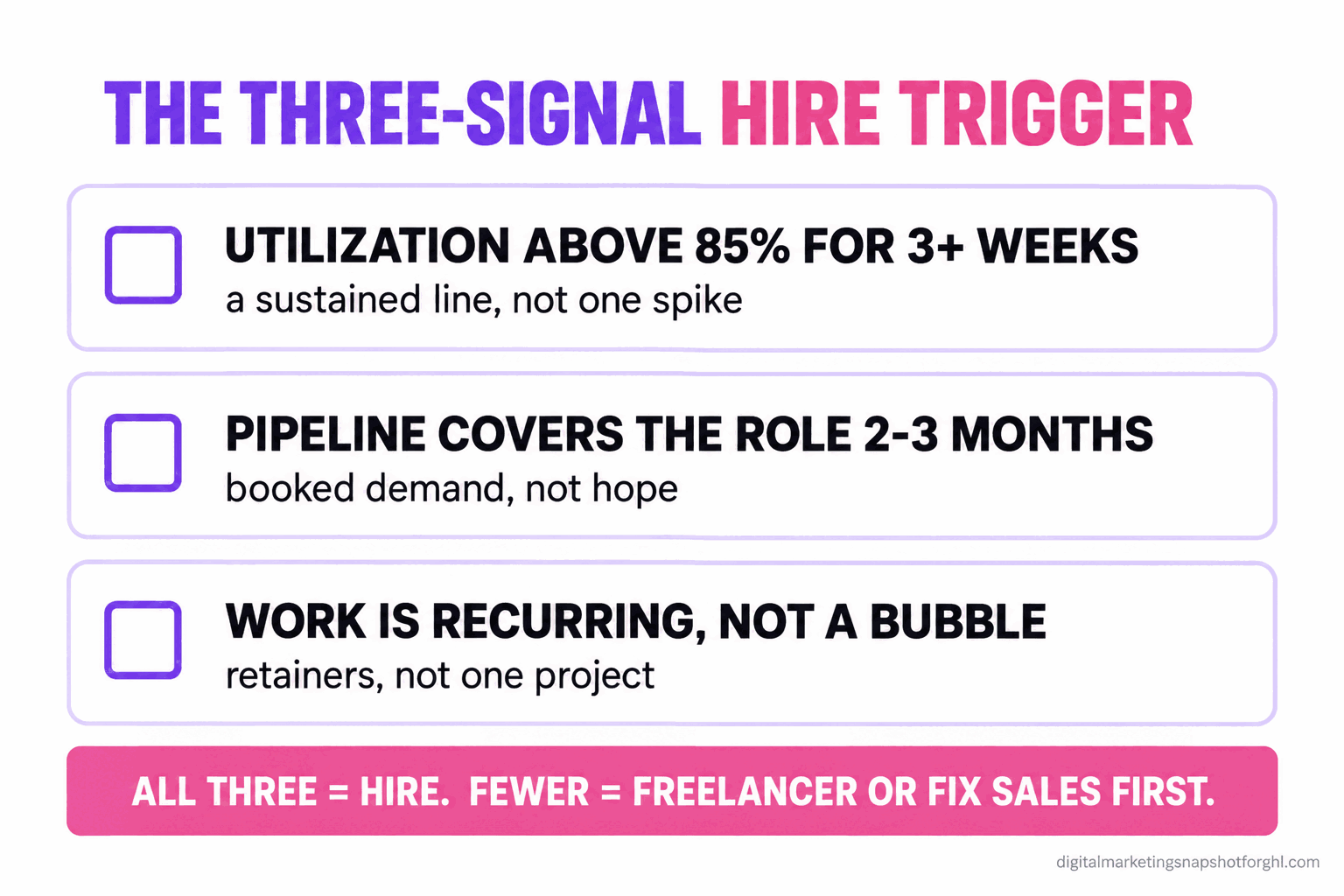
Use a rule instead of a gut call, because your gut follows whichever pain is loudest this week: in a crunch it screams “hire now,” in a slow patch it whispers “save the money.” The rule does not panic or get complacent, and it forces you to check the pipeline, the signal most owners skip.
Where it breaks: owners treat the trigger as permission to hire the most obvious body. Utilization tells you that you are out of capacity, not which. That is Stage 4.
Stage 4: Pick the right role and the right model
Utilization at the red line is a symptom. Before you hire, diagnose which kind of hour you are short on, because it changes who you hire and what it costs. Three patterns are common:
- Short on doers. Strategy is fine, the work is the bottleneck. Hire a specialist or production role (a media buyer, an SEO, a designer), one deep skill, not a generalist.
- Short on coordination. Work gets done but late, approvals stall, clients chase you for updates. Hire a project or account manager. Owners delay this one longest because it does not feel billable, yet it buys back the most of your own time, the real constraint in a founder-dependent agency.
- You are the bottleneck. Everything routes through you for approval. No hire fixes that; systems and delegation do, as in scaling without adding headcount.
Then pick the model, which need not be a salary.
Three ways to add capacity
| Plan | Freelancer / contractor | Offshore / trained VARecommended | Full-time hire (FTE) |
|---|---|---|---|
| Price | Per project or hour | Flat monthly, lower cost | 0.5-2x salary to replace |
| Feature 1 | Fast: live in days | Covers repeatable delivery and ops | Deepest ownership and continuity |
| Feature 2 | No long-term commitment | Scales onboarding and reporting | Right for proven recurring load |
| Feature 3 | Right for project spikes and bubbles | Cheaper than a local FTE | Highest fixed cost and risk |
| Feature 4 | You still manage the work | The low-risk bridge to proven demand | Weeks to hire, months to ramp |
| See VA support → |
The order that protects margin is usually contractor or VA first, then convert to a full-time role once demand is undeniable. Paying a fixed salary to hedge against demand you have not confirmed is how a profitable month turns into a nervous quarter, the way margin shrinks as an agency grows.
Where it breaks: hiring a generalist because it feels flexible. A generalist at the red line gives a little relief everywhere and solves nothing fully, and six months later you are back at the line with a bigger payroll. Hire the specific gap the data shows.
Stage 5: Hire ahead and protect margin
The last stage is timing, where the planning runway from Stage 2 pays off.
Hire into the runway, not the wall. A full-time hire takes weeks to find and months to reach full output. Start the search at 85% and they are productive three months later, and you have been over the red line the whole time, the burnout window you were avoiding. Recruit as utilization climbs toward the line, not after it parks above it.
Protect the margin on the way in. A new hire is non-billable while they ramp, so model two or three months of that cost and make sure the pipeline from signal 2 absorbs it. If it does not, bridge with a contractor rather than carry a salary against hope.
Keep a named owner for capacity. In a small shop that is you, once a week, for ten minutes, acting on the number.
And when you are genuinely full, say so cleanly instead of overpromising. Tell the prospect you are at capacity, name a real start date, and send onboarding now so day one is productive. A short, honest message protects quality and your reputation, and often makes the client value the slot more than a rushed yes would.
Three scenarios: solo, 11-20, 20-plus
The system is the same at every size. The inputs and the first hire are not.
Solo operator. Capacity is your own billable hours, and your red line comes fast because non-billable work (sales, admin, your own marketing) eats the week. The trigger is simpler: you are turning away good-fit work, or doing a day a week of admin a cheaper pair of hands could do. Your first “hire” is almost never a full-timer. It is a VA or contractor who takes the repeatable load (onboarding, reporting, scheduling) so your hours go back to client work.
Growing team (11-20). Now you plan at the pool level, not the person level. One person at 95% while the team sits at 70% is a balancing problem, not a hiring problem, and fixing the balance first can delay a hire by a quarter. You hire by role against the trigger, and the project or account manager hire usually comes due here, because coordination overhead grows faster than headcount.
Established agency (20-plus). Capacity planning becomes a forecasting function with a named owner, usually a resource or ops manager, running utilization by team against a 60 to 90 day pipeline. You manage a bench deliberately and watch utilization as a leading indicator of margin and burnout. The discipline is identical to the solo version: measure, set a line, read the trigger, hire ahead.
Across all three, the tool is secondary to the habit. For budgeting, entry pricing billed annually runs about $9-17 per user for ClickUp (Core to Business), $10-25 for Teamwork.com (Basics to Accelerate, top tiers quote-only), and $10-25 for the agency-native Productive.io (Essential to Professional, Ultimate quote-only); see our Productive.io pricing breakdown. None of them tells you when to hire; they hold the number, and you set the red line.
The compliance cost that scales with your client count
Here is the capacity cost almost nobody models: every client you add raises your compliance load, and it shows up on no pricing page.
When you send SMS for clients, carriers require A2P 10DLC registration, and agencies registering for multiple clients need a reseller identifier set up correctly. Unregistered traffic gets filtered or blocked, so a campaign silently stops delivering, covered in A2P 10DLC registration for agencies. Email is the same: every send for a client falls under CAN-SPAM, which requires accurate headers, a real address and a working unsubscribe (FTC), detailed in email compliance when you send for clients. Manageable by hand for ten clients, it is a process for thirty. Plan headcount to carry compliance, not just delivery.
Objections
“Can’t we just push through the busy stretch?” For a week, yes. As a strategy, no. Sustained work above the red line is where quality slips and good people leave, and replacing one costs half to two times their salary (Gallup). The red line stops you spending a retainer’s margin and then paying far more to backfill the person who burned out earning it.
“I can’t afford to hire right now.” Then do not hire a salary. A contractor or VA adds capacity at a fraction of the cost, so you cover the crunch and prove the demand before you take on fixed payroll. The expensive mistake is not the cautious hire, it is the salary made off one good month.
“Isn’t this overkill? I know my team.” You know them today. The slide from 78% to 88% never happens in one jump, so you will not notice until a client mentions a missed deadline. The weekly check catches the drift while it is still cheap to fix.
Frequently asked questions
Agency capacity planning: quick answers
How do I know when my agency needs to hire?
Hire when three signals are true at once for three weeks or more: team billable utilization sits above about 85%, booked or near-booked recurring revenue funds the role for two to three months, and the overload is steady retainer work, not one short project. Any one signal alone will mislead you; all three together is the green light.
What is a good billable utilization rate for a marketing agency?
Target about 75%, where high-performing professional services firms run. It leaves a quarter of the week for new business, training and internal work. The 2025 industry average was 66.4%, the lowest in SPI Research's 19-year benchmark. Running sustained above 85% is not a win, it means you are understaffed for your current load.
How many billable hours should I expect from a full-time employee?
Start from about 2,080 paid hours a year (40 hours times 52 weeks), subtract roughly four weeks off to land near 1,880 working hours, then apply your utilization target. At 75% that is about 1,410 billable hours a year per person; at the 66.4% average it is closer to 1,250, a gap of roughly a month of billable work per head.
What role should a small agency hire first?
Diagnose the gap first. If strategy is fine but the work is the bottleneck, hire a specialist or production role. If work gets done but late and approvals stall, hire a project or account manager, the hire owners delay too long and the one that buys back the most of their own time. If everything routes through you for approval, no hire fixes that; systems and delegation do.
Should I hire a full-time employee or use a freelancer?
Match the model to the demand. A project spike that ends in weeks gets a freelancer. Proven recurring delivery can justify a salary. When you are unsure the load is permanent, a contractor or trained VA is the low-risk bridge: cover the crunch, prove the demand, then convert once it is undeniable. You need no software to start, just a true utilization number and a weekly ten-minute check.
Back to that Tuesday. In the old version, you say yes and find the hours in your team’s evenings, and do not notice the cost until a client or a specialist leaves. With a system, you glance at last week’s capacity check, know you are at 79% with a VA already briefed for the ramp, and say yes without the stomach drop. Capacity planning does not make the work smaller. It makes the next yes a decision, not a gamble.